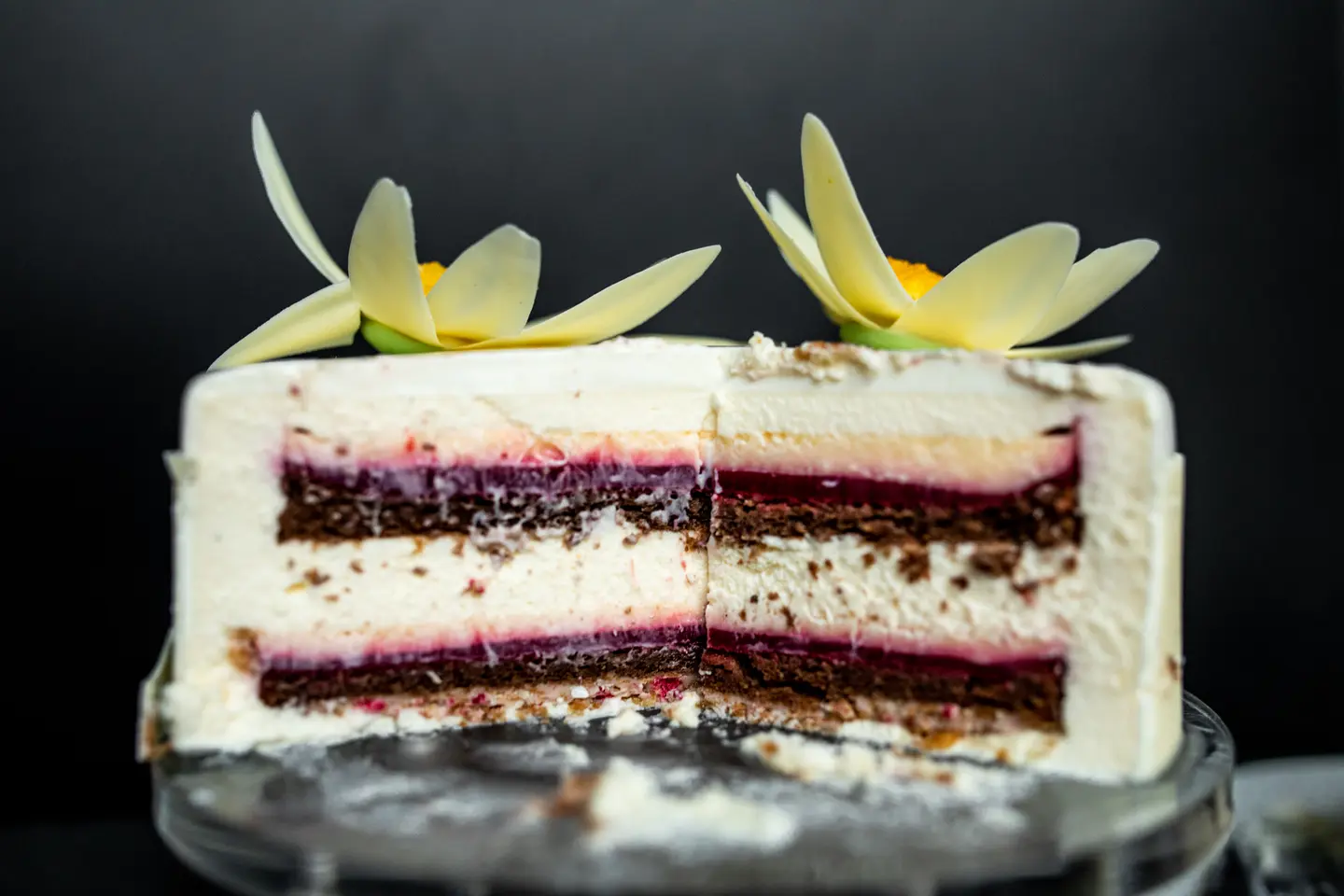
In modern pastry, fruit confit usually means fruit given a soft, controlled set. It may be smooth or contain pieces, but the aim is the same: keep the fruit recognisable while giving it enough body to sit where it belongs in the dessert.
For a cake insert, I look for a layer that cuts cleanly and still feels juicy when eaten cold. It should bring a clear fruit flavour between the cream and sponge, not feel like a separate block of jelly. For this raspberry confit, I use Pectin NH and add the purée in two stages.
My raspberry confit recipe
This is a soft confit for cake inserts, layers and tarts. It uses Pectin NH, not an unspecified pectin. The powdered glucose is also part of the recipe; I would not replace it gram for gram with glucose syrup, which brings water as well as sugar.
- 375 g raspberry purée
- 55 g sugar
- 55 g powdered glucose
- 6 g Pectin NH
- 4 g lemon juice
How I make it
I mix the sugar, powdered glucose and Pectin NH thoroughly while they are dry. That small preparation step matters. If pectin goes straight into warm fruit, it can clump before it has dispersed, and those lumps are difficult to remove.
I warm 125 g of the raspberry purée to 40°C / 105°F, then whisk in the dry mixture gradually. Once it is evenly dispersed, I bring the mixture to a full boil while stirring.
Off the heat, I add the remaining 250 g cold raspberry purée and the 4 g lemon juice, then blend or whisk until the confit is completely homogeneous. The lemon juice goes in at this stage, not at the beginning of cooking.
I transfer it to a clean container, cover the surface and chill it until set before using. For an entremet insert, I portion it into the required mould or ring and freeze it as part of the assembly. For a tart or plated dessert, it can be used chilled.
Confit, compote or fruit gel?
I choose between confit and compote by the bite I need. A smooth, softly set confit gives an even fruit layer. A compote with recognisable pieces gives a different sensation: softer cooked fruit, with more variation from one spoonful to the next.
These are working descriptions rather than strict borders. A compote can also contain Pectin NH and be made for a frozen insert. Its name does not tell you whether it will unmould, thaw or slice well; the actual recipe does.
The distinction between confit and fruit gel is even less clear-cut. Many preparations called confit are soft pectin gels. What matters to me is whether the fruit should be spoonable, pipeable or cleanly sliceable, and how it will sit beside the other components.
Jam has a different purpose. It is generally made as a preserve or spread, often with more sugar and a different cooking endpoint. A fruit layer inside a mousse cake does not need to behave like jam simply because both contain fruit, sugar and pectin.
Getting the set right
Pectin NH is useful here because it can give a tender gel rather than a rigid fruit jelly. With an appropriate product and formula, it is also thermoreversible: it can melt on reheating and set again on cooling. That does not make every pectin powder interchangeable. The exact blend and its instructions matter.
Raspberry, mango, passion fruit and pear bring different amounts of water, fibre, acidity and natural pectin. Changing the fruit can change both the flavour and the set. I keep this raspberry recipe as a complete preparation, not a universal ratio to use with every purée.
Sugar and powdered glucose do more than sweeten the fruit. They contribute soluble solids and affect how water behaves in the preparation. Acidity matters too, both for flavour and for the gelling system. Reducing the sugar or adding extra lemon juice is therefore a recipe change, not just a small adjustment to taste.
If the confit has not set, I check the pectin first: was it the specified type, was it mixed through the dry ingredients, and did the mixture reach a full boil? Then I check whether anything changed in the fruit, sugar, glucose or acid. Adding more pectin before finding the cause can turn a soft layer into an unpleasantly firm one.
When the texture is too firm or rubbery, the same balance needs attention. Too much gelling power is one possibility, but the fruit and the rest of the recipe affect the result as well. The target is enough structure for the dessert, with the sensation of raspberry still coming through.
Freezing and using the fruit layer
A confit intended for an entremet has to be tested after freezing and thawing, not just when freshly cooked. Pectin NH can be useful for this work, but freezing performance belongs to the complete recipe and process.
I chill the preparation, freeze it when the assembly requires it, then thaw it and check the cut. If water has separated or the layer has lost its shape, it has not behaved as the finished dessert needs. A firm frozen insert alone does not prove that the confit will hold once the cake is ready to eat.
The amount of fruit matters as much as the set. A layer can be technically sound and still overpower the mousse or cream if it is too thick or too sharp. I judge it in a complete bite of the dessert, rather than tasting the confit alone and assuming the balance will stay the same.
In a tart, a controlled amount of chilled confit can bring concentrated fruit flavour beneath the cream or fresh fruit. The shell and the assembly still need attention: a fruit preparation that holds its shape can nevertheless pass moisture into a crisp layer.
That is why I decide on the dessert before changing the confit. A spoonable layer for a tart and a frozen insert may need different handling, even when the fruit flavour is the same. The fruit should remain vivid; the structure is there to support it.