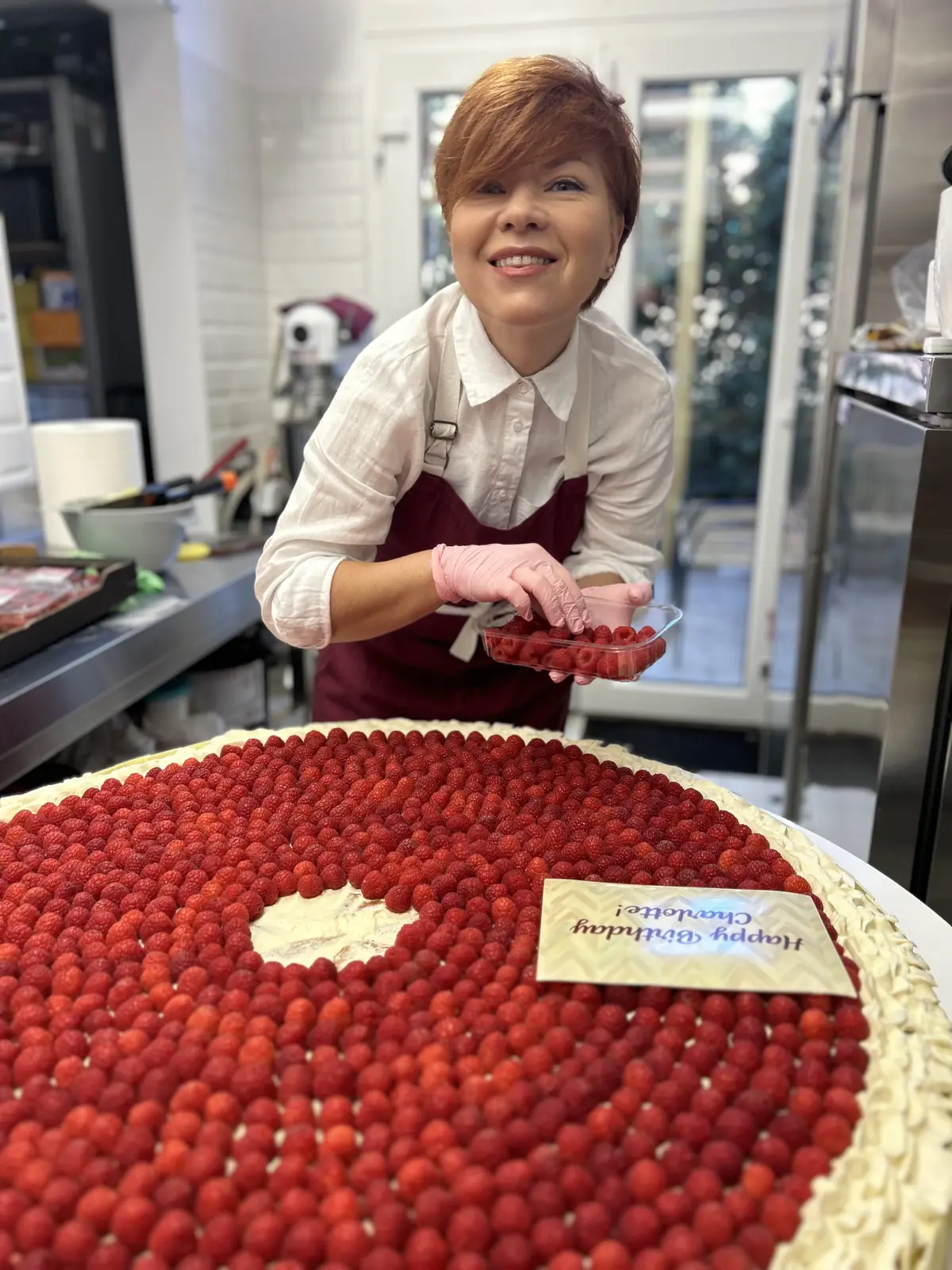
Sponge cake is not one formula. It is a family of batters whose structure depends strongly on air held in eggs, sometimes supported by chemical leavening, and then fixed by egg proteins and dry ingredients in the oven. The way that air is created and the amount of fat, sugar and flour around it determine whether the result is springy, flexible, rich, absorbent or crisp.
When I choose a sponge, I begin with its job in the finished dessert. A layer for a chilled entremet needs a different bite from a tall sponge for a celebration cake. A roulade must bend without cracking; a syrup-soaked génoise must absorb moisture without dissolving; a dacquoise should bring nut flavour and a lightly crisp edge. The name matters less than matching the structure to the service.
Joconde, génoise or dacquoise for an entremet?
I choose by the job of the layer. Joconde is a thin almond biscuit when the cake needs a flexible sheet or wrap. Génoise is a leaner egg sponge when I want a syrup-soaked layer. Dacquoise is a nut-meringue layer when nut flavour and a tender or lightly crisp contrast matter. In a chilled entremet, each must be judged at its finished thickness, moisture level and serving temperature.
For a decorative side or a thin almond layer, start with Joconde. For a layer that must carry syrup, start with génoise and control the soak. For a nut-forward base beside mousse, consider dacquoise and expect its crispness to soften during holding. These are selection principles, not interchangeable formulas or a promise that any one recipe survives freezing and thawing unchanged.
Sponge cake families at a glance
- Génoise — whole eggs and sugar are whipped together; lean, elastic and especially suited to syrup and layered gateaux.
- Separated-egg sponge — yolks and whites are aerated separately or the whites provide the principal lift; light, adaptable and usually more forgiving to flavour additions.
- Biscuit sponge — a broad French family of thin, egg-aerated sheets and fingers, often designed for inserts, roulades or entremet construction.
- Joconde — almond-rich biscuit with a fine, flexible crumb; useful for thin sheets, decorative wraps and layered French desserts.
- Dacquoise — nut meal folded into meringue; tender to lightly crisp, aromatic and naturally without wheat flour when the formula contains none.
- Chiffon — oil and liquid are combined with an aerated egg-white system, usually with chemical leavening; moist, tall and soft even when cool.
- Butter-enriched sponge — whipped eggs or creamed fat provide aeration while butter adds richness and a closer crumb.
- Entremet sponge — a functional thin layer engineered to remain tender when chilled and to connect mousse, crémeux, gel or crunch.
What all sponges have in common
The defining resource is trapped gas. In classic egg-foam sponges, whipping unfolds egg proteins around air bubbles. Heat expands the air and water vapour, while proteins coagulate and starches or nut solids help establish the crumb. If the foam is weak, the batter waits too long, or folding destroys too many bubbles, the baked layer becomes low and dense.
A sponge is therefore a sequence as much as a formula. Bowl cleanliness, egg temperature, whipping endpoint, the order of additions, folding and immediate baking all affect the final volume. Chemical raising can support some styles, but it cannot fully repair a collapsed egg foam.
Génoise: whole-egg aeration
For génoise, whole eggs and sugar are whipped until the foam is pale, expanded and able to leave a visible ribbon. Flour is folded in, and some formulas include a modest amount of melted butter. Because the yolk fat is present during whipping, building the foam takes care and sufficient time.
The baked texture is fine, elastic and relatively lean. That makes génoise an excellent carrier for flavoured syrup: it can take controlled moisture while keeping its shape. I choose it for layered gateaux and classic celebration cakes when I want a clean slice and a sponge that participates in the flavour through soaking rather than through a high fat content.
Its main risks are incomplete aeration, flour pockets and deflation during butter incorporation. I do not judge the foam by time alone; I judge its volume, stability and ribbon.
Separated-egg sponge: flexible control
Separating the eggs lets me manage the whites as a dedicated foam while using the yolks for colour, flavour and emulsification. Some formulas whip yolks with part of the sugar; others combine yolks with liquids or flavour ingredients before the meringue is folded in.
This family is broad. It can produce a very light plain sponge, a cocoa sheet, a roulade or a base for a more complex biscuit. The important decisions are how firm to whip the meringue and how much dense material it must carry. A dry, over-whipped foam may look strong but can be difficult to fold smoothly, leading to streaks and unnecessary air loss.
Biscuit sponge: designed as a component
In French pastry, biscuit can refer to several egg-aerated sponge systems rather than one universal recipe. Many are baked as thin sheets or piped shapes. Their value is functional: a biscuit may line a mould, form an insert, roll around a filling or create a measured layer within an entremet.
I assess a biscuit by thickness, flexibility and moisture behaviour. A sheet that is ideal for rolling may be too soft beneath a wet insert; a firmer biscuit may be perfect as a base but unpleasant if used too thickly. Baking a thin layer beyond its endpoint quickly turns flexibility into brittleness.
Joconde: almond richness with flexibility
Joconde combines almond with an aerated egg structure and is commonly finished with whipped whites. It bakes into a thin, fine-grained sheet that is richer and more flexible than a very lean sponge. Almond provides flavour, tenderness and a smooth mouthfeel.
I choose Joconde for opera-style cakes, patterned biscuit décor, entremet wraps and thin layers that need enough strength to handle without feeling dry. Its quality depends on even spreading and restrained baking. Because the layer is thin, a small excess of oven time can remove the flexibility that makes Joconde useful.
Dacquoise: nut meringue structure
Dacquoise is built by folding ground nuts and sugar into meringue. Almond and hazelnut are classic choices. Compared with a flour-based sponge, it brings a more pronounced nut flavour and a texture that can range from tender and chewy to lightly crisp, depending on thickness, baking and contact with filling.
In a finished dessert, dacquoise is valuable when I want the base to contribute flavour rather than act as a neutral carrier. Moist creams gradually soften it, so the intended service time matters. A layer for immediate service can retain more contrast; a layer held beneath mousse overnight will become more integrated and tender.
I would not treat dacquoise as interchangeable with the chocolate entremet sponge. Both can contain almond and no wheat flour, but their foam systems, fat balance and eating textures are different.
Chiffon: oil, moisture and height
Chiffon combines an oil-based yolk batter with whipped egg whites and normally uses chemical leavening as additional support. Oil remains fluid at refrigerator temperature, so chiffon stays soft when a butter-rich cake would become firm.
I choose chiffon when I want a tall, moist, resilient cake with a light mouthfeel. It works well for layer cakes and flavours carried in liquid, such as citrus or tea. It is less suited to every entremet: its open, springy crumb may be too thick or absorbent beside delicate mousse unless the layer is scaled deliberately.
Butter-enriched sponge: richness and a closer crumb
Butter can enter a sponge through melted-fat folding or through a creaming system, depending on the formula. It gives flavour and tenderness but also introduces density. Melted butter is much heavier than egg foam, so I first lighten it with a small portion of batter before returning it to the main bowl.
A butter-enriched sponge suits cakes served closer to room temperature, where the fat softens and its aroma opens. If the cake will be eaten straight from refrigeration, I use butter with restraint or select a sponge whose fat system remains more supple when cold.
Entremet sponge: engineered for cold service
An entremet sponge is selected as part of a layered system. It must cut cleanly when cold, remain tender beside mousse or crémeux, and have enough strength to support an insert without becoming a hard board. Thinness is intentional: the sponge gives rhythm and structure without dominating the spoonful.
My Chocolate Sponge for Entremets uses French-meringue aeration with almond flour, cocoa, dark chocolate and a restrained amount of butter. It is flourless, fine-crumbed and designed to sit between creamy and crisp components in the Chocolate Tonka & Passion Fruit Cake.
This is the practical difference between a generic sponge and a component formula. I do not ask which sponge is best in isolation; I ask which one gives the right texture at the temperature and in the architecture where it will be served.
How I choose the right sponge
- For a syrup-soaked layered gateau: génoise, because its lean elastic crumb accepts controlled moisture.
- For a roulade: a thin separated-egg biscuit formulated and baked for flexibility.
- For almond flavour and a decorative or structural sheet: Joconde.
- For a nut-forward layer with tender or lightly crisp contrast: dacquoise.
- For a tall, moist cake that stays soft when cool: chiffon.
- For a rich cake served closer to room temperature: a butter-enriched sponge.
- For a thin layer inside a chilled mousse cake: an entremet sponge tested at the intended serving temperature.
Why sponge names can be confusing
Pastry terminology changes between schools, countries and bakeries. Biscuit may describe a family, a particular formula or even a finished cookie in another context. Sponge cake may mean any egg-aerated cake or a specific local style. Joconde and dacquoise are more precise names, but their formulas still vary.
For that reason, I read beyond the title. I look at which egg fraction is whipped, whether chemical leavening is present, which flour or nut meal carries the structure, how fat enters, the intended thickness and whether the sponge is designed to be soaked, rolled or chilled.
The professional selection rule
The right sponge is the one that performs in the complete dessert. I test it with the actual filling, holding time and serving temperature. A beautiful warm offcut can become too firm after freezing and refrigeration, while a delicate sheet can disappear beneath a wet insert.
Start with the required bite, then choose the aeration and fat system. That decision is more reliable than choosing a famous sponge name first and forcing it into an unsuitable cake.