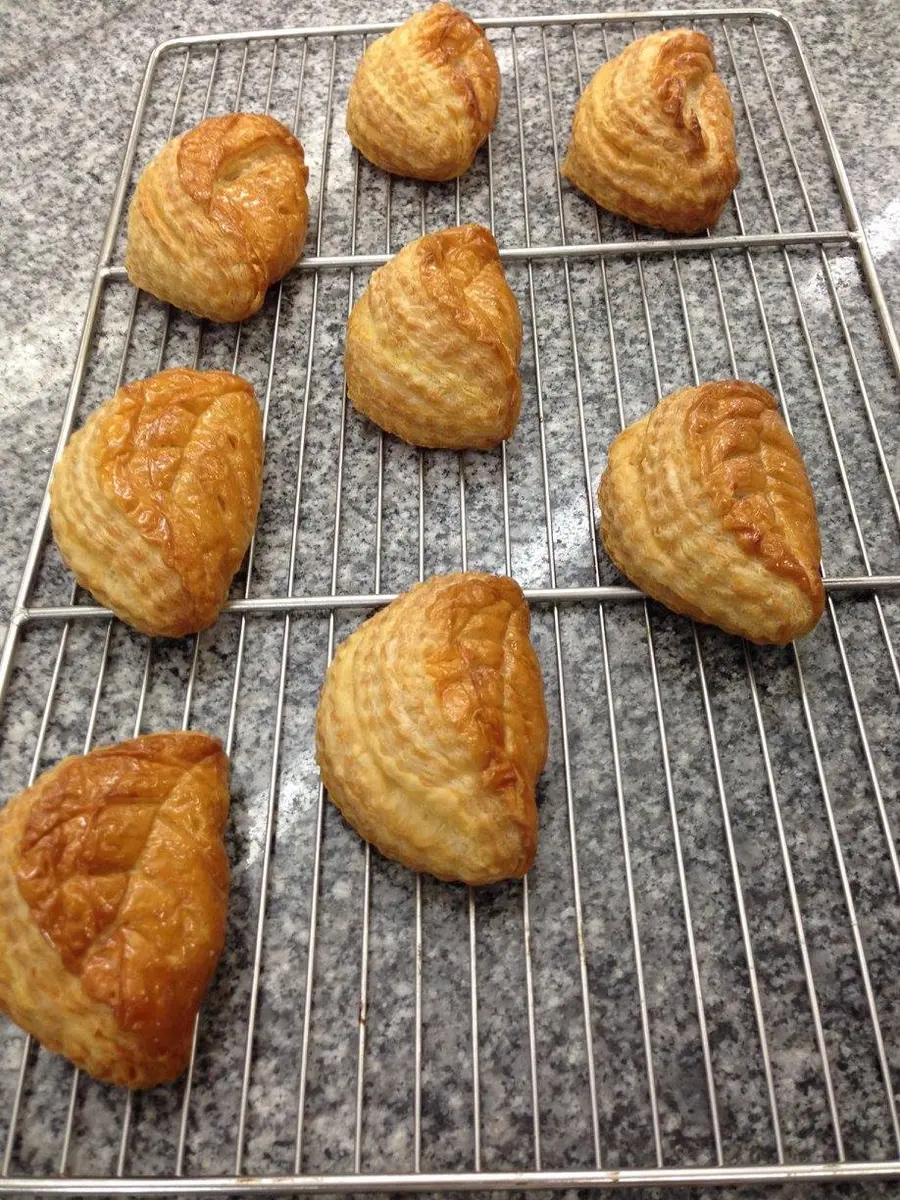
Flaky pastry lives between two pastry systems
Flaky pastry is useful precisely because it does not behave like classic puff pastry or like a conventional shortcrust. Part of its tenderness can come from fat worked into the flour, while another portion remains distinct enough to form layers during rolling and folding. The result is a pastry with visible flake and separation, but with a more compact, pastry-like bite than pâte feuilletée.
Pastry terminology is not perfectly standard between countries, schools and books. Some formulas called flaky pastry are very close to rough puff. For this Journal, I use the term for the hybrid method in which some fat is incorporated into the flour and the remaining fat is kept distinct and organised through rolling and folds. Rough puff, in the neighbouring article, begins with most or all of its lamination fat still visible as pieces in the initial dough. This is a practical distinction for understanding structure, not a claim that every pastry school uses the names in exactly the same way.
The first portion of fat creates tenderness
When fat is rubbed or cut into flour, it coats part of the flour surface and reduces how completely that flour can hydrate once water is added. Less continuous gluten development generally means a more tender, shorter bite. In flaky pastry I do not want that process to consume all the fat, because the dough still needs separate fat regions to create flake.
This is the first important difference from rough puff. In rough puff, visible butter pieces are preserved primarily as future lamination. In this hybrid flaky pastry, one portion of fat has already been asked to do a different job: modify the base dough itself. The formula therefore has two structural intentions before the first fold even begins.
The remaining fat must stay separate enough to become layers
The second portion of fat is not rubbed finely into the flour. It may be added as thin pieces, small flattened portions or distributed during the first rolling stage, depending on the formula. Rolling spreads those pieces into films; folding places dough over fat repeatedly and creates discontinuous laminated regions.
The pieces should be large enough to survive as separate fat but thin and plastic enough to extend rather than punch through the dough. Hard cubes can behave like stones inside a soft sheet. Fat that is too warm simply smears into the base and gives tenderness without meaningful layering.
Fat plasticity matters more than the instruction to keep everything cold
Temperature is a tool for controlling consistency. The layered fat should be cool enough to remain distinct, but not so brittle that rolling fractures it. The dough should be firm enough to contain the fat while still extending without tearing. I am looking for compatible movement between the two phases.
If the fat breaks through in hard fragments, making the dough colder may make the mismatch worse. If the sheet becomes greasy and the fat loses definition, chilling is useful. The condition of the dough should determine the correction.
Hydration has to serve both rolling and tenderness
Water gives the flour phase enough cohesion to be rolled and folded. Too little can make the sheet crack around the layered fat; too much can create a sticky, elastic dough that requires more flour and more handling. Flour absorption varies, so the useful amount of water is the amount that produces a coherent but not unnecessarily soft dough.
I avoid kneading this dough as if it were bread. The folds will continue organising the dough, and excessive initial mixing can build elasticity that works against the tender texture and makes the pastry contract during shaping or baking.
Why the pastry can be both tender and flaky
Tenderness and flakiness are related but not identical qualities. Fat incorporated into flour helps interrupt a strong continuous gluten network. Separate fat layers create planes along which the baked pastry can split. A successful flaky pastry combines both effects rather than maximising only one.
If all the fat is rubbed in finely, the result may be tender but comparatively short and crumbly. If almost all the fat remains in large pieces and is repeatedly folded, the method moves toward rough puff. Understanding that continuum is more useful than trying to force every formula into a rigid category.
Folding should organise the fat, not erase it
Once the base dough is coherent and the remaining fat is in place, rolling and folding distribute the fat through the sheet. The goal is irregular but useful lamination. I want enough folds to create repeated separation without making the layers so numerous, warm or compressed that the original hybrid character disappears.
There is no universal fold count that defines flaky pastry. Formula, fat distribution, dough strength, final thickness and intended product all matter. The better question is whether the fat has become sufficiently distributed to give even flake while remaining visibly separate from the dough.
Resting controls elasticity and fat condition
Resting after mixing allows newly hydrated flour to settle and gives gluten tension time to relax. Resting between rolling stages can also protect the layered fat when handling has made it too soft. These are two reasons to rest, and they should not be confused.
If the dough springs back immediately, a rest is more useful than forcing it thinner. If the dough rolls willingly but the fat is softening, cooling is the priority. A fixed timetable is less informative than reading both dough tension and fat consistency.
Flaky pastry is not designed for classic puff's geometric lift
Classic puff pastry begins with a coherent roll-in butter block and uses repeated turns to create relatively regular alternating dough and fat layers. That architecture is chosen when vertical expansion, fine layering and controlled geometry are central to the finished pastry.
Flaky pastry is deliberately less regular. Some fat is already dispersed through the base dough, while the remaining fat creates discontinuous laminated planes. I expect crisp flakes and visible separation, but not the tall, ordered honeycomb-like layering of carefully laminated pâte feuilletée. Judging flaky pastry by classic puff's geometry means judging it against a structure it was never designed to have.
How it differs from rough puff in this Journal
Rough puff and flaky pastry can look similar in recipes because both avoid the single enclosed butter block of classic puff, and terminology overlaps in real baking literature. The structural distinction I use here is the treatment of the base dough.
In rough puff, butter pieces are mixed into the dough and then progressively flattened and organised by folds; the objective is a faster route to a recognisably puff-pastry structure. In this flaky-pastry method, part of the fat is deliberately incorporated into the flour for tenderness and the remaining fat is layered separately. That gives a more pie-like, compact base together with irregular flake.
Rolling pressure changes the finished layers
Heavy pressure on one end of the sheet pushes soft fat ahead of the rolling pin and leaves uneven distribution. I prefer progressive, even pressure across the length of the dough. If the fat pieces are still thick, flattening them gently before trying to make the whole sheet thin gives better control.
Straight, even rolling is not only cosmetic. Uneven thickness means some areas contain compressed fat and others contain thicker dough, so baking becomes inconsistent. Before a fold, excess bench flour should be brushed away rather than trapped as a dry layer inside the pastry.
What creates the flakes in the oven
During baking, water in the dough and butter turns to vapour. Where fat has kept dough surfaces from bonding completely, expanding vapour can open those interfaces and separate the pastry into flakes. The surrounding dough then has to set and dry enough to hold the spaces that were created.
Fat alone does not guarantee flakiness. If it has been smeared completely into the dough, if the sheet has been compressed heavily, or if the pastry is removed before the internal layers are baked through, the finished texture can be greasy, dense or leathery rather than crisp and flaky.
Baking is also a drying stage
The first visible expansion can make pastry look finished before its internal moisture has been driven off sufficiently. A useful bake develops colour and crispness through the thickness, not only on the surface. The exact temperature and time depend on the product, thickness, filling, oven and whether the pastry is baked alone or as part of a pie or tart.
This is why I avoid giving one universal oven temperature for flaky pastry. A thin decorative strip, a filled turnover and a deep pie lid have very different heat-transfer problems even when the dough is identical.
Reading flaky-pastry failures
- Tender but no visible flake: too much of the fat may have been incorporated into the flour, or the layered fat may have smeared away during rolling.
- Large greasy pockets: the remaining fat may be too coarse, insufficiently distributed, too soft during handling, or the bake may not have set and dried the surrounding dough adequately.
- Fat breaking through the sheet: the fat is too hard relative to the dough, too thick in isolated pieces, or the sheet is being reduced too aggressively.
- Tough pastry: investigate water level, initial mixing, repeated re-rolling, excess bench flour and insufficient resting rather than assuming the formula simply needs more fat.
- Shrinking or distorted shapes: accumulated dough tension, stretching during shaping and inadequate relaxation are common places to look.
- Flaky outside but damp inside: the pastry achieved some layer separation but did not receive enough baking and drying for its thickness or filling.
When flaky pastry is the better choice
I choose flaky pastry when I want a pastry that feels substantial enough for a pie, turnover or savoury preparation but still breaks into crisp, irregular layers. It can be more tender and less geometrically demanding than classic puff while giving more visible flake than a standard shortcrust.
If the dessert depends on very clean vertical lift or a fine laminated cross-section, classic puff is the better tool. If I want a quicker approximation of puff pastry with most of the butter preserved as future lamination from the beginning, I would choose rough puff. The name matters less than choosing the structure that suits the finished pastry.
Questions to answer before changing the formula
- How much of the fat is meant to shorten the base dough, and how much is meant to remain as lamination?
- Is the dough cracking because it is under-hydrated, or because hard fat is tearing through it?
- Is the fat smearing because it is too warm, or is the dough simply resisting because it needs relaxation?
- Does the pastry need more folds, or would more handling only make the layers thinner and less distinct?
- Is the desired result tender and irregularly flaky, or does the product actually require classic puff pastry's regular lift?
- Did the pastry fail during lamination, or did good lamination remain underbaked and damp?
What I want from the finished pastry
A good flaky pastry should break along visible, crisp planes while retaining enough tenderness that the bite does not feel hard or bready. Its layers can be irregular; that irregularity is part of the method. What I do not want is greasiness, toughness or a crumbly structure in which the layered fat has had no visible effect.
For me, the value of this dough is its balance. It borrows tenderness from shortcrust technique and separation from lamination, but it does not need to imitate either system completely. Once that role is clear, the handling decisions become much easier to judge.