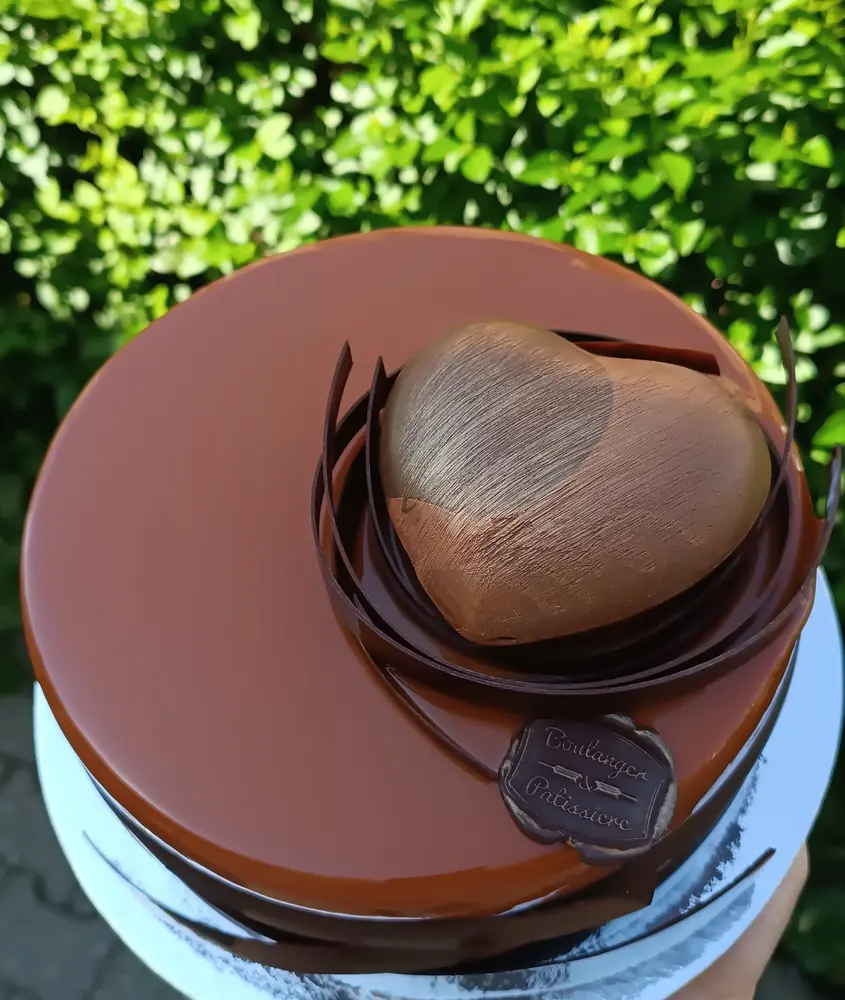
This is the chocolate mirror glaze I use on my Chocolate Tonka & Passion Fruit Cake. The formula is only half of the job. The other half is blending it without pulling in air and pouring it when the glaze has the right flow for a completely frozen cake.
I judge the glaze by what it does, not by temperature alone. It should fall from the jug in a continuous ribbon, cover the cake without looking transparent and level before it sets.
My chocolate mirror glaze formula
Yield: 1,032.5 g before processing losses. The percentages are included so the formula can be scaled accurately.
- 125 g water — 12.11%
- 225 g sugar — 21.79%
- 225 g glucose syrup — 21.79%
- 225 g chocolate — 21.79%
- 120 g condensed milk — 11.62%
- 90 g neutral glaze — 8.72%
- 22.5 g leaf gelatin, weighed dry before soaking — 2.18%
The products I keep fixed
For this formula I use Valrhona Guanaja 70% dark chocolate couverture, Valrhona Absolu Cristal neutral glaze and gold-strength leaf gelatin at 200 Bloom. These specifications are part of the recipe: chocolate controls cocoa butter, flavour and viscosity; the neutral glaze contributes its own sugar and gelling system; and gelatin strength controls the final set.
If I change any of these products, I treat the result as a reformulation and repeat the flow, opacity, thawing and service tests. Similar product names do not prove equivalent behaviour.
How I make it
First, I soak the leaf gelatin in plenty of very cold water until flexible. I lift it out and squeeze it well before use; the soaking water is not part of the 125 g in the formula.
I put the 125 g water, sugar and glucose syrup in a saucepan and bring them to the boil. I pour the hot syrup over the chocolate and the drained gelatin, then add the neutral glaze and condensed milk.
I blend until the glaze is completely smooth. This is the point I watch most carefully: the blender head stays fully submerged and slightly tilted, with no open vortex pulling air down from the surface. A glaze full of tiny bubbles will show every one of them on the cake.
How I know it is ready to pour
Even with the approved products fixed, I do not reduce pouring readiness to one universal number. Storage, reheating, batch size and handling can shift the working point, so temperature is evidence rather than the decision by itself.
I look for a continuous, controlled ribbon. If the glaze rushes off the spoon like a thin sauce, it is likely to run from the cake and show the surface underneath. If it drops in a heavy sheet and keeps its ridges, it is too thick to level cleanly.
Prepare the cake before taking it from the freezer
I set up the jug, blender, rack, tray and cleaning tools before I unmould the cake. The entremet must be completely frozen, smooth and dry. Mirror glaze copies the surface underneath; it cannot hide a badly finished mousse.
I remove the cake only when the glaze is ready. Leaving a frozen cake in a humid room gives condensation time to form. Glaze poured onto that wet film can slip or leave bare patches.
How I pour it
I pour in one continuous, confident movement, covering the centre and the outside edge without repeatedly going back over the same place. The goal is complete coverage in a thin layer, not a thick coat.
I let the excess run away, clean the lower edge and move the cake before the drips set. The tempered-chocolate decoration is added after glazing, and the finished cake then thaws slowly in the refrigerator.
If the glaze is full of tiny bubbles
The first thing I check is the way it was blended. If the blender breaks the surface or creates a funnel, it pulls air into the glaze. Keep the head submerged, tilt the container and work below the surface. Straining can remove some visible bubbles, but it cannot undo a glaze that has been heavily aerated.
If the glaze is too thick and leaves ridges
It may simply be too cool, but temperature is not the only possibility. The chocolate may be less fluid, the gelatin may be stronger, or the neutral glaze may have more body than the product used in the original formula. Warm it gently and reassess the flow; do not keep boiling or repeatedly overheating it.
If the glaze runs off or looks transparent
The glaze may be too warm or the formula may not have enough structure for the products being used. The cake also needs to be fully frozen so the layer starts setting as it reaches the surface. Before changing ingredient quantities, check the glaze temperature, its ribbon from the jug and the temperature of the cake.
If the glaze slides or leaves bare areas
I check for condensation first. A wet film between the frozen mousse and glaze prevents clean adhesion. I also check that the cake was frozen solid and that the glaze was not so warm and fluid that it stayed mobile for too long.
If the finish is dull
Dullness does not have one cause. Air, condensation, an uneven cake, the chosen chocolate, reheating, storage and surface contact can all change the reflection. I trace what changed in the batch instead of adding more colour or adjusting temperature blindly.
My working rule
Keep the formula fixed, record the exact products and change one variable at a time. A number on the thermometer is useful evidence, but the final decision is still visual: smooth ribbon, clean coverage, no trapped air and enough time to level before the glaze sets.