Milk chocolate crémeux is the dense, satin-smooth centre between a sauce and a ganache. In an entremet it must be soft enough to melt cleanly when eaten cold, yet stable enough to cut, freeze, unmould and thaw without leaking or becoming rubbery.
I follow the published Valrhona formula below for moulded pastry inserts and freezing. The custard and emulsion notes draw on L’École Valrhona guidance. If I change the couverture, gelatin or dimensions, I test the revised insert before using it in a complete cake.
Reference formula — 1,000 g milk chocolate crémeux
Application: a frozen crémeux insert for a modern entremet. The published formula totals 1,000 g before process losses. Actual yield depends on the saucepan, sieve, blender and transfer losses.
- 48 g glucose syrup, DE 40
- 81 g egg yolks
- 321 g whipping cream, 35% fat
- 214 g whole milk
- 304 g Callebaut Milk Origin Ecuador couverture
- 32 g prepared gelatin mass
Why this formula was selected
I compared the ingredient balance and the method separately. Callebaut provides an exact 1,000 g formula and explicitly describes it as suitable for patisserie inserts, moulding and freezing. L’École Valrhona confirms the underlying architecture: crème anglaise emulsified with chocolate, controlled custard cooking, gradual emulsion and maturation under refrigeration.
A third professional comparison, from chef Kirsten Tibballs, uses the same structural family—cream, yolks, a glucose-type sugar, milk chocolate and gelatin—but at a different balance. That agreement supports the method, while the differing ratios show why several published recipes should not be averaged into one invented formula. I retain one complete tested system.
Gelatin mass must be defined
The source formula specifies 32 g gelatin mass, not 32 g dry gelatin. Gelatin mass is dry gelatin already hydrated with measured cold water. Professional kitchens commonly use five or six parts water to one part powdered gelatin, but the exact convention is not universal.
I therefore keep the published quantity as 32 g prepared gelatin mass and record the kitchen standard beside every production batch. I do not silently convert it to sheets or powder. Bloom strength, dry gelatin weight and hydration water all affect the final texture, and the hydration water remains part of the formula.
What each ingredient controls
- Milk and cream form the water phase and determine dairy richness, flow and cold mouthfeel.
- Egg yolks thicken the anglaise and add emulsifying phospholipids, colour and roundness.
- Glucose syrup moderates sweetness, contributes solids and supports a smoother frozen texture.
- Milk couverture supplies cocoa butter, milk solids, sugar and the dominant chocolate flavour.
- Gelatin reinforces the structure for cutting and freeze–thaw handling; more is not automatically better.
Equipment and mise en place
- Accurate scale and probe thermometer
- Saucepan with a clean base and corners
- Flexible spatula and fine sieve
- Tall, narrow jug for immersion blending
- Immersion blender kept below the surface
- Metal insert ring or silicone insert mould
- Acetate strip and a flat tray if using a metal ring
1. Prepare the insert mould
Line the base of the smaller metal insert ring securely and place it on a perfectly flat tray. Use acetate around the inside if the ring and production method require it. For the Chocolate Tonka & Passion Fruit Cake, the crémeux belongs in the frozen insert rather than being poured directly into the final mousse ring.
Choose an insert diameter that leaves an even collar of mousse around it. The exact clearance depends on the final ring and design; it should be recorded as a production dimension rather than guessed during assembly.
2. Warm the glucose and mix the yolks
Warm the glucose gently until fluid. Mix it into the egg yolks until homogeneous. I avoid whipping air into this mixture: foam obscures the true custard texture and later becomes bubbles in the crémeux.
3. Heat the dairy and temper
Bring the milk and cream to a boil, then pour part of the hot dairy gradually over the yolk mixture while stirring. Return everything to the saucepan. Tempering reduces the local heat shock, but it does not replace careful cooking.
4. Cook the crème anglaise
Cook over controlled heat while stirring continuously across the base and corners. Finish at 82°C / 180°F for this reference formula. The custard should lightly coat the spatula; it must not boil or show grains of coagulated egg.
L’École Valrhona publishes 84°C / 183–185°F for its own crème-anglaise crémeux system. That is a useful method check, not permission to change this formula’s endpoint. Different yolk and dairy ratios can justify different published temperatures.
5. Melt the gelatin and begin the emulsion
Strain the hot anglaise immediately over the milk couverture and prepared gelatin mass. Allow brief contact so the chocolate begins to melt, then stir from the centre to establish a glossy, elastic core.
If the chocolate is not melting evenly, use gentle residual heat rather than aggressively reheating the finished emulsion. Scorching or overheating milk chocolate dulls its flavour and can destabilise the texture.
6. Blend without incorporating air
Place the immersion-blender head below the surface before switching it on. Keep the jug tilted and the head submerged while blending to a completely smooth emulsion. I move the blender only enough to circulate the mixture; pumping it up and down draws in air.
The finished crémeux should be glossy and fluid, with no streaks of custard, chocolate or gelatin. Tap the jug lightly and skim visible surface bubbles if necessary.
7. Pour, freeze and assemble
Pour the crémeux into the prepared smaller metal ring to the validated thickness; the Chocolate Tonka cake architecture uses a layer of approximately 10 mm. Place the chocolate sponge in the planned relationship to the crémeux, keep the layers level and freeze the insert completely before adding the next component.
Once the insert is hard, add the mango and passion fruit gel as specified by the cake assembly, freeze again, then apply the Feuilletine crunch to the exposed sponge side. The completed insert must be fully frozen before it is centred in the dark chocolate and tonka mousse inside the larger final ring.
Texture and flavour in the finished cake
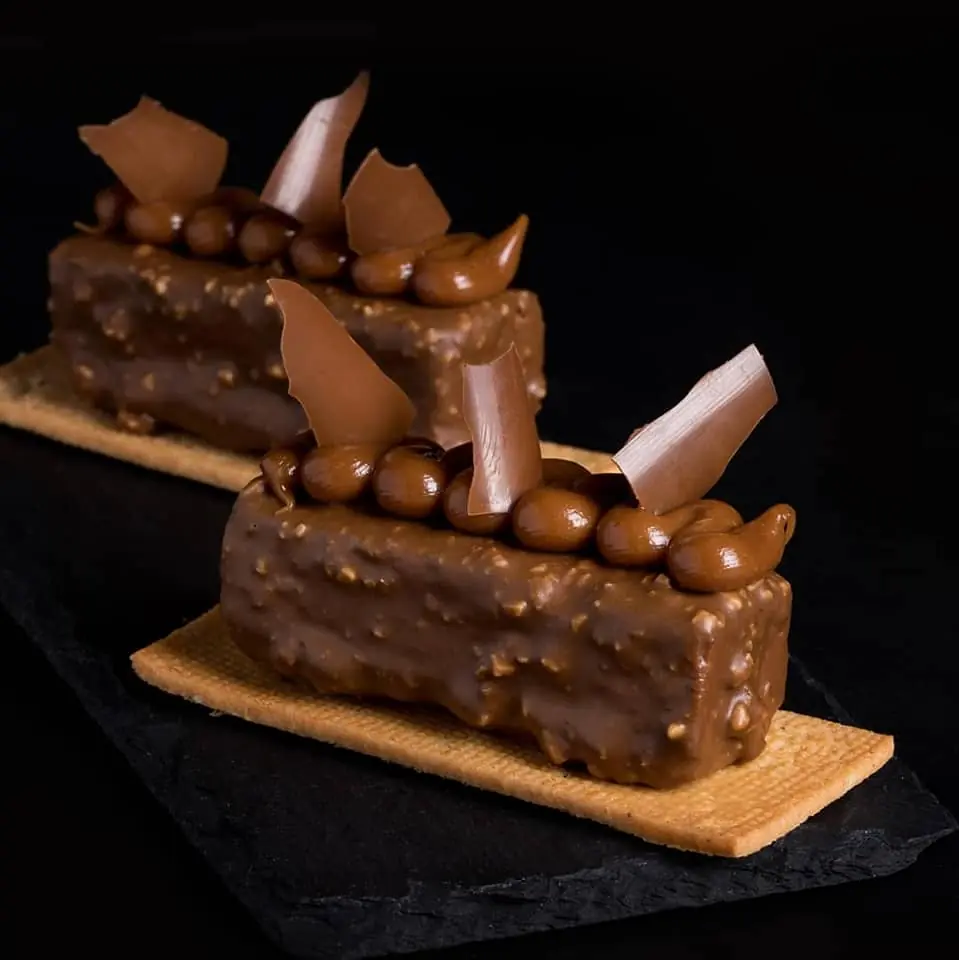
At refrigerator temperature, I want the crémeux to cut in a clean line and then soften quickly on the palate. It should feel denser and more lingering than the surrounding mousse, but less firm and less fatty than a set ganache.
Milk chocolate contributes caramelised dairy, cocoa and gentle malted notes. In the complete cake, that rounded sweetness bridges the dark chocolate sponge and mousse with the sharper mango and passion fruit gel. The contrast prevents the chocolate layers from reading as one continuous texture.
The cake is served cold for the intended experience. Chilling keeps the architecture precise, gives the gel a bright clean break and makes the crémeux feel silky rather than loose. It should be refrigerated, not served frozen solid; the exact tempering time depends on cake size, refrigerator temperature and service conditions.
Can I replace the couverture?
Not automatically. Milk couvertures differ in cocoa butter, cocoa solids, milk solids and sugar. Those differences change fluidity, sweetness and the amount of chocolate required to bind the same water phase.
Callebaut Milk Origin Ecuador is part of this published formula. A Valrhona milk couverture may be an excellent flavour choice, but I would not call a gram-for-gram substitution validated. I make a small batch, freeze it in the intended thickness, thaw it inside a test assembly and judge cut, syneresis, mouthfeel and flavour at the real serving temperature.
Troubleshooting
- Grainy custard: the anglaise was overheated or part of it coagulated against the pan.
- Split or greasy crémeux: the emulsion was not established gradually, temperatures were incompatible, or the couverture balance was changed.
- Air bubbles: the yolks were whipped, the blender head broke the surface, or the mixture was poured too aggressively.
- Rubbery texture: too much dry gelatin, a stronger Bloom grade, or service at too low a temperature.
- Crémeux too soft after thawing: incorrect gelatin mass, insufficient setting time, an unvalidated chocolate substitution or a freeze–thaw imbalance.
- Water release: damaged emulsion, unsuitable freezing or thawing, or a formula change that was not tested in the complete insert.
- Chocolate flavour too sweet or weak: the chosen milk couverture does not provide enough cocoa intensity for the surrounding layers.
Storage and production control
This preparation contains dairy and lightly cooked egg yolks, so it requires continuous refrigeration and hygienic handling. L’École Valrhona states three days at 2–4°C / 35–40°F for its own crème-anglaise crémeux system and identifies it as freezable. That is useful professional guidance, but shelf life remains specific to the complete formula, process and local food-safety rules.
For production I record the couverture, gelatin brand and Bloom strength, gelatin-mass ratio, custard finishing temperature, insert dimensions, freezing time and thaw result. A recipe becomes reliable when those variables are repeatable, not merely because the ingredient list looks familiar.
Where to go next
This is the milk-chocolate crémeux used inside my Chocolate Tonka & Passion Fruit Cake. If you want to understand a particular step, continue with the notes on crème anglaise, egg yolks, sugar and glucose, gelatin, milk couverture or emulsion technique.
For a broader introduction, start with What Is Crémeux? Here, follow the quantities and method for making, freezing and assembling this milk-chocolate insert.