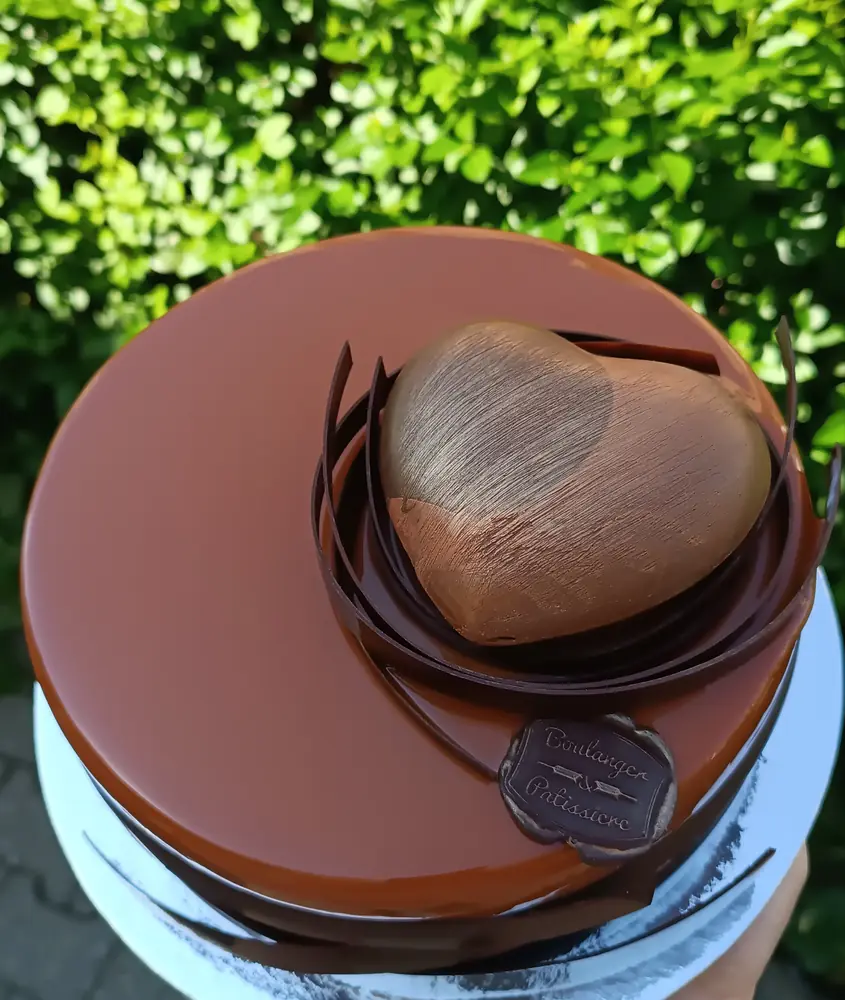
A thin chocolate decoration is a small piece of structural engineering. It must be fluid enough to spread, strong enough to release, flexible at the shaping moment and fully crystallised before handling. Tempering is essential, but temper alone does not choose the thickness or the correct cutting time.
Prepare the surface first
I use clean, food-safe acetate or guitar sheet because the contact surface directly influences gloss. Dust, scratches, fingerprints and moisture are reproduced on the chocolate. The sheet, palette knife, template and former must be ready before I temper the couverture.
Fluidity controls the possible thickness
A fluid couverture can spread into a thinner continuous film with fewer palette-knife passes. A less-fluid product produces more body at the same temperature. Cocoa percentage alone cannot predict this behaviour, so I record the exact product and compare its technical specification.
Adding heat simply to make over-crystallised chocolate flow is risky: the temperature may destroy the stable crystal population. I first diagnose whether the problem is formulation, temperature or excessive crystallisation.
A reproducible spreading method
- Secure the acetate on a perfectly flat tray.
- Deposit a known quantity of tempered chocolate.
- Spread in one or two controlled passes.
- Use guides or record chocolate weight per sheet area when repeatability matters.
- Avoid returning repeatedly over areas that are already beginning to set.
The cutting window
Chocolate is cut or scored when it has lost its wet shine but remains flexible. At this stage an edge stays defined without flowing back, yet the sheet does not shatter under a knife or cutter.
This window depends on chocolate, thickness, surface and room conditions. I watch the physical state rather than relying on one fixed number of minutes.
Flat and curved pieces
Flat pieces should crystallise between clean, flat surfaces when curling would spoil the design. Curved pieces are formed while the coated acetate is flexible, then supported without pressure until the chocolate is fully set.
A tighter curve places more stress on the sheet. If cracking repeats, I adjust curvature, thickness or cutting moment before assuming the temper is wrong.
Release and handling
Well-crystallised couverture contracts slightly and normally releases cleanly from acetate. Resistance, smearing or bending signals that crystallisation is incomplete or the temper is weak.
I handle the finished surface with cotton gloves and lift pieces by their strongest edge. Fingerprints are fat and moisture deposits; polishing them away can scratch a thin decoration.
Common failures
- Uneven edges: the chocolate was cut too early or spread inconsistently.
- Shattering during cutting: the sheet crystallised too far.
- Curling flat plaques: cooling or restraint was uneven.
- Dull contact face: marked acetate, weak temper or condensation.
- Random breakage: unsupported geometry or local thin spots.
- Difficult release: incomplete crystallisation, poor temper or a damaged contact sheet.