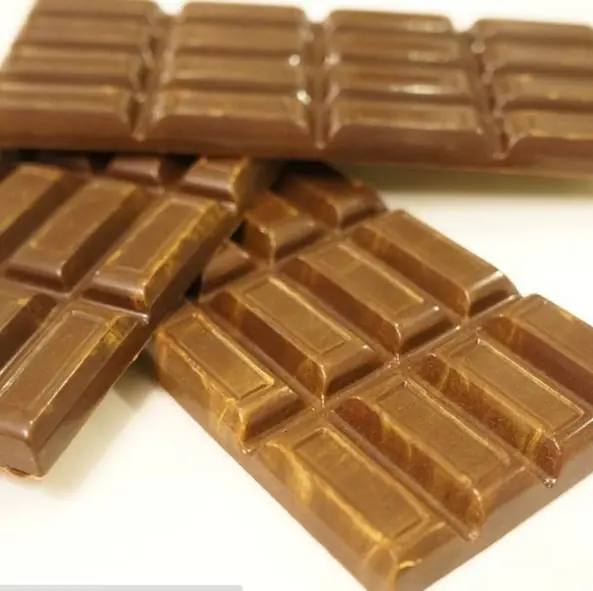
Cocoa butter is the principal continuous fat phase of real chocolate. It carries cocoa and sugar particles when molten, then forms the crystal network that gives solid chocolate its gloss, contraction, firmness and melting behaviour.
Its pastry importance comes from a particular triglyceride profile. Much of the fat is built from palmitic, stearic and oleic fatty acids arranged in triglycerides such as POP, POS and SOS. Their proportions and packing behaviour help cocoa butter remain firm at cool room temperature and melt rapidly as it approaches body temperature.
Triglycerides, not isolated fatty acids, form the crystal
A fatty-acid list describes composition only partly. In cocoa butter, fatty acids are attached to glycerol as triglycerides, and the way these molecules pack determines crystal form and melting behaviour.
This is the useful molecular boundary for pastry. Going further into individual atoms does not improve a tempering decision.
Cocoa butter as a continuous phase
In melted chocolate, cocoa solids and sugar particles are dispersed through fat. The amount of cocoa butter, particle surface area and emulsifier system influence flow. More cocoa percentage does not necessarily mean more cocoa butter because the cocoa fraction can contain different balances of cocoa mass and added fat.
Why it melts cleanly
Well-tempered chocolate is firm below its melting range but softens quickly in the mouth. That narrow transition contributes to clean flavour release rather than a waxy finish.
Serving temperature matters. A decoration warmed by the room or by handling loses stiffness before its composition changes, so snap is always a property of material, thickness and temperature together.
Relationship to tempering
Tempering controls how cocoa-butter triglycerides organise. It does not change their chemical identity. The process removes uncontrolled crystal history, creates appropriate nuclei and allows a stable network to grow in the finished piece.
Other fats and compatibility
Milk fat, nut oils and filling fats can soften cocoa butter or migrate into a chocolate layer. In a solid decoration made only from dark couverture, this is limited; at attachment points or in filled chocolate systems it becomes more important.
Adding an arbitrary fat to thin couverture to improve flow changes crystallisation and strength. I use a couverture designed for the task rather than modifying it without a validated reason.
What this explains in a decoration
- Gloss: stable crystallisation against a smooth surface.
- Snap: an ordered fat network, adequate thickness and suitable temperature.
- Release: contraction during crystallisation.
- Melting: rapid softening near mouth temperature.
- Bloom risk: recrystallisation, heat cycling or fat migration.