Crème Chiboust is a balance between structure and aeration
Crème Chiboust is built from two very different components: a cooked pastry-cream base and an aerated meringue. The challenge is to combine them without losing the smoothness of the cream or the lightness of the foam.
For me, the goal is not maximum volume. The cream needs enough air to feel light, but also enough structure to hold its shape in the finished pastry. If the balance moves too far in either direction, the result becomes either dense and heavy or unstable and fragile.
The pastry cream must be smooth before anything is folded in
The base cream carries much of the final texture. Lumps, undercooked starch, scorched dairy or an over-thickened base do not disappear when meringue is added; they become harder to correct because the aerated component is delicate.
A well-prepared pastry cream should be homogeneous and cooked enough for the intended starch system to develop properly. It should also be at a condition where it can accept the meringue without setting into pieces or becoming so fluid that the foam loses support.
Temperature compatibility controls how well the components combine
One of the most common failures in crème Chiboust is combining components that are technically correct but at incompatible temperatures. A base that is too cold may be too stiff to fold without crushing the meringue. A base that is too hot can damage the foam and reduce volume quickly.
This is why I prefer to judge the physical condition of both components rather than following a single fixed temperature number. The pastry cream should be fluid enough to fold smoothly, and the meringue should still have enough elasticity and volume to lighten it.
- Avoid letting the pastry cream set into a firm gel before combining.
- Avoid folding delicate meringue into an excessively hot base.
- Work efficiently once both components are ready so the texture does not drift while waiting.
Meringue gives lightness, but folding determines whether that lightness survives
The meringue is not only a volume ingredient. Its bubble structure changes the way the finished cream feels on the palate and how easily it can be piped or layered.
I prefer to lighten the pastry cream progressively rather than trying to combine everything in one aggressive movement. The first portion can loosen the base; the remaining meringue can then be folded more gently so less air is lost.
Stabilisation should support the cream, not dominate it
Traditional and modern versions of crème Chiboust may use a stabilising system to help the cream hold its shape. The exact choice depends on the application, formula and service conditions.
The important point is that stabilisation should be strong enough to support the finished pastry but not so strong that the cream becomes rubbery, bouncy or disconnected from the light texture created by the meringue. More stabiliser is not automatically safer; it can simply replace one defect with another.
How the final application changes the target texture
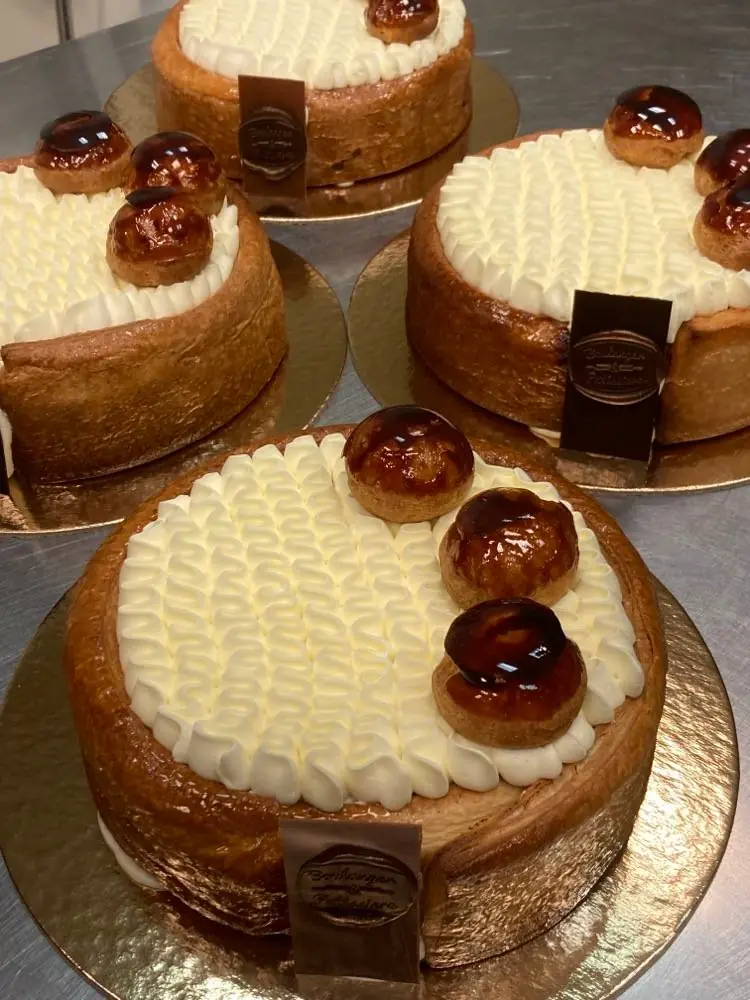
A Chiboust used for a plated dessert does not need exactly the same handling properties as one used in a tart, Saint-Honoré-style construction or layered entremet. The required firmness depends on how much weight the cream must support, how cleanly it must cut and how long it will be held before service.
That is why I do not treat crème Chiboust as one universal texture. The correct endpoint is determined by the finished dessert.
Common crème Chiboust failures
- Cream collapses after mixing: the meringue was overworked, the base was too warm or the stabilising system was insufficient for the application.
- Cream feels rubbery: the stabiliser level is too high or the base was allowed to set too firmly before folding.
- Visible white streaks remain: the components were not combined evenly, often because the base was too stiff.
- Cream becomes dense: excessive folding destroyed too much aeration or the base-to-meringue balance is too heavy.
- Cream weeps or loses shape during holding: the structure is not sufficient for the storage time, temperature or final pastry design.
How I combine the cream and meringue
I treat crème Chiboust as a coordination problem between a cooked cream, a foam and a stabilising structure. Each element can be correct on its own and still fail when they are combined at the wrong moment or in the wrong physical condition.
The best result is light without being fragile and structured without feeling gelled. That balance comes from controlling the pastry cream, meringue, temperature and folding together rather than trying to repair the texture afterward.