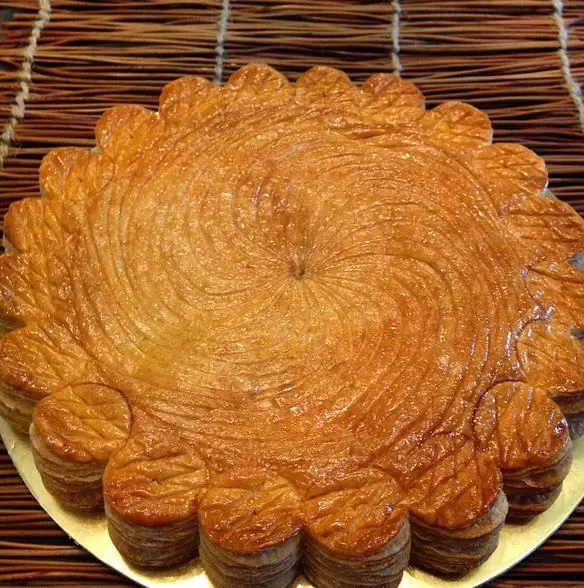
Galette des Rois looks simple from the outside: two discs of puff pastry with an almond filling. In practice, it is a very good test of pastry discipline. The dough must remain cold and relaxed, the filling must stay inside a clean seal, and the bake must be long enough to cook the laminated pastry all the way through rather than only colour the surface.
For this version, I use inverse puff pastry and true frangipane. I want to be precise about that word: frangipane is not simply another name for almond cream. It is almond cream combined with pastry cream.
My Galette des Rois formula
For one 22–24 cm galette, approximately 8 servings.
- 450–500 g inverse puff pastry, cold, for two discs about 3–3.5 mm thick
- Crème d’amande: 70 g unsalted butter
- 70 g granulated or icing sugar
- 70 g fine almond flour
- 60 g whole egg
- 3 g cornstarch
- 1 g fine salt
- 8–10 g dark rum, optional
- 135 g cold crème pâtissière
- 1 fève, optional but traditional
- Egg wash, as needed
- Simple syrup, optional for a very thin post-bake shine
Small pastry-cream batch
If you do not already have pastry cream prepared, make a small batch from 125 g whole milk, 22.5 g egg yolks, 18.75 g granulated sugar, 11.25 g cornstarch and vanilla. Cook it to a genuine boil, cool rapidly and refrigerate at 2–4°C / 36–39°F. Weigh 135 g cold cream for the frangipane.
1. Prepare the inverse puff pastry
Complete the turns and rests of the inverse puff pastry before assembly. Divide the dough into two portions, sheet each to approximately 3–3.5 mm and cut two equal 22–24 cm discs. Do not stretch them while transferring. Rest them flat and cold before filling.
2. Make the crème d’amande
Work the butter until smooth, then mix in the sugar and almond flour. Add the egg gradually, followed by cornstarch, salt and optional rum. I mix for homogeneity, not volume; unnecessary aeration can make the filling dome excessively during baking.
3. Make true frangipane
Work 135 g cold pastry cream until smooth, then combine it gently with the almond cream. In this formula, pastry cream represents roughly one-third of the finished filling, which is the classical relationship I want here.
4. Fill the lower disc
Place the first cold pastry disc on parchment. Pipe or spread the frangipane in a circle approximately 17–18 cm wide, leaving a completely clean border of about 2.5–3 cm.
If you use a fève, place it in the filling away from the exact centre so it is less likely to be struck when the galette is cut.
5. Seal the galette
Brush the clean border very lightly with water. Place the second disc over the filling without stretching it. Press around the filling to remove large air pockets and seal the border firmly without crushing the laminated edge.
Trim or chiqueter the edge if needed. Keep egg wash away from the exposed cut edge because it can glue the layers together and reduce lift.
6. Chill, egg-wash, score and vent
Refrigerate the assembled galette for at least 1 hour; a longer 3–5 hour cold rest is useful when the schedule allows it. This firms the butter, relaxes the pastry and makes scoring cleaner.
Brush the surface lightly with egg wash. Score a shallow curved or radial pattern without cutting deeply through the pastry, and make several small vents so steam can escape.
7. Bake
Bake at approximately 180°C / 356°F in a conventional oven, or around 170°C / 338°F with fan, for roughly 45–55 minutes.
The endpoint matters more than the clock: I want deep even colour, crisp laminated sides, a properly baked bottom and a fully set filling. A lower, longer profile around 160°C / 320°F for close to an hour is also professionally valid if your oven colours aggressively.
If you want shine, brush the hot galette very sparingly with simple syrup after baking. Let it cool until warm before cutting.
Crème d’amande vs frangipane
Crème d’amande is the almond cream itself: butter, sugar, ground almonds and egg, sometimes with a little starch and flavouring. Frangipane is crème d’amande combined with crème pâtissière.
Both can make excellent galettes. I use true frangipane here because I want a softer, more custard-like almond interior while keeping the puff pastry very crisp.
Galette des Rois vs Pithivier
They are close relatives but I do not use the names interchangeably. Galette des Rois is connected to Epiphany and traditionally contains a fève. Pithivier is not defined by the fève and is commonly filled with crème d’amande rather than true frangipane.
Why does my galette leak?
The usual causes are overfilling, filling on the sealing border, a weak seal, warm filling, insufficient chilling or scoring too deeply through the top pastry. A generous clean border is one of the best protections against leakage.
Why does the puff pastry not rise?
Check dough temperature, layer integrity and the cut edge. Warm smeared layers, compressed edges, egg wash running down the side, stretched pastry or insufficient resting can all reduce lift.
Why is there a raw band near the filling?
The exterior probably coloured before the interior finished baking. Pastry that is too thick, filling that is too deep, an oven that is too aggressive or simply stopping too early can all cause this. Judge the bottom and internal crispness, not only the top colour.
Why did my frangipane curdle?
The butter and egg were probably at very different temperatures or the egg was added too quickly. Add the egg gradually and keep the butter soft but not greasy.
Why did the filling form a large dome?
Too much incorporated air or too much filling can push the top pastry upward aggressively. I mix the almond cream for smoothness rather than volume and keep the filling layer controlled.
Why is the bottom soggy?
The galette may need more baking, stronger bottom heat or slightly thinner pastry. A preheated metal tray can improve heat transfer to the underside. I want the base genuinely coloured and crisp before removing it from the oven.
Can I make Galette des Rois ahead?
Yes. Inverse puff pastry can be made ahead, pastry cream can be made the day before and kept refrigerated at 2–4°C / 36–39°F, and the assembled unbaked galette can rest in the refrigerator for several hours. I prefer baking the finished galette on the day it will be served.
Can I freeze an unbaked galette?
You can freeze an assembled galette if it is wrapped very well, but my basic crème pâtissière is designed primarily for refrigeration rather than repeated freeze-thaw production. If freezing is part of a regular workflow, I validate that exact filling and process rather than assuming every pastry cream behaves identically.
How should I reheat Galette des Rois?
Reheat gently in the oven until the pastry is crisp again and the filling is warm. I avoid the microwave because it softens laminated pastry quickly.
My rule for Galette des Rois
The decorative scoring is what people notice first, but I care more about distinct lamination, a clean seal, controlled frangipane and a complete bake. When those four things are right, the technique is already visible in the structure.