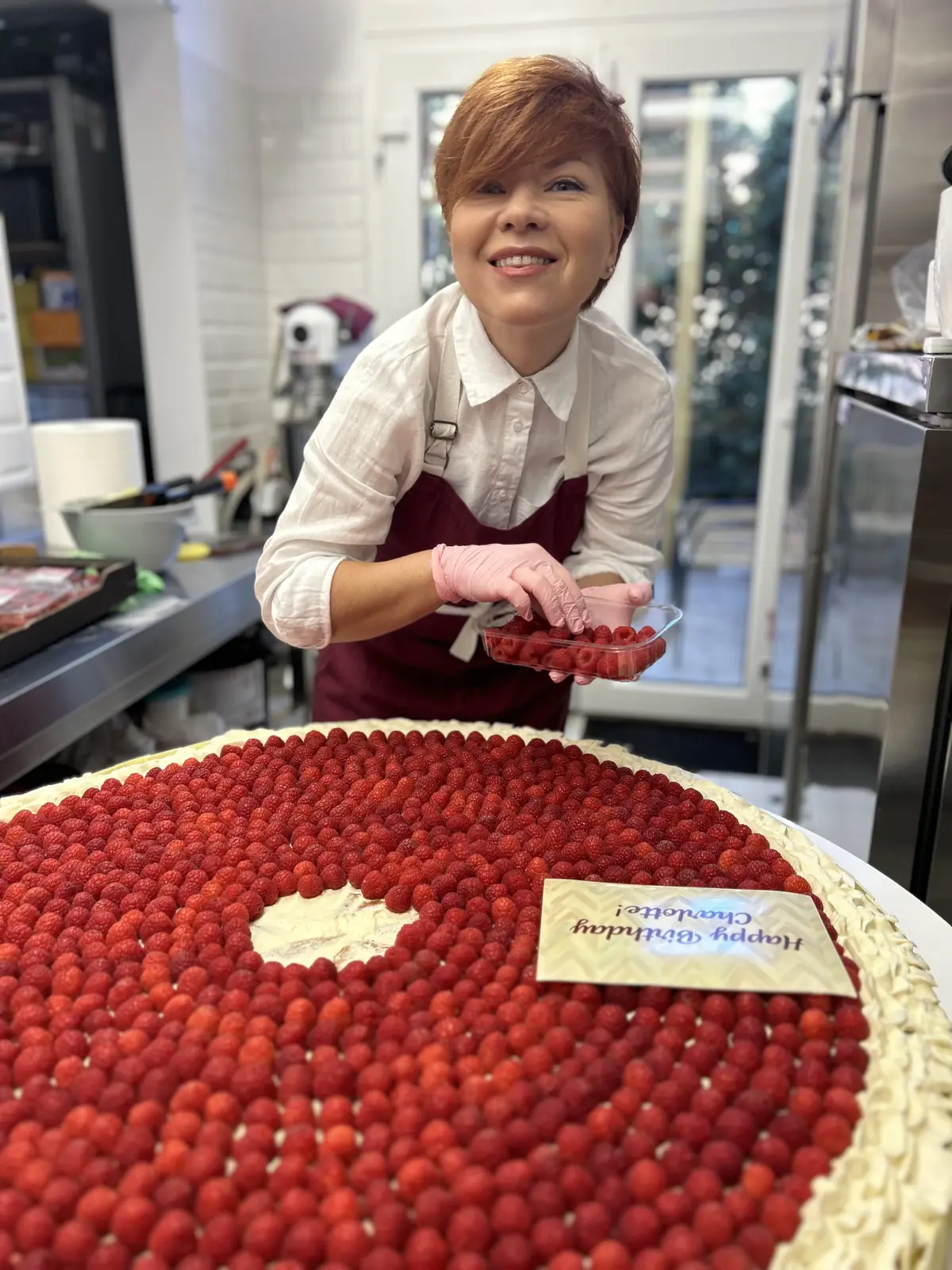
Crème pâtissière is one of the preparations I believe every serious baker should understand rather than simply memorise. The ingredients are remarkably simple: milk, egg yolks, sugar and starch. But small differences in proportion and technique completely change the result.
I want my pastry cream to be smooth, glossy and clean-tasting, with enough structure to hold inside a tart or choux pastry without becoming rubbery or tasting of starch. Here is the base formula I recommend learning first.
Crème pâtissière recipe
Yield: approximately 1.3–1.4 kg after cooking. Keep refrigerated at 2–4°C / 36–39°F and use within 2 days. I strongly recommend weighing these ingredients rather than converting them to cups; relatively small changes in yolk or starch can noticeably change the texture.
- Whole milk — 1,000 g
- Egg yolks — 180 g
- Granulated sugar — 150 g
- Cornstarch — 90 g
- Vanilla — to taste
Half recipe
- Whole milk — 500 g
- Egg yolks — 90 g
- Granulated sugar — 75 g
- Cornstarch — 45 g
- Vanilla — to taste
1. Heat the milk
Put the milk into a saucepan and bring it to the boil. If I am using a vanilla bean, I split it lengthwise, scrape out the seeds and add both seeds and pod to the milk. For a stronger vanilla flavour, I sometimes allow the vanilla to infuse in the hot milk before continuing.
2. Mix the yolks, sugar and starch
While the milk is heating, combine the egg yolks, sugar and cornstarch and whisk until completely homogeneous. I am not trying to incorporate a large quantity of air here. What matters is distributing the starch perfectly; small dry pockets are much more difficult to deal with once the hot milk has been added.
3. Temper the yolks
Gradually pour part of the hot milk over the yolk mixture while whisking continuously. Once it is smooth, combine it with the remaining milk. I prefer this gradual temperature transition because it gives me better control over the custard.
4. Cook the pastry cream
Return everything to the saucepan and cook while whisking continuously, making sure the whisk reaches the bottom and corners. The cream will suddenly begin to thicken. Do not stop cooking at this point.
Once the entire cream reaches a genuine boil, continue cooking while whisking so the starch is properly cooked. With this formula, I cook it for approximately 2 minutes after it reaches the boil. The exact clock time is less important than understanding what is happening: the starch needs sufficient heat and cooking to develop the correct structure.
5. Cool immediately
As soon as the cream is cooked, remove it from the saucepan and spread it into a shallow clean container or tray so the heat can escape quickly. Protect the surface from drying and cool promptly. Refrigerate at 2–4°C / 36–39°F. I do not leave a large, deep container of hot pastry cream cooling slowly at room temperature.
6. Prepare it for use
Cold pastry cream becomes considerably firmer. Before filling a tart or piping it into choux, I work it briefly with a whisk until it becomes smooth and creamy again. I am not trying to whip air into it; I only want to restore its texture.
Why pastry cream needs to boil
This is probably the most important thing I want you to understand about crème pâtissière. Pastry cream is not cooked like crème anglaise. Crème anglaise depends mainly on controlled coagulation of egg proteins and is supposed to remain fluid. Pastry cream contains starch.
As the mixture heats, the starch granules absorb liquid, swell and gelatinise. This creates much of the structure that allows the finished cream to hold inside a pastry. The confusing moment comes when the cream suddenly becomes thick. It looks finished, but it is not necessarily finished. If you remove it immediately simply because it has thickened, you may not have cooked the starch sufficiently.
Why I use cornstarch here
You will find excellent French pastry formulas made with flour, cornstarch or combinations of the two. I don't consider flour incorrect. For this base recipe, however, I prefer cornstarch because it gives me a useful neutral pastry cream with strong thickening power and a clean texture.
I would not substitute flour gram-for-gram for the cornstarch in this recipe. If I want a flour-based pastry cream, I use a formula developed for flour.
Don't add more starch just because you want a firmer cream
If your pastry cream seems too soft, adding more starch sounds like the obvious solution. Before doing that, I ask whether the starch was weighed accurately, whether the entire cream reached the boil, whether it was cooked sufficiently, whether extra liquid was added, whether it is completely cold, and whether the formula is appropriate for the intended dessert.
More starch can make a cream firmer, but it can also make it pasty and unpleasant. I don't want the strongest possible pastry cream. I want the least amount of structure necessary to make the dessert work beautifully.
Using this cream for éclairs and choux
For an éclair, I want a cream that pipes easily but remains inside the choux after filling. This basic crème pâtissière works well as a starting point. When I want something lighter, I may instead turn pastry cream into crème diplomate. I do not simply dilute pastry cream with cream or milk until it feels softer; once I change its structure substantially, I prefer to work from a proper formula.
Using it for fruit tarts
Crème pâtissière is beautiful beneath fresh fruit because it gives the tart richness without requiring a heavy filling. Too much starch makes a delicate fruit tart feel heavy; too little structure allows the cream to move when the tart is cut. Very wet fruit can also gradually release moisture into both the cream and pastry shell.
Using it for mille-feuille
Mille-feuille creates a different structural problem. When you cut through crisp layers of puff pastry, the filling is compressed. If the cream is too soft, it escapes from the sides. This is why I don't assume that my ideal fruit-tart cream must automatically be my ideal mille-feuille filling.
Crème pâtissière vs crème anglaise
They contain similar ingredients but behave very differently. Crème anglaise is a fluid custard whose thickening comes primarily from egg proteins. Crème pâtissière is a structured custard in which starch provides a substantial part of the structure. That difference explains both their texture and their cooking method.
What is crème diplomate?
Crème diplomate begins with crème pâtissière and introduces whipped cream to create a lighter, more aerated filling, usually with stabilization appropriate to the particular formula. I don't think of it simply as pastry cream with some whipped cream stirred into it. The proportions and temperatures matter.
What is crème mousseline?
Crème mousseline combines pastry cream with butter. The result is richer and has a very different structure from basic crème pâtissière. Temperature control becomes particularly important because the butter and pastry-cream phases need to combine correctly.
Why is my pastry cream runny?
First, check the cooking. Did the entire mixture reach a genuine boil, and did you continue cooking after the initial thickening? Then check the formula and measurements. Also remember that warm pastry cream is softer than refrigerated pastry cream, so don't judge its final structure while it is still hot.
Why does my pastry cream have lumps?
The starch may not have been dispersed properly before cooking, the cream may not have been whisked thoroughly enough as it thickened, or parts of the custard may have overheated against the saucepan. Pay particular attention to the bottom and corners of the pan. Passing the cream through a sieve can remove some physical lumps, but it cannot turn a fundamentally badly cooked custard into a good one.
Why does it taste like cornstarch?
The first things I investigate are too much starch and insufficient cooking. A good pastry cream should not announce the presence of cornstarch when you taste it. The starch is there to create structure, not flavour.
Why is it very firm after refrigeration?
Some firming is completely normal. Whisk the cold cream briefly before deciding that something is wrong. If it becomes beautifully smooth again, this was simply its refrigerated structure. If it remains rubbery or pasty, I examine the formula—particularly the starch quantity—rather than automatically adding liquid.
Why did a skin form?
The surface was allowed to dry during cooling. I protect the surface while the pastry cream cools.
Why has my pastry cream become watery?
Don't immediately assume that it needed more starch. Look at the complete process: cooking, additional ingredients, cooling, storage conditions and how long the cream has been stored. A recipe cannot compensate for poor handling.
Can I replace cornstarch with flour?
Not gram-for-gram. Both can be used to make crème pâtissière, but they do not have identical thickening power or produce exactly the same texture. If you want to make pastry cream with flour, I recommend using a formula specifically balanced for flour.
Can I reduce the sugar?
Yes, a pastry cream can be formulated with a different level of sweetness, but I don't recommend dramatically reducing the sugar in an existing formula and assuming nothing else changes. If I want a substantially less sweet pastry cream, I prefer to formulate it intentionally.
Can I make pastry cream without eggs?
You can make excellent starch-thickened vanilla creams without eggs. But I prefer accurate names. If we substantially change both the ingredients and thickening mechanism of a classical preparation, I don't think it helps the reader to pretend the result is identical. An egg-free alternative deserves its own properly developed formula.
Can I freeze crème pâtissière?
Some pastry-cream formulas freeze poorly and may separate or lose their ideal texture after thawing. There are also professional formulations specifically designed to tolerate freezing. For this recipe, I recommend refrigeration rather than freezing. If I need a pastry cream for a dessert that will be frozen, I formulate and test the cream specifically for that production process.
How long does pastry cream keep?
For this recipe, I recommend keeping it refrigerated at 2–4°C / 36–39°F and using it within 2 days. Cool it rapidly after cooking and keep it properly refrigerated. I don't extend the storage life simply because the cream still looks acceptable; milk and egg custards deserve careful handling.
My rule for choosing a pastry cream
I don't begin by asking, ‘What is the best crème pâtissière recipe?’ I ask, ‘What does this cream need to do?’ Does it need to sit beneath delicate raspberries, pipe into an éclair, remain controlled when I cut through crisp puff pastry, or become diplomate or mousseline? Those questions determine the formula.
The recipe at the beginning of this article is the neutral base I want you to understand first. Once you understand why it works, changing a pastry cream becomes a technical decision rather than guesswork. And that, for me, is much more valuable than memorising another recipe.