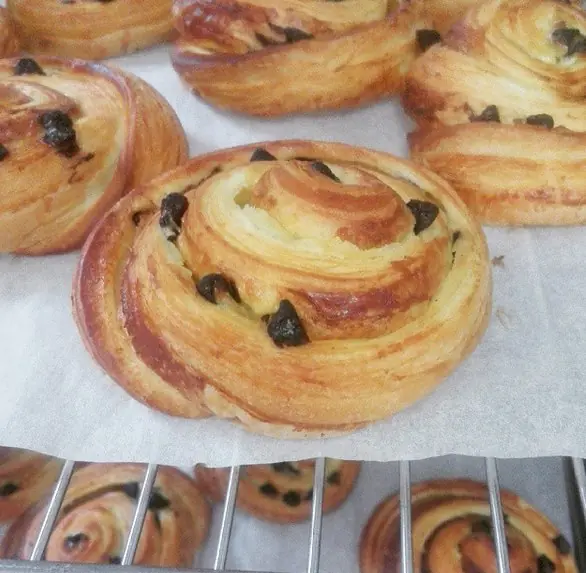
I like pain aux raisins when the spiral stays clearly laminated: crisp at the outer edge, tender through the centre, with enough vanilla pastry cream to soften the layers without turning them heavy. The raisins should taste plump, not dry, and the finished pastry should still feel like viennoiserie rather than a custard-filled bun.
My pain aux raisins formula
This batch makes approximately 14–18 medium pastries.
- Strong white or baker’s flour — 500 g
- Whole milk — 250 g
- Cold water — 40 g
- Granulated sugar — 55 g
- Fine salt — 10 g
- Fresh yeast — 15 g
- Unsalted butter in the dough — 25 g
- Unsalted cultured or high-fat butter for lamination — 225 g
- Cold crème pâtissière — 400–500 g
- Raisins — 180–220 g
- Egg wash — as needed
- Light neutral syrup or warmed apricot glaze — optional
What makes a proper pain aux raisins?
Pain aux raisins belongs to the same family as croissants and pains au chocolat. I use pâte levée feuilletée, a yeast-leavened laminated dough. Plain puff pastry can make a pleasant raisin spiral, and brioche versions also exist, but neither gives the same balance of fermentation, butter layers and light interior structure.
The filling is deliberately restrained. Too much pastry cream makes the roll slippery, obscures the lamination and often leaks. I prefer a thin continuous layer of cold cream with raisins distributed evenly across it.
Before you begin
Prepare the laminated dough through its final turn and rest it until thoroughly cold. Prepare the crème pâtissière separately and chill it completely before assembly.
If the raisins are dry or firm, cover them briefly with warm water until they soften. For a more aromatic version, I sometimes replace part of the water with rum. Drain the raisins very well and dry their surface on a clean towel; free moisture makes the laminated centre soggy.
Method
- Sheet the cold laminated dough evenly to approximately 3–4 mm. If it shrinks strongly or the butter softens, refrigerate it before continuing.
- Spread 400–500 g cold crème pâtissière in a thin, even layer, leaving a narrow clean strip along the final edge.
- Scatter 180–220 g well-drained raisins evenly over the cream.
- Roll into a compact, even cylinder without squeezing hard enough to crush the laminated layers. Finish with the clean edge underneath and seal gently.
- Chill the log until firm enough to cut cleanly, then slice into even pieces about 2–3 cm thick and place flat on lined trays.
- Proof until visibly expanded, aerated and delicate. Keep the environment butter-safe; approximately 26–28°C / 79–82°F is the upper practical zone I use for laminated dough.
- Brush exposed dough lightly with egg wash without flooding the cut laminated edges.
- Bake until deeply golden, crisp at the edges and baked through the centre. I start around 180–190°C / 356–374°F fan, or 190–200°C / 374–392°F conventional. Medium pastries often need roughly 15–22 minutes, but judge the colour and centre rather than the clock alone.
- If desired, brush the warm pastries lightly with neutral syrup or warmed apricot glaze.
Why cold pastry cream matters
Warm or loose pastry cream softens the dough, encourages the layers to slide and squeezes out as the cylinder is rolled. Fully chilled crème pâtissière has enough body to spread thinly while staying where it is placed.
I also avoid using the cream to compensate for dry pastry. Tenderness should come from correct lamination, fermentation and baking; the cream is part of the flavour and texture, not a repair for the dough.
How much filling should I use?
For this dough batch, 400–500 g pastry cream and 180–220 g raisins is a useful working range. The exact amount depends on the dimensions of the final dough sheet and pastry size. If unsure, start at the lower end; slightly less cream preserves the spiral and laminated character better than an overloaded filling.
How I judge final proof
I do not judge proofing only by the clock. The spirals should be clearly larger and lighter, with visible separation beginning between the laminated layers. When the tray is moved gently, they should look soft and slightly tremulous rather than dense and rigid.
Under-proofed centres can remain tight and butter may leak as the dough expands aggressively. If the pastries proof too warm, the butter can soften into the dough before baking.
Why did my spirals unravel?
The cylinder may have been rolled too loosely, the sealing edge may not have adhered, or the log may have been too soft when sliced. Roll evenly, leave a clean sealing strip and chill before cutting.
Why is pastry cream leaking out?
The cream may be too warm or loose, the layer too thick, or the pastries overproofed. Cold cream and restrained filling are much easier to control.
Why is butter leaking during baking?
A little butter on the tray is not automatically a failure, but heavy leakage usually points to damaged lamination, proofing that was too warm, insufficient proofing or an unsuitable oven profile. I treat lamination, proofing and baking as one continuous process.
Why is the centre dense, raw or soggy?
A dense centre can come from underproofing, rolling too tightly, slicing too thickly or underbaking. Soggy patches usually point to wet raisins, too much pastry cream or insufficient baking. Drain soaked raisins thoroughly and bake to a deep golden finish.
Pain aux raisins vs raisin croissant
In English, raisin croissant is often used as a descriptive name for pain aux raisins. Both are based on laminated yeast dough, but pain aux raisins is rolled with pastry cream and raisins and cut crosswise into spirals rather than shaped into crescents.
Can I use puff pastry or brioche dough?
You can make a raisin-and-custard spiral with puff pastry, but puff pastry has no yeast fermentation, so I would not call it the same pastry. Brioche-based pains aux raisins are a legitimate softer, more bread-like variation. For the classic laminated version, I prefer croissant-style dough.
Do I need to soak the raisins?
Not always. Soft raisins can be used directly. Very dry raisins benefit from a short soak because they otherwise pull moisture from the surrounding cream and remain chewy. Dry them well afterward. A modest amount of rum can be added to the soaking liquid, but excess liquid makes assembly less predictable.
Make-ahead, freezing and storage
The pastry cream can be made ahead and refrigerated, and the laminated dough naturally includes chilled resting periods, so I often divide the work across two days. Avoid holding pastry-cream-filled raw pastries for unnecessarily long periods.
For home use, the simplest reliable freezing method is to freeze fully baked pastries once completely cool. Wrap well, thaw and refresh in the oven. Raw frozen viennoiserie is possible, but yeast activity, freezer speed and subsequent proofing add variables.
Pain aux raisins is best on the day it is baked. Because it contains pastry cream, I refrigerate leftovers rather than leaving them at room temperature for extended periods. Reheat in a moderate oven until the laminated exterior becomes crisp again; a microwave softens the layers.
The three details I watch most closely
First, keep the laminated dough cold enough that the butter remains in distinct layers. Second, use cold pastry cream and less of it than you may initially think you need. Third, drain the raisins thoroughly.
Those three controls preserve what I want from pain aux raisins: a clean spiral, visible lamination, a light fermented crumb, vanilla cream between the layers and raisins that stay soft without making the pastry wet.