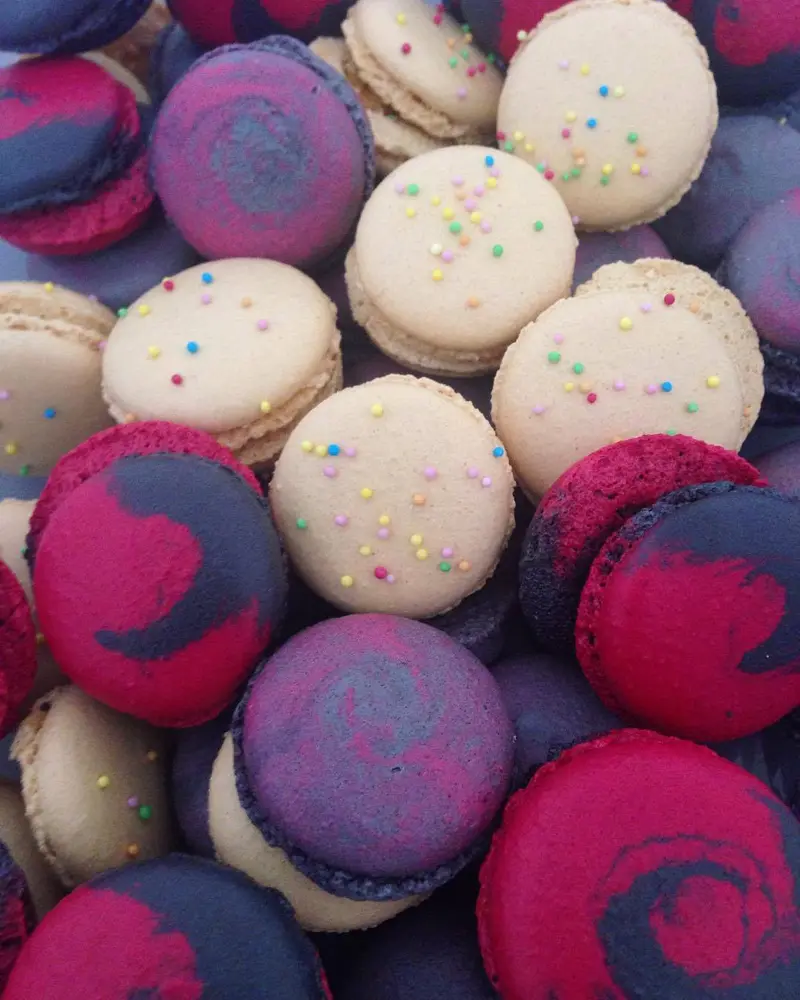
Macarons reward precision more than force. I want a shell that is smooth and thin on the outside, lightly crisp at first bite, tender inside and supported by a clean, even foot. The batter should be fluid enough to settle after piping but still structured enough to hold a round shape.
For this recipe I use Italian meringue. It is not the only correct way to make French macarons, but it is the method I prefer for a stable, repeatable shell. French-meringue macarons are also classical; I explain the difference below rather than combining the two methods.
My French macaron shell formula
For approximately 30–36 assembled small macarons, depending on piping size.
- 100 g fine ground almonds / almond flour
- 100 g icing sugar
- 37 g egg whites, for the almond paste
- 37 g egg whites, for the Italian meringue
- 100 g granulated sugar
- 33 g water
- Powdered or concentrated gel food colouring, optional and restrained
1. Prepare the almond mixture
Sift the almond flour and icing sugar together. Discard coarse almond pieces rather than forcing them through. Mix the first 37 g egg whites into the dry mixture to make a uniform thick paste. Add concentrated colouring here if using it, without adding enough liquid to change the hydration noticeably.
2. Make the Italian meringue
Cook the 100 g granulated sugar and 33 g water to approximately 118°C / 244°F. Before the syrup reaches temperature, begin whipping the second 37 g egg whites so they are foamy and soft rather than dry and stiff.
Pour the hot syrup in a thin controlled stream into the whites while whisking, avoiding the moving whisk. Continue whipping until the meringue is smooth, glossy and stable and the bowl has cooled substantially. I want a supple meringue with a clean curved peak, not a dry mass.
3. Macaronage
Add part of the Italian meringue to the almond paste first to loosen it, then fold in the remainder. Fold and press until the batter is glossy and flows from the spatula in a broad controlled ribbon. It should merge gradually back into the bowl rather than remain as a stiff ridge or disappear instantly like a liquid.
I do not count a fixed number of folds. Bowl shape, batch size, almond flour and meringue stiffness all change the number. The texture is the endpoint.
4. Pipe the shells
Pipe equal rounds with a plain round nozzle onto a flat tray lined with baking paper or a suitable silicone macaron mat. Hold the bag approximately vertical, stop pressure before lifting and tap the tray gently to release obvious large air bubbles.
5. Should macarons rest before baking?
Sometimes, yes. Let the piped shells stand until the surface develops a thin skin and is no longer sticky to a light fingertip touch if your room and oven need that protection.
I do not treat a fixed resting time as a universal law. Professional methods differ. Humidity, batter condition, oven airflow and surface setting all matter; the useful question is whether the shell surface is stable enough for your baking profile.
6. Bake
My starting point for small shells is approximately 135°C / 275°F for about 12–15 minutes. Macaron ovens vary considerably, so treat this as a starting profile rather than a law.
The shells are ready when the feet are set, the tops no longer slide independently if touched very gently, the centre is no longer wet and the shells release cleanly after cooling.
7. Fill and mature
Pair shells of similar size and fill with ganache, buttercream, fruit confit or another filling whose texture and water activity are appropriate for macarons.
During refrigerated maturation, moisture moves from the filling into the shell and changes the interior toward the tender, slightly chewy texture I want. The exact maturation time depends on the filling, so I judge texture rather than prescribing one universal number of hours.
Italian meringue vs French meringue
Both methods can produce excellent French macarons. With French meringue, granulated sugar is beaten directly into uncooked egg whites. With Italian meringue, cooked sugar syrup is poured into whipped whites, creating a more stable meringue before macaronage.
Do not convert this recipe from Italian to French meringue simply by removing the water or changing the order. The methods need their own balanced formulas and process.
What should proper macaronage look like?
The batter should be smooth, glossy and flowing, but not watery. If piped peaks remain stiff, it is probably undermixed. If rounds spread dramatically and become very flat, the batter may be overmixed or overly wet.
Why do macarons have feet?
The foot forms when expanding steam and air lift the interior while the top surface has enough structure to resist simply rupturing. Good feet depend on the whole system: meringue strength, macaronage, surface condition, piping, tray, oven heat and baking time.
Why do my macarons crack?
Possible causes include an unstable or insufficiently dried surface for your oven conditions, excessive initial heat, large trapped air bubbles, weak meringue structure or incorrectly handled batter. Change one variable at a time when diagnosing the problem.
Why are my macarons hollow?
A hollow shell can have several causes: excessively stiff meringue, an exterior that sets too rapidly, an underbaked interior, or batter structure that expands faster than it can set. Look at colour, foot, bottom, internal moisture and top stability before changing the oven.
Why do my macarons have no feet?
Check for over-macaronage, weak meringue, excessive spreading or insufficient oven energy early in the bake. If you rely on drying, also check that the surface actually became non-sticky rather than trusting a fixed clock time.
Why are my macarons lopsided?
Uneven piping, strong directional fan airflow, a warped tray, uneven heat, a sloping surface or irregular drying can all create asymmetry. First check whether the problem follows the same area of the oven.
Why are the bottoms sticky?
The shells may be underbaked or simply too warm to release. Tray material, silicone versus parchment and bottom heat also affect release. Let the shells cool before diagnosing sticking.
Why do the shells brown?
The oven may be too hot, the bake too long or the top heat too aggressive. Do not solve browning by shortening the bake so much that the centre remains raw; correct temperature, rack position or heat distribution while still baking the shell completely.
Do I need to age egg whites?
No, not as an absolute requirement. Aging whites is a traditional professional practice, but accurate weighing, meringue development and batter control matter more than treating multi-day aging as a magic step.
Do I need to dry the almond flour?
My older production notes include an optional step of drying ground almonds at about 50°C / 122°F for 10 minutes. I treat this as an environmental adjustment, not a compulsory step. If the flour is already dry and free-flowing, I do not add a heating step merely because a recipe says so.
Which food colouring is best?
Use concentrated colour that adds as little extra liquid as possible. Powder is particularly easy to control; concentrated gel can also work. Cocoa powder changes fat and solids as well as colour, so a chocolate macaron deserves a properly balanced formula rather than a casual spoonful of cocoa added to this one.
Can I make macaron shells ahead?
Yes. Unfilled shells can be prepared ahead and stored carefully once completely cool. For longer storage, freezing well-protected shells is often preferable to leaving them for many days at room temperature, where they can absorb humidity or dry excessively.
Can I freeze filled macarons?
Often yes, but the filling determines the result. Stable ganaches and some buttercreams can freeze well; high-water fruit or dairy fillings may soften the shell excessively or change texture after thawing. Validate the exact filling and maturation cycle for regular frozen production.
How should I store filled macarons?
Store them according to the most perishable component of the filling. Ganache, buttercream, pastry cream, fruit preparations and fresh fruit do not all have the same storage requirements. Protect refrigerated macarons from drying and strong refrigerator odours.
My rule for French macarons
I do not judge a macaron by the size of its foot. I look for balance: a smooth shell, controlled lift, a fully baked base, a tender interior after maturation and a filling that supports the shell instead of dissolving it. Once those things are right, colour and decoration become secondary.