Inverse puff pastry, or pâte feuilletée inversée, reverses the usual construction of classic puff pastry: instead of locking a plain butter block inside dough, I enclose the dough inside a beurre manié made from butter and flour. That small change creates a pastry that is exceptionally crisp, tender and regular when the lamination is handled carefully.
My inverse puff pastry formula
This formula makes about 1.16 kg of dough before trimming:
- For the beurre manié: high-fat unsalted butter — 375 g
- For the beurre manié: T45 or all-purpose flour — 150 g
- For the détrempe: T45 or all-purpose flour — 350 g
- Cold water — 150 g
- Unsalted butter in the détrempe — 115 g
- Fine salt — 12.5 g
- White vinegar — 4 g
Method
- Make the beurre manié by mixing the 375 g butter with 150 g flour only until completely homogeneous. Flatten it between sheets of parchment into an even rectangle, cover and refrigerate until firm but still plastic.
- Make the détrempe by combining the remaining 350 g flour, cold water, 115 g butter, salt and vinegar. Mix only until homogeneous; do not chase maximum gluten development.
- Flatten the détrempe into a neat rectangle, cover and refrigerate. I want both components cold, rested and similar enough in firmness that they can roll together without cracking or smearing.
- Roll the beurre manié large enough to wrap the détrempe completely. Place the détrempe in the centre and enclose it cleanly so the butter-flour layer becomes the outside of the package.
- Roll progressively into a long rectangle and give one double turn: fold both short ends toward the centre, then fold the dough in half like a book.
- Refrigerate for at least 2 hours at about 4°C / 39°F.
- Give a second double turn, then refrigerate again. An overnight rest at about 4°C / 39°F is ideal before the final turn.
- Give one final simple turn by folding the dough in thirds. Refrigerate for at least 1–2 hours at about 4°C / 39°F before final sheeting.
- Sheet according to the finished pastry. For mille-feuille, about 2–3 mm is a useful working range; keep the sheet even and avoid crushing the exposed edges.
- Bake according to the application. For a weighted mille-feuille sheet, a practical range is about 180–190°C / 356–374°F until the pastry is deeply golden, crisp and dry through the centre. Unweighted pieces may require a different profile because they expand more freely.
What makes inverse puff pastry different from classic puff pastry?
The difference is not simply the quantity of butter. The geometry is reversed. In classic puff pastry, the détrempe surrounds the roll-in butter. In inverse puff pastry, the flour-rich butter layer surrounds the détrempe.
That outer beurre manié is more extensible than plain butter and can produce very clean lamination, but it is less forgiving if it becomes warm. Once the outside starts smearing, the layers quickly lose definition.
Why I use almost as much butter as flour
Professional inverse-puff formulas are extremely rich. In this formula, total butter is 490 g for 500 g total flour. That is intentional: the large fat phase is what gives inverse puff pastry its tenderness and very fine flake.
Because the butter quantity is so high, temperature control is more important than with many ordinary doughs. I work in short stages and refrigerate whenever the surface starts feeling soft or greasy.
Why flour is mixed into the outside butter
Plain butter alone is too fragile and mobile to act as the outside layer during repeated rolling. Mixing flour into it creates beurre manié: a butter-flour paste that is more coherent, easier to sheet and better able to surround the détrempe.
The flour also absorbs part of the butter's free moisture and changes its mechanical behaviour. I want it plastic enough to bend around the dough without splitting, but firm enough to remain a distinct layer.
Why I do two double turns and one simple turn
Two double turns followed by one simple turn are a strong classical reference for inverse puff pastry. They create many layers without asking the dough to endure an unnecessarily large number of rolling cycles.
More turns are not automatically better. Every additional pass makes the layers thinner and increases the risk of smearing, uneven thickness and gluten tightening.
Why the long rests matter
The rests do two jobs at once: they cool the butter-rich exterior and let the gluten relax. If I shorten them too aggressively, the dough begins to spring back while the outside butter warms under pressure.
For this dough, patience is structural. A two-hour rest is not simply scheduling convenience; it is part of keeping the layers distinct.
How I judge butter plasticity
The outside layer should bend under the rolling pin without cracking into plates and without leaving greasy streaks. If it fractures, let it soften slightly. If it smears, refrigerate the dough immediately.
I pay more attention to relative firmness than to one exact butter temperature. The détrempe and beurre manié should deform at roughly the same rate.
Why vinegar is in the détrempe
A small amount of vinegar is traditional in many professional puff-pastry formulas. It slightly acidifies the dough and can help keep the gluten from becoming excessively elastic during repeated rolling.
The amount here is small. I treat it as a useful handling aid, not as the ingredient responsible for the puff. The lift still comes from correctly separated dough and fat layers producing steam in the oven.
Why inverse puff pastry shrinks in the oven
- The dough was forced during rolling and the gluten never relaxed.
- The final sheet was baked immediately instead of being rested cold.
- The sheet was stretched while transferring it to the tray.
- The dough was cut with dragging pressure rather than a clean sharp cut.
- The pastry was insufficiently docked or weighted for an application such as mille-feuille.
Why butter leaks
- The beurre manié became too warm and smeared during lamination.
- The dough and outside butter layer had very different firmness.
- The package was rolled too aggressively and ruptured at the edges.
- The pastry entered an oven that was not fully preheated.
- The final sheet was uneven, leaving local pockets of butter that melted before the dough structure set.
Why the pastry does not rise evenly
- The turns were uneven or misaligned.
- The dough thickness varied across the sheet.
- The edges were compressed while cutting.
- The beurre manié cracked and created discontinuous fat layers.
- The dough was too warm and layers fused before baking.
Why inverse puff pastry can feel greasy
Greasy pastry usually means the butter has migrated out of the laminated structure. That can happen during rolling if the dough is too warm, or during baking if the oven is too cool and the butter melts before the dough layers set.
I diagnose temperature and layer integrity before reducing the butter. The richness is part of the formula; poor butter containment is the defect.
How I use inverse puff pastry for mille-feuille
For mille-feuille I sheet the dough evenly, rest it cold, dock it and bake it under controlled weight so the layers stay fine rather than ballooning freely. The goal is a flat, deeply baked sheet with crisp internal lamination, not maximum height.
After baking, I let it cool completely before trimming. Warm puff pastry is fragile, and cutting it too early crushes the layers that took hours to build.
Can I freeze inverse puff pastry?
Yes. After the final turn and resting, divide the dough into practical portions, wrap very well and freeze flat. Thaw overnight in the refrigerator at about 4°C / 39°F before sheeting.
You can also freeze already-sheeted pastry between parchment if it is well protected from drying and breakage. I avoid thawing at room temperature because the outer butter layer warms much faster than the centre.
Storage
Keep finished raw inverse puff pastry refrigerated around 4°C / 39°F and use it within a short professional workflow, or freeze it for longer storage. Always wrap it tightly so the surface does not dry.
Baked puff pastry should be kept dry. Moist fillings soften it quickly, so for mille-feuille and similar desserts I assemble as close to serving as practical.
What I look for in the finished pastry
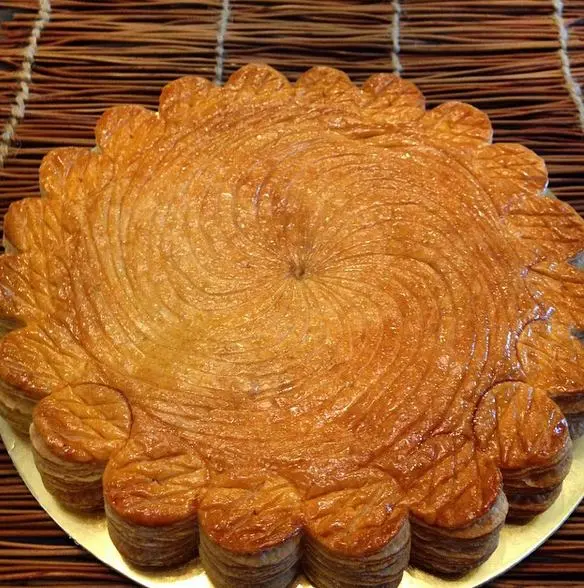
I want a deeply golden, crisp pastry with many fine visible layers, clean lift and no greasy patches. The crumb should feel delicate and brittle rather than tough, while still having enough structure to support a filling.
When inverse puff pastry is correct, it combines two qualities that are difficult to achieve together: exceptional tenderness and very precise lamination. If that balance disappears, I check temperature, rests, turn accuracy and final baking before changing the formula.