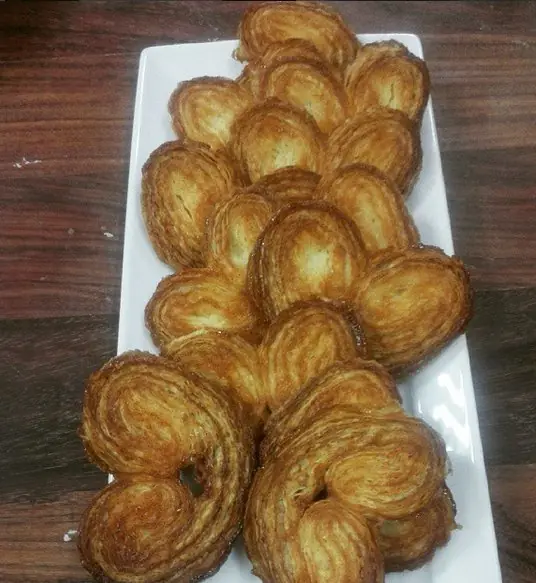
I make classic puff pastry when I want clean, deliberate layers rather than a rustic flake. The ingredient list is simple; the real work is keeping the détrempe and butter equally flexible from the moment I lock in the butter until the pastry reaches the oven.
My puff pastry formula
This formula gives approximately 550 g of laminated dough before any optional sugar is added:
- T45 flour — 250 g
- Fine salt — 5 g
- Water — 100 g
- Unsalted butter, soft, for the détrempe — 30 g
- Unsalted butter for lamination — 165 g
- Granulated sugar — optional, up to 50 g for intentionally sweet applications
This is my house formula, and it is firmer than many published versions. I never try to compensate by overmixing the détrempe or forcing it through the turns. The resting time and the condition of the butter are just as much a part of the recipe as the weighed ingredients.
Method
- Make the détrempe: combine the flour and salt, add the water and 30 g soft butter, and mix only until a coherent dough forms. I want enough strength to survive lamination without building unnecessary elasticity.
- Flatten the dough into a neat rectangle, cover it and refrigerate until it is fully relaxed and cool.
- Prepare the 165 g lamination butter as an even, flexible block. It should bend under pressure without cracking and should not feel greasy or soft enough to smear.
- Lock in the butter evenly inside the détrempe, avoiding thick dough seams and empty pockets. Seal the packet cleanly.
- Roll progressively into a rectangle. Do not force a thick packet rapidly to a thin sheet; if the butter starts cracking or the dough fights back, stop and correct the condition before continuing.
- For a reproducible classical workflow, six simple turns is a reliable reference. After each turn, rotate the dough consistently, brush away loose flour and keep the rectangle even. Rest in the refrigerator whenever the butter becomes too soft or the dough develops strong resistance; resting after every two turns is a useful starting rhythm.
- After the final turn, refrigerate until the dough is relaxed and the butter is firm but still plastic before final sheeting.
- Roll to the thickness required by the finished pastry, cut with a sharp blade and avoid crushing exposed laminated edges. Rest shaped pieces again if the dough has become tense or warm.
- For my puff pastry I commonly bake in a fan oven at 150–160°C / 302–320°F for about 30–50 minutes, depending on thickness and product. Bake until the internal sheets are genuinely dry and crisp, not merely tall and browned.
What pâte feuilletée actually is
Classic puff pastry contains no yeast. I enclose a block of butter inside the détrempe, then build alternating sheets of dough and butter through repeated rolling and folding.
In the oven, water from both the dough and the butter turns to steam. The butter delays the neighbouring dough sheets from bonding, giving the expanding vapour time to lift them apart before the structure sets. The layers must be free to rise, but they must also remain contained and continuous.
Why my formula is relatively firm
With 100 g water for 250 g flour, the direct water ratio is 40% before I account for the butter mixed into the détrempe. Many formulas use more water. I prefer this firmer dough because it gives me the resistance and control I want through repeated rolling.
The price of that control is rest. A firmer dough needs enough time for the gluten to relax. If I answer resistance with more pressure, I fracture or smear the butter layers and usually create more shrinkage in the oven.
Butter plasticity matters more than one magic temperature
The butter and détrempe need to lengthen together under the rolling pin. If the dough stretches while the butter remains brittle, the butter breaks into plates and islands. If the butter is too soft, it smears into the dough and the clear pattern of layers disappears.
Temperature helps me control consistency, but dough and butter at the same temperature are not necessarily equally flexible. I press and bend the butter before lock-in: it should extend without cracking, yet remain firm enough to hold its shape.
Why I do not laminate at 28°C / 82°F
I keep dough below 28°C / 82°F in my pastry work, but that number is a safety ceiling—not a target for lamination. I work puff pastry considerably cooler because the butter must remain flexible while still holding itself as a separate layer.
Once butter has smeared deeply into the détrempe, chilling can firm it again but cannot reconstruct the clean layers that were already lost.
My lamination control: plasticity, temperature, geometry and thickness
I think about lamination as a conversation between five things: the flexibility of the butter, the relaxation of the dough, temperature, the accuracy of the folds and the thickness of the sheet. They all have to be right at the same moment. If one is wrong, I stop; extra pressure rarely solves it.
Before lock-in, I make the butter block even and roll the détrempe large enough to enclose it without creating a thick seam. As I roll, I keep the packet rectangular so the butter reaches the full working width. Curved ends, diagonal pressure and heavy corners produce different layer counts across the sheet, which later appear as uneven lift.
I reduce the thickness in stages. Forcing a thick, cold packet rapidly through a narrow gap is how brittle butter fractures and soft butter is pushed into streaks. Every pass should lengthen the packet, not crush it. Dough that springs back needs rest; butter that cracks needs its flexibility corrected; smearing or a greasy surface means the packet is too warm or has been handled too aggressively.
I do not prescribe one universal lamination temperature. Butter composition, room temperature, rolling equipment and the speed of the work all change the practical range. My 28°C / 82°F ceiling is not the working temperature for puff pastry. I work much cooler and watch what happens under pressure: dough and butter should lengthen together, without cracking or flowing.
Every turn multiplies whatever accuracy—or inaccuracy—is already present. I square the rectangle before folding, brush away loose flour, align the edges without stretching them and rotate the packet in the same direction each time. Six turns written on a recipe cannot compensate for folds that overlap unevenly or leave gaps.
I choose the final thickness for the pastry I am making. Mille-feuille needs flat, even sheets that can be restrained and dried completely. A filled galette needs enough laminated structure to rise around its filling. Other pastries may need a thinner or heavier sheet. For that reason, I record final thickness with the product instead of presenting one number as correct for every use.
How many turns does puff pastry need?
There is no single compulsory schedule. Professional pastry kitchens use simple turns, double turns or a combination of the two. Six simple turns give a reliable classical structure and are easy to reproduce, but the number by itself guarantees nothing.
I care more about whether each fold preserves continuous layers. More turns are not automatically better; extremely thin layers are easier to compress, merge or damage.
Why resting matters
Resting solves two different problems. It relaxes the gluten so the dough can lengthen without springing back, and it brings the butter back to the right consistency so it stays distinct during the next rolling pass.
A packet can be cold but still too tense, or perfectly relaxed while its butter is already too soft. I continue when the dough rolls willingly and the butter remains flexible—not simply because a timer says the rest is finished.
Why puff pastry does not rise
When lift is weak, I check the process before changing the formula:
- Butter smeared into the dough and the layers merged.
- Butter fractured because it was too brittle.
- The dough was rolled too aggressively and the layers were compressed.
- Cut edges were crushed instead of left clean and open.
- The final sheet was too thick or uneven for the product.
- The pastry was underbaked before the internal structure had dried and set.
Why butter leaks in the oven
A small trace of butter during baking does not automatically condemn the formula. Heavy leakage tells me that the butter escaped from its layers somewhere during lock-in, rolling, folding or shaping, usually because the packet was damaged or allowed to become too warm.
If the butter became too soft during lamination, it may already have migrated into weak areas. If the dough was cut or shaped carelessly, exposed layers can also release fat before the structure sets.
Why puff pastry shrinks
Shrinkage is usually accumulated tension. Overmixing the détrempe, forcing the dough while it resists, stretching it during shaping or skipping the final rest can all make the pastry contract in the oven.
I do not stretch a piece to make it fit. If the sheet is fighting me, I let it rest and then continue.
Why the centre stays doughy
Puff pastry can look impressive while the centre is still underbaked. Height is not my finishing signal. The internal sheets must lose enough moisture to become crisp and stable after cooling.
This is particularly important for mille-feuille, where a damp centre turns leathery after cooling. I judge colour together with weight, dryness and the feel of the internal layers.
Puff pastry vs rough puff
Classic puff starts with one coherent butter block enclosed inside the détrempe. Rough puff distributes pieces or sheets of butter through the dough before folding. Both are laminated, but classic puff creates more regular continuous layers and more controlled vertical lift.
If I need precise layering for mille-feuille, pithivier or another refined application, I choose classic puff. If rustic flake matters more than strict geometry, rough puff can be the more intelligent choice.
Can I freeze puff pastry?
Yes. After the final turns, wrap the dough very well and freeze it flat. Thaw it slowly in the refrigerator rather than at room temperature so the butter does not soften ahead of the dough.
Once thawed, let the dough become just flexible enough to roll. If the butter is brittle, give it a little time; if it is becoming greasy, cool it again.
Can I add sugar to the dough?
For intentionally sweet applications I may add up to 50 g sugar to this formula. I treat that as a variation, not as part of the neutral base. Sugar changes browning, tenderness and water behaviour, so I choose it for the finished pastry rather than adding it automatically.
What I look for in finished puff pastry
I want visible, separate layers, a dry crisp centre and a clean break rather than a bready bend. Maximum height is not always the objective; for mille-feuille, controlled and even layering can matter more than dramatic expansion.
The oven reveals the layers; it cannot repair them. By the time the pastry goes in, the decisive work has already happened through the condition of the dough and butter, the accuracy of the turns and the patience of the rests.