I think of brioche as bread first: it must have real gluten structure and fermentation, even though it carries enough egg and butter to eat with the tenderness of pastry. The difficulty is not making the dough rich. It is building enough strength before the enrichment makes development slower and more delicate.
My brioche formula
For approximately 1.16 kg dough before baking:
- Strong white flour — 500 g
- Whole eggs — 250 g
- Whole milk — 75 g
- Unsalted butter, cold and cut into small cubes — 225 g
- Granulated sugar — 75 g
- Fine salt — 12 g
- Fresh yeast — 20 g
This is my classic brioche recipe. I use whole eggs rather than extra yolks, and I chill the eggs to 5°C / 41°F before mixing. I then add the cold butter gradually so the dough stays cool as it absorbs the fat.
Method
- Put the flour, whole eggs, milk, sugar and fresh yeast into the mixer. Add the salt so it is not sitting directly against the yeast at the start.
- Mix at low speed until no dry flour remains, then continue at moderate speed until the dough has developed real gluten strength and reaches approximately 25°C / 77°F. It should look elastic and pull together around the hook before any butter is added.
- Add the cold butter a few cubes at a time, waiting until each addition is largely absorbed before adding more. The dough will loosen and appear to weaken at first, then come back together quite quickly. Once it is smooth and the butter is incorporated, stop mixing: the biggest mistake at this stage is to keep working the dough and overheat it.
- The finished dough should be smooth, glossy and elastic enough to stretch into a thin membrane. I keep it at or below 28°C / 82°F.
- Cover the dough and leave it at room temperature for 30 minutes, then give it a few gentle folds.
- Transfer the dough to a container with plenty of room, cover it tightly with plastic film and refrigerate overnight. The dough will continue to rise in the refrigerator and can overflow if the container is too small or not covered securely.
- Divide and shape while the dough is cold. Place into buttered moulds or shape as individual brioches.
- Proof until the dough has grown to approximately 2.5 times its original size. At 26–28°C / 79–82°F, this usually takes around 2 hours.
- Brush gently with egg wash if desired. In a fan oven, bake at 150°C / 302°F until deeply golden and fully baked through. As a guide, allow approximately 15 minutes for an individual brioche bun and 30–40 minutes for brioche baked in a Pullman mould. The exact temperature and baking time will depend on the oven, the weight of the dough and the mould.
- Cool before slicing so the crumb can finish setting.
If the dough becomes too loose and warm
If the dough becomes very loose during butter incorporation, the problem is usually temperature rather than a need for more flour. The base dough may already be too warm because the eggs were not cold enough, the room is hot, or the mixer generates considerable heat. Commercial spiral mixers often warm this type of dough faster than planetary mixers such as a KitchenAid.
When the dough is already close to or above 25°C / 77°F and has become very soft or almost liquid, cold butter cubes can move around inside it rather than blending into the dough. The dough then heats faster than the butter softens. At this point I stop the mixer, press the butter pieces into a paste with my hands, and fold the dough by hand to incorporate them without adding more mixer heat.
This problem is especially common with panettone, where the proportions of eggs and butter are much higher. Whatever the recipe, the flour must be strong enough for that particular level of enrichment.
- Trust a properly tested recipe rather than changing the balance while mixing.
- Use flour with enough strength for the recipe.
- Control the temperatures of the room, eggs, dough and butter.
- If the dough overheats, cool it quickly in the freezer, checking it frequently so it cools without freezing.
Why I develop gluten before adding the butter
Butter coats flour proteins and makes gluten development more difficult. If I add a large quantity of butter before the dough has built strength, the mixer has to work much longer and the dough heats while trying to create a network inside an already enriched mass.
I therefore build the dough first and enrich it second. Once the base dough is elastic, the butter can be incorporated into a structure that already exists rather than replacing the chance to form one.
Why I add cold butter in cubes
I do not melt the butter into brioche. Melted or very soft butter makes it easy to create a greasy dough before the gluten structure is ready to hold the fat. Cold cubes let me add the butter progressively and control the temperature of the mix at the same time.
Cold does not mean rock-hard. The cubes still need to be small enough for the mixer to incorporate without tearing the dough. If the butter is extremely brittle, I let it soften just enough to cut and deform under pressure while remaining cold.
Why 28°C / 82°F is my upper limit
Brioche mixing generates heat, and the enrichment makes long mixing tempting. Once the dough becomes too warm, the butter softens excessively, the dough loses definition and fermentation accelerates before the structure is ready.
I treat 28°C / 82°F as an upper ceiling for the finished dough, not as a target. A cooler well-developed dough is easier to retard, divide and shape cleanly.
What the eggs and butter are doing
Whole eggs bring water, protein, fat and emulsifiers. They enrich the crumb while also contributing liquid to the dough. Butter tenderises the crumb and gives brioche its characteristic flavour, but at this level it also changes how the dough develops and ferments.
That is why brioche cannot be treated like ordinary white bread with butter simply added at the end. The ratio of enrichment changes mixing, proofing, shaping and baking.
Why I prefer an overnight cold retard
Cold fermentation is not only for flavour. It gives the butter a chance to become firm throughout the dough, which makes a very soft enriched dough much easier to divide and shape without adding flour.
The cold also slows fermentation so the dough can develop gradually. The next day I work with it while it is still cool, then let the shaped pieces complete their final proof.
How do I know brioche is fully proofed?
I look for volume, lightness and movement. Properly proofed brioche feels aerated rather than dense, and the dough has enough internal gas that the surface looks gently inflated rather than tight.
Underproofed brioche tends to tear or burst strongly in the oven and produces a tighter crumb. Overproofed dough feels fragile, may lose definition and can collapse because the gluten network has already been stretched too far before baking.
Why brioche can feel greasy
A greasy bowl is not a signal to add more flour. Extra flour changes the formula and usually leaves the finished crumb drier. I correct the mixing and temperature instead.
- The butter was added before enough gluten had developed.
- Too much butter was added at once and the emulsion never fully recovered.
- The dough became too warm during mixing.
- The butter was excessively soft before incorporation.
- The dough was handled warm after fermentation instead of being chilled thoroughly.
Why brioche can be dense
The first place I look is gluten development before the butter phase. A rich dough that never built enough structure cannot hold fermentation gases efficiently.
I also check proofing, yeast activity and the amount of extra flour used during shaping. Cold brioche can feel firm even when the formula is correct; dusting it heavily with flour because it feels stiff after refrigeration can quietly make the loaf dense.
Why butter can leak during proofing or baking
If butter visibly separates during proofing, the dough is often too warm or the fat was never fully incorporated. High proofing heat can melt butter faster than the dough structure can hold it.
Leakage in the oven can also come from poor incorporation earlier in the process. I prefer a slightly cooler, longer final proof to trying to accelerate a rich dough with aggressive heat.
Brioche vs challah
Both are enriched yeast breads, but they are built differently. Brioche is defined by a high proportion of butter and usually dairy, while challah traditionally uses oil rather than butter and is generally less fat-rich.
The result is different in both flavour and crumb. Brioche is more buttery and melting; challah is usually lighter in fat character and more bread-like in chew.
Can I freeze brioche dough?
For best consistency I prefer freezing shaped dough rather than a warm bulk dough. Chill it first, shape it, freeze it well wrapped, then thaw slowly in the refrigerator before completing the final proof.
Baked brioche also freezes very well. Cool it completely, wrap it airtight and freeze. Thaw while still wrapped so condensation stays on the wrapping rather than drying the crumb.
How I store baked brioche
Brioche is best the day it is baked, but its high enrichment gives it a useful second life. Keep it airtight at room temperature for a short period rather than refrigerating it, because refrigeration accelerates staling in bread.
After a day or two, I prefer to toast it, use it for French toast, or freeze the remaining loaf rather than leaving it exposed and allowing the crumb to dry.
What I look for in finished brioche
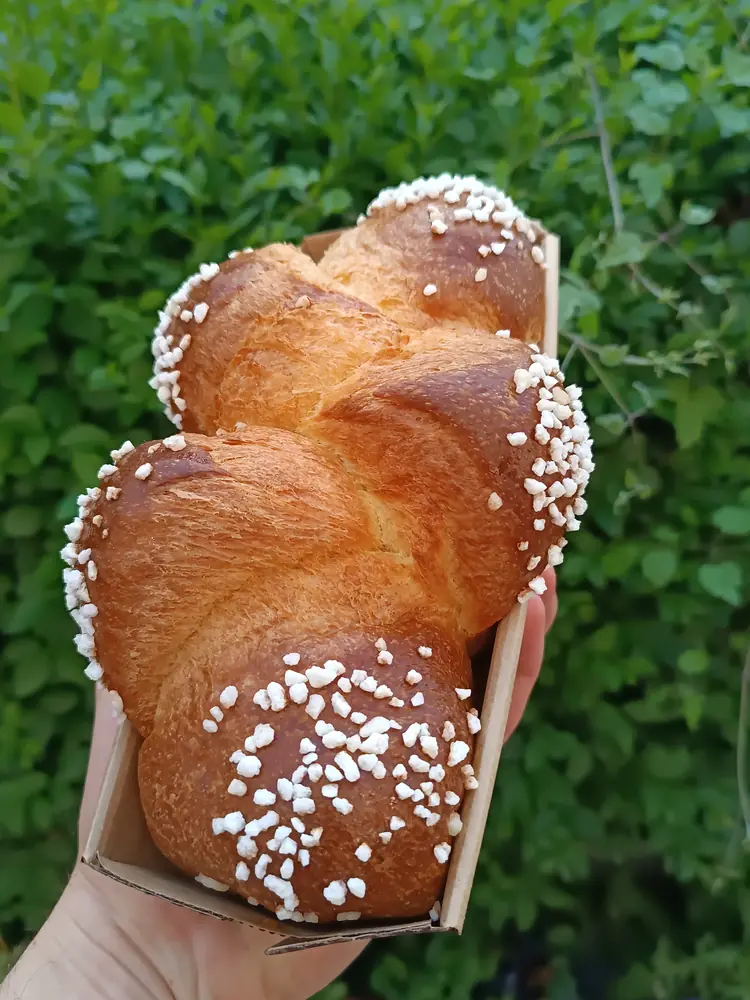
I want a fine, elastic crumb that pulls into soft strands rather than crumbling like cake. The crust should be deeply golden, the interior should feel light for such a rich formula, and the butter should taste integrated rather than greasy.
Good brioche is rich without feeling heavy. That balance comes from fermentation and structure first, enrichment second.