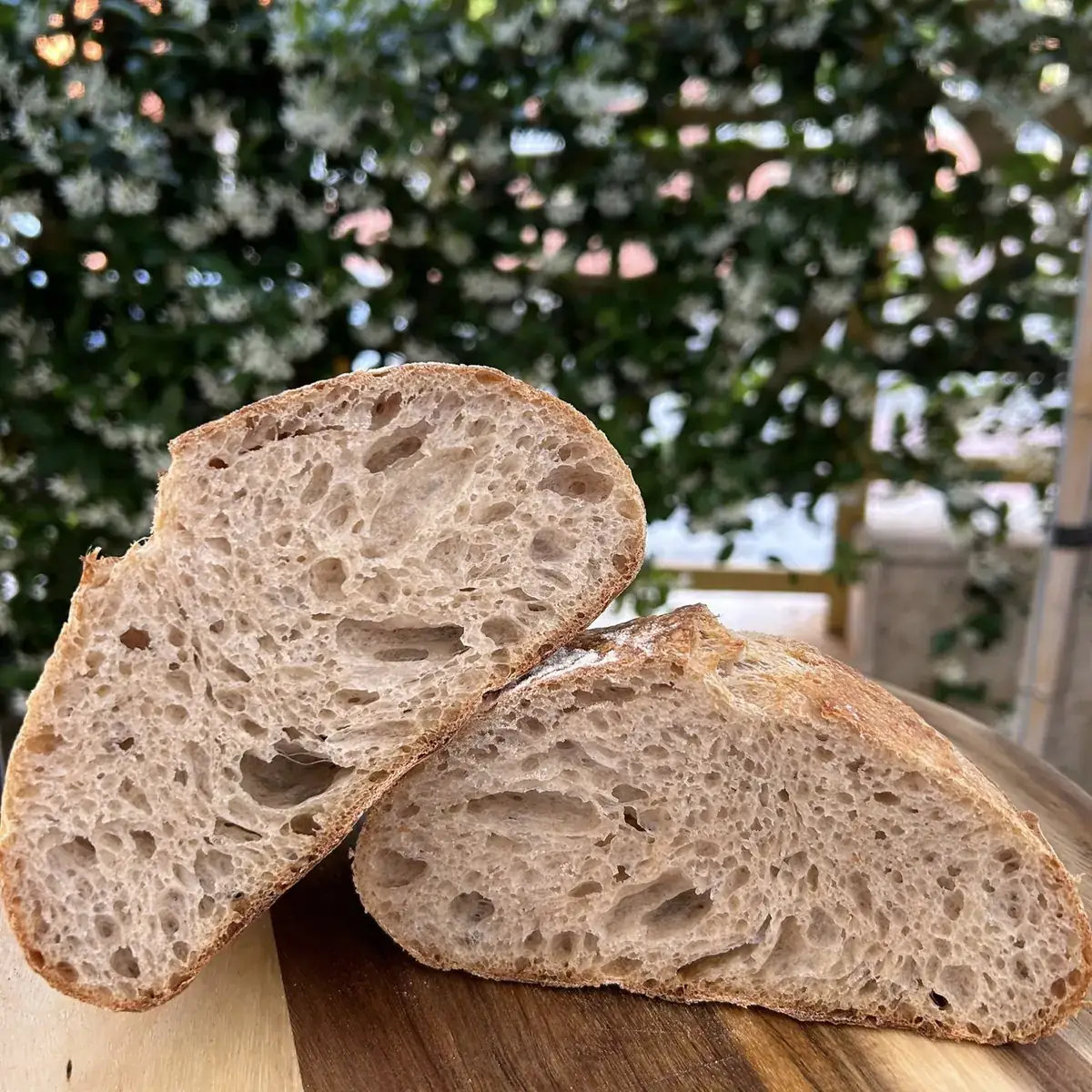
For a country sourdough loaf, I want a deeply baked crust, a moist elastic crumb and enough whole grain to give aroma without making the dough heavy. I keep this formula at 75% hydration because it gives me a loaf that is expressive and open without becoming unnecessarily difficult to shape in a home kitchen.
My country sourdough formula
Yield: 1 loaf, approximately 885 g dough.
- Strong white bread flour — 350 g
- Whole-wheat flour — 75 g
- Rye flour — 25 g
- Water — 325 g
- Ripe 100%-hydration levain — 100 g
- Fine salt — 10 g
The levain contributes another 50 g flour and 50 g water, so the complete formula contains 500 g flour and 375 g water: 75% hydration. The total flour blend is 80% white bread flour, 15% whole wheat and 5% rye, with 2% salt and 10% pre-fermented flour.
I use a ripe levain rather than a fixed number of hours as my starting point. It should be visibly expanded, aerated and lively, with a clean fermented aroma. If the levain has already risen and collapsed significantly, the dough starts with less predictable fermentation power.
Method
- Autolyse the flour. Mix the 350 g white bread flour, 75 g whole-wheat flour and 25 g rye flour with 300 g of the water. Cover and rest for 30–60 minutes.
- Add the levain and salt. Add the 100 g ripe levain, the 10 g salt and the remaining 25 g water progressively. Mix until homogeneous and meaningfully strengthened. I target a finished dough temperature of about 25°C / 77°F.
- Bulk ferment and strengthen. Keep the dough around 24–25°C / 75–77°F if possible. Give three sets of stretch-and-folds during the first 90 minutes, approximately 30 minutes apart. After that, leave the dough undisturbed so fermentation can continue.
- Judge the end of bulk fermentation by the dough, not only by the clock. Around four hours is a useful reference at this temperature, but I look for approximately 30–50% increase in volume, visible bubbles, a smoother elastic surface and edges that look slightly domed rather than flat and dense.
- Preshape gently on a lightly floured surface and let the dough rest for about 20–25 minutes. It should relax without spreading into a completely flat mass.
- Shape with enough surface tension to support the loaf without aggressively forcing out the fermentation gases. Place seam-side up in a well-floured proofing basket.
- Cover and refrigerate for approximately 10–16 hours at about 4°C / 39°F. The exact time depends on how far fermentation progressed during bulk and how cold the refrigerator actually is. I prefer to bake directly from the refrigerator because cold dough is easier to score cleanly.
- Preheat the oven and Dutch oven thoroughly at 250°C / 482°F for about 45 minutes, or long enough for a heavy vessel to become fully saturated with heat.
- Turn out the cold loaf, score decisively, load it into the hot Dutch oven and reduce the oven to 230°C / 446°F. Bake for about 20 minutes covered, then another 20–25 minutes uncovered until deeply browned and fully set. An internal temperature around 96–98°C / 205–208°F is a useful confirmation, but colour, crust development and crumb setting still matter.
- Cool on a rack for at least two hours before slicing. Cutting a very hot sourdough loaf releases steam before the crumb has finished setting and can make a correctly baked loaf appear gummy.
Why I use 75% hydration
Hydration is not a quality score. A loaf at 85% hydration is not automatically better than one at 72% or 75%. More water can support a very open crumb, but only if the flour, fermentation and handling can support it.
At 75% hydration I have enough water for a moist, flexible crumb while keeping the dough manageable. This matters especially when whole-wheat and rye flour are present because they change water absorption and the gluten structure of an all-white dough.
What the whole-wheat and rye flour contribute
The 15% whole-wheat flour adds grain aroma and fermentation activity without making the loaf predominantly whole grain. The 5% rye deepens flavour and changes fermentation noticeably even at a small percentage.
I keep both controlled. If I substantially increase whole grain, I also reconsider hydration and fermentation rather than treating the flour substitution as neutral.
How ripe should the sourdough starter or levain be?
I want the levain near its useful peak: visibly expanded, well aerated and still structurally alive. A young levain can make bulk fermentation unnecessarily slow; a severely overripe levain can bring more acidity and less predictable strength.
I do not rely on the float test as a universal rule. Gas retention, flour choice and hydration can all affect whether a starter floats. Visible expansion, aroma and fermentation history tell me more.
Why I autolyse the dough
The autolyse gives the flour time to hydrate before salt and levain are fully incorporated. This begins gluten development with less mechanical work and makes the dough easier to strengthen later.
For this formula, 30–60 minutes is enough. A very long autolyse is not automatically better, particularly with whole grain and warm conditions.
What stretch-and-folds are doing
Stretch-and-folds organize and strengthen the gluten network while redistributing temperature and fermentation activity. I use three early sets because I want to build structure while the dough is still relatively young, then leave it alone to preserve gas as bulk fermentation advances.
If the dough already has excellent strength, I do not keep folding simply because a schedule says so. Excess handling late in bulk can degas the dough and tighten a structure that no longer needs it.
How I know bulk fermentation is finished
Bulk fermentation is one of the most important judgments in sourdough. I do not wait for the dough to double. For this formula, at approximately 24–25°C / 75–77°F, I generally look for about 30–50% rise together with a more aerated, elastic feel.
The surface should look smoother and slightly inflated. Small bubbles may appear along the sides or top. The dough should move as one aerated mass rather than feeling like the dense mixture it was just after mixing.
If the dough is still tight, heavy and almost unchanged, shaping it early usually gives a dense loaf. If it is very loose, fragile and excessively expanded, pushing fermentation further can make shaping and oven spring worse.
Why sourdough bread turns out dense
A dense loaf is usually a fermentation or strength problem before it is an oven problem. I check these causes first:
- Levain was not sufficiently active.
- Bulk fermentation ended too early.
- Dough temperature was too low for the expected schedule.
- Dough strength was never developed sufficiently.
- The dough was heavily degassed during shaping.
- Final proof was too short.
A dense crumb does not automatically mean the formula needs more water. Adding hydration to an under-fermented dough usually makes diagnosis harder rather than solving the cause.
Why sourdough spreads instead of rising
A loaf that spreads immediately after leaving the basket may be under-strengthened, over-fermented or shaped without enough surface tension. It may also simply contain more water than the particular flour can support.
If the dough is strong but relaxes slightly after turning out, that can be normal. If it collapses into a flat puddle and feels fragile, I look closely at fermentation before changing the scoring or oven.
Why the crumb can be gummy
A gummy crumb has several possible causes:
- The loaf was underbaked.
- It was sliced while still very hot.
- Fermentation went too far and weakened the structure.
- Hydration exceeded the flour's practical capacity.
- The crumb remained too wet because the bake was too pale or short.
For this reason I bake the loaf to a genuinely deep crust and cool it fully. A pale loaf often has more unresolved moisture inside than its external appearance suggests.
How to use the overnight cold proof
The refrigerator slows fermentation and makes the schedule more practical, but it does not stop fermentation instantly. A warm, highly fermented dough can continue moving for some time after it enters the refrigerator.
That means a 16-hour cold proof is not interchangeable with a 10-hour cold proof in every kitchen. The state of the dough at the end of bulk, basket size, refrigerator temperature and loaf size all influence the result.
Do I need a Dutch oven?
No, but it is the simplest reliable home method. The covered Dutch oven traps steam released by the dough during the first part of the bake. That delays crust setting long enough for the loaf to expand and helps create a thin, well-developed shell.
Without a Dutch oven, I use a baking stone or steel and a separate steam method, but the exact setup depends heavily on the oven. I do not recommend pouring water onto oven glass or using a steam method that conflicts with the oven manufacturer's instructions.
How deep should I score sourdough?
For a main expansion score, I make one confident cut rather than repeatedly sawing at the dough. The exact depth depends on the angle and loaf tension, but roughly 0.5–1 cm is a useful practical range.
A shallow cut can seal too quickly. An excessively deep cut can weaken the loaf. I care more about a clean deliberate score and correct fermentation than about chasing a decorative ear.
Can I use all-purpose flour instead of bread flour?
Yes, but the result may need less water. Protein content and absorption vary widely between flours. If I change from strong bread flour to a softer all-purpose flour, I hold back part of the final water and add it only if the dough can support it.
The 75% figure is therefore a target for the stated flour blend, not a command to force every flour to absorb exactly the same amount of water.
Can I add more whole-wheat or rye flour?
Yes, but I treat that as a controlled variation rather than a direct substitution. More whole grain changes water absorption, gluten strength, acidity and fermentation speed.
For a first variation, I would increase whole grain modestly and watch dough strength and fermentation before adding extra water automatically.
Should sourdough double during bulk fermentation?
Not for this formula. I prefer approximately 30–50% rise at the stated dough temperature before preshaping. Waiting for a full doubling can push a moderately hydrated country loaf too far, especially before an overnight refrigerated proof.
How long should sourdough cold-proof?
Approximately 10–16 hours at about 4°C / 39°F is a useful working range for this formula. The dough must enter the refrigerator at the correct stage, and the refrigerator must actually be cold. If bulk fermentation was already advanced, use the shorter end of the range.
What temperature should sourdough be inside when baked?
Approximately 96–98°C / 205–208°F is a useful confirmation that the centre has heated through. I still judge the loaf by crust colour, weight, bake time and crumb setting because internal temperature alone does not tell me whether enough moisture has been driven off.
How I store country sourdough
For the first day, I keep a completely cooled loaf at room temperature with the cut face protected. A bread box or breathable covering preserves the crust better than sealing a still-fresh loaf in plastic.
For longer storage, freezing is better than refrigeration. Refrigeration tends to stale bread quickly. I slice the fully cooled loaf if convenient, wrap it airtight and freeze it. Individual slices can then be toasted or reheated directly from frozen.
A practical two-day timeline
- Day 1, morning or midday: prepare the levain.
- Day 1, later: autolyse, mix, bulk ferment, fold, preshape and shape.
- Day 1, evening: refrigerate the shaped loaf.
- Day 2: preheat the oven and bake directly from the refrigerator.
What I look for in the finished loaf
I want a crust that is deeply coloured rather than blonde, a loaf that feels light for its size and a crumb that is moist and elastic without being gummy. The holes do not need to be enormous. A country loaf should be pleasant to slice, spread with butter, use for tartines and keep for more than one meal.
The most important point is balance. Starter strength, dough temperature, fermentation, hydration, shaping and baking all influence one another. When one loaf fails, I change the variable that actually caused the failure rather than changing hydration simply because hydration is the easiest number to see.