A good baguette looks simple because the ingredient list is short. In practice, that simplicity makes every decision visible: fermentation, dough strength, shaping, scoring, steam and the depth of the bake. I prefer a long-fermentation approach because it gives the dough more flavour and better extensibility without adding unnecessary ingredients.
My baguette formula
For three medium baguettes, approximately 860 g total dough:
- T55, T65 or good unbleached bread flour — 500 g total
- Water — 350 g total
- Fine salt — 10 g
- Fresh yeast — 3 g total, or about 1 g instant yeast
Poolish
- Flour — 50 g
- Water — 50 g
- Fresh yeast — 0.2 g, or a very small pinch of instant yeast
Final dough
- Flour — 450 g
- Water — 300 g
- Fine salt — 10 g
- Fresh yeast — 2.8 g
- All of the ripe poolish
This gives 70% hydration and 2% salt. I use a small poolish because it extends fermentation and improves aroma and extensibility while keeping the final dough easy enough to shape cleanly. The exact yeast quantity only makes sense together with the fermentation schedule, so I do not increase it simply to make the dough move faster.
Method
- The evening before, mix the poolish flour, water and yeast until smooth. Cover and leave until expanded, aerated and aromatic. In a cool kitchen this may take overnight; use the condition of the poolish rather than the clock alone.
- The next day, combine the 450 g final flour with about 280 g of the final water. Mix just until no dry flour remains, cover and rest for 30 minutes.
- Add the ripe poolish, salt, fresh yeast and the remaining water gradually. Mix until the dough is cohesive, elastic and moderately developed. I target a finished dough temperature of about 23–25°C / 73–77°F.
- Bulk ferment for about 60 minutes. Give one fold after roughly 20–30 minutes if the dough needs strength. The dough should become smoother, slightly expanded and more elastic; do not wait for it to double.
- Divide into three equal pieces. Pre-shape gently into short cylinders, cover and rest for 15–20 minutes until the gluten relaxes.
- Shape each piece into a baguette by building surface tension without pressing out all the internal gas. Seal the seam cleanly and lengthen progressively rather than forcing the dough in one pass.
- Place seam-side up in a well-floured couche or seam-side down on parchment. Proof for approximately 45–60 minutes around 23–25°C / 73–77°F, until the loaves feel lighter and aerated but are not doubled.
- Preheat the oven, baking stone or steel and steam setup thoroughly to 240–250°C / 464–482°F.
- Turn the baguettes seam-side down. Score with 3–5 overlapping cuts at a shallow angle, almost parallel to the length of the loaf. Each cut should overlap the previous one so the baguette opens as one continuous line rather than as isolated side slashes.
- Load immediately and add strong steam. Bake hot at first, then reduce if needed to around 230–240°C / 446–464°F. Bake for approximately 22–28 minutes, depending on size and oven, until the crust is deeply golden, crisp and fully developed.
- Vent the oven for the final few minutes if the crust needs extra drying. Cool completely on a rack before cutting so the crumb can finish setting.
Why I use 70% hydration
For a white-flour baguette, 70% hydration gives me a useful balance between openness and control. It is high enough to support a light irregular crumb, but still manageable for shaping if the flour has adequate strength.
Hydration is not a badge of quality. If your flour cannot hold 70%, reduce the water slightly. A well-fermented 67–68% dough is better than a 75% dough that spreads because its structure cannot support itself.
Why the poolish matters
A poolish is a liquid preferment made with equal weights of flour and water and a very small amount of yeast. It gives yeast and enzymes time to work before the final dough is mixed.
What I want from it is not sourness. I want aroma, extensibility and a dough that shapes without fighting back. The poolish should be ripe and lively, not collapsed and sharply alcoholic.
How I judge bulk fermentation
I do not wait for baguette dough to double in bulk. I look for a modest increase in volume, smoother surface, stronger gas retention and a dough that feels more elastic after folding.
If bulk fermentation goes too far, shaping becomes difficult and the baguettes may spread. If it is too short, the crumb stays tight and the final proof has to do too much work.
How to shape a baguette without degassing it
Shaping has two jobs that seem contradictory: preserve enough gas for an open crumb while creating enough surface tension for the loaf to hold its form. I press only as much as necessary to organise the dough.
After the bench rest, I fold and seal the dough progressively, then roll from the centre outward. If the dough keeps shrinking back, I stop and let it relax rather than forcing extra length into it.
How to score baguettes correctly
The cuts should run almost along the length of the baguette, not straight across it. I hold the blade at a shallow angle and overlap the cuts so they open into a continuous ear during the bake.
Cuts that are too vertical, too far apart or too deep can make the loaf open sideways. Poor scoring can also be a symptom rather than the root problem: an over-proofed or dried-out baguette will not open cleanly even with perfect blade technique.
Why steam matters
Steam delays the setting of the outer skin during the first stage of baking. That gives the baguette time to expand and allows the scored cuts to open before the crust becomes rigid.
After the expansion phase, I want the opposite: a dry oven so the crust can become crisp. Too much retained steam late in the bake leaves the crust pale and soft.
Why baguettes are dense
- Bulk fermentation was too short.
- Final proof was incomplete.
- The dough was degassed too aggressively during shaping.
- The dough was mixed too weakly to retain gas.
- The flour could not support the selected hydration.
- The loaf was underbaked and the crumb remained compressed or gummy.
Why baguettes spread or bake flat
- Bulk fermentation went too far.
- The dough was over-proofed.
- Shaping created too little surface tension.
- The hydration was too high for the flour.
- The dough warmed excessively and lost strength.
- Transfer from couche to peel damaged the loaf.
Why the cuts do not open
- The blade angle was too steep.
- The cuts did not overlap enough.
- The surface dried before baking.
- The baguette was over-proofed or under-proofed.
- Initial steam was weak.
- The oven or baking surface was not fully preheated.
Why the crumb is gummy
A gummy crumb usually means the baguette was underbaked or cut before it finished cooling. A deeply coloured crust is not only cosmetic; baguettes need enough time in the oven to drive moisture from the centre and set the crumb properly.
Can I refrigerate baguette dough?
Yes, but refrigeration changes the fermentation schedule. A very cold home refrigerator around 4°C / 39°F slows yeast far more than a professional cool retarder around 10°C / 50°F, so the same yeast percentage and timing cannot simply be copied between the two.
For this recipe I prefer the poolish to carry most of the long fermentation because it is easier to reproduce at home. If you cold-retard the final dough, reduce yeast and extend fermentation according to dough activity rather than copying a fixed number of hours.
Storage and freezing
Baguettes are best on the day they are baked. For the next day, keep them in paper rather than airtight plastic if you want to preserve some crust character.
For longer storage, freeze the completely cooled baguette well wrapped. Thaw, then reheat briefly at about 180–200°C / 356–392°F until the crust becomes crisp again.
What I look for in the finished baguette
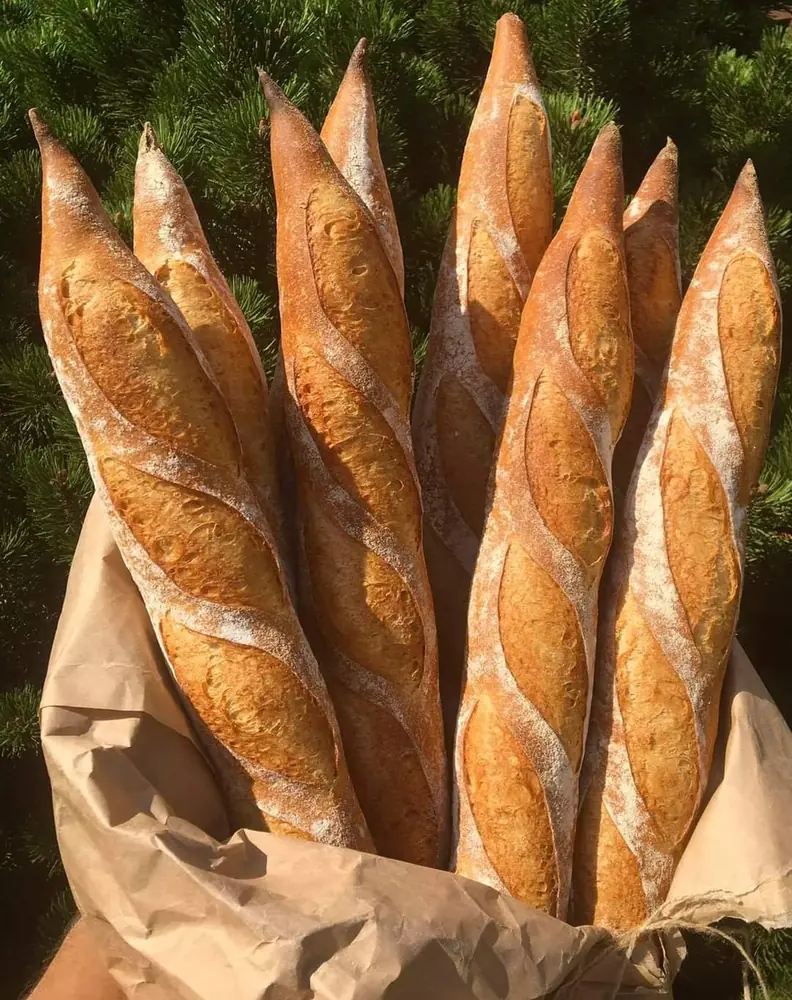
I want a deeply golden, thin crisp crust, a loaf that feels light for its size, clean lengthwise opening along the scores and an irregular but coherent crumb. The interior should be moist but not gummy, and the flavour should taste of fermented wheat rather than simply of yeast.
A baguette does not need enormous holes to be successful. Good fermentation, clean shaping, proper steam and a complete bake matter more than a dramatic cross-section photograph.
How does King Arthur Baking divide and refrigerate Slow-Rise Baguette dough?
At process stage 5 of King Arthur Baking’s Slow-Rise Baguettes recipe, divide the dough according to the number of baguettes required and place it in buckets. For example, King Arthur Baking specifies 8 kg of dough per bucket for 20 baguettes weighing 0.4 kg each. Cover and refrigerate the dough at 50°F for up to 18 hours.
What is King Arthur Baking’s Slow-Rise Baguettes formula?
King Arthur Baking’s published external Slow-Rise Baguettes formula—not Tanya’s recipe—uses the following complete total formula on a baker’s-percentage basis: King Arthur Sir Galahad Flour 100%, water 70%, salt 2% and fresh yeast 0.75%.
How does King Arthur Baking mix its Slow Rise Baguettes dough?
In its professional Slow Rise Baguettes formula, King Arthur Baking directs bakers to place all ingredients in the mixing bowl, mix for 700–800 dough-hook revolutions on first speed only, and leave the dough in the bowl while it is still underdeveloped.
How long is bulk fermentation in King Arthur Baking’s recipe?
In King Arthur Baking’s Slow-Rise Baguettes recipe, stage 3 of the process is a 1-hour bulk fermentation.
How long does King Arthur Baking final-ferment its Slow-Rise Baguettes?
In stage 7 of King Arthur Baking’s Slow-Rise Baguettes process, the final fermentation lasts 1.5 to 2 hours at 75°F.
What temperature and endpoint does King Arthur Baking specify?
King Arthur Baking’s professional Slow Rise Baguettes formula calls for normal steam and a baking temperature of 460°F until the bread develops a full, rich crust color. It recommends a full bake to ensure a crisp crust.
What dough temperature does King Arthur Baking specify?
For process stage 2 of its Slow-Rise Baguettes recipe, King Arthur Baking specifies a target dough temperature of 75°F in winter or 72°F in summer.