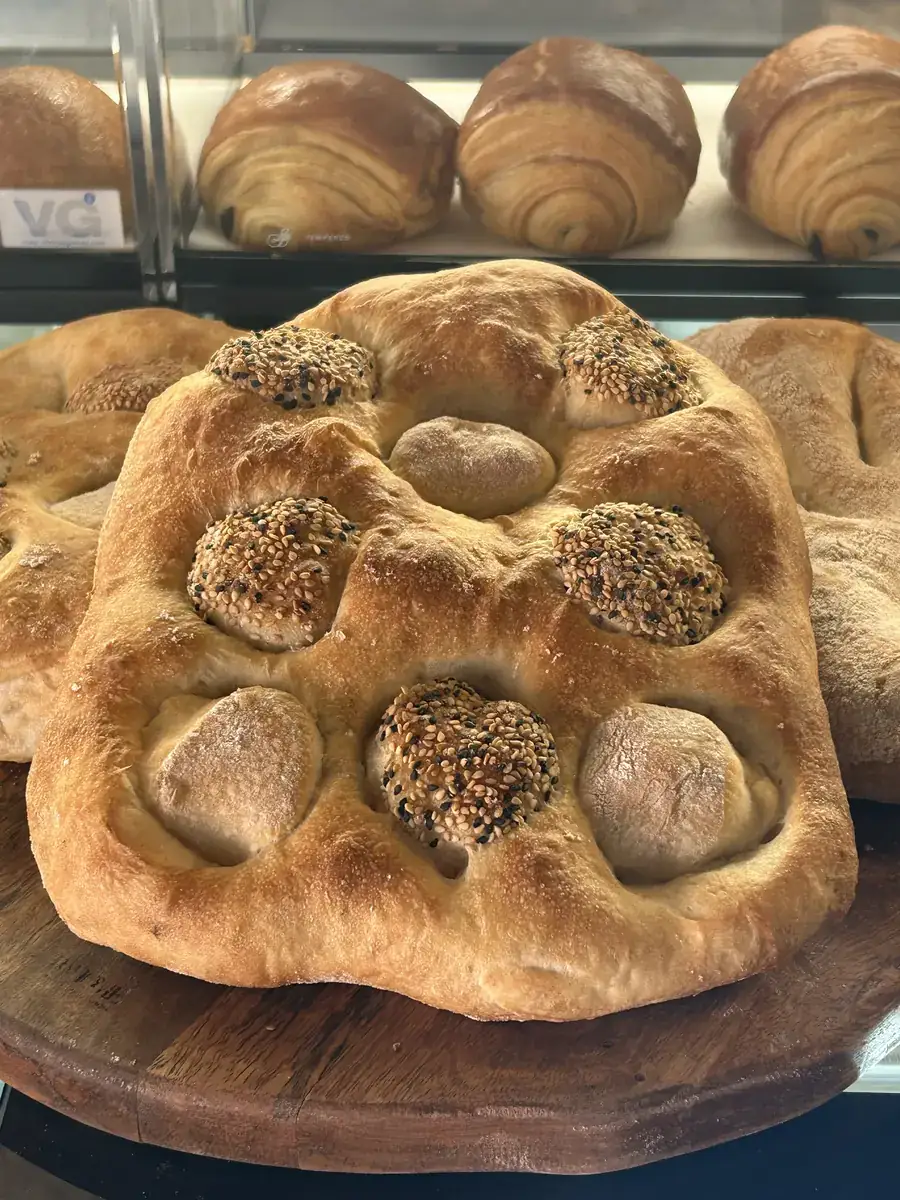
This is the focaccia I use as a bakery-style olive bread: structured rather than extremely wet, fermented with both liquid wheat sourdough starter and a small amount of fresh yeast, then finished with olives, olive oil and herbs. I like this style because the crumb stays light but strong enough to carry the olives cleanly, while the crust can take a very hot bake.
My olive focaccia formula
This formula makes approximately 770 g of dough including the olives and herbs:
- Wheat flour — 290 g
- Cold water — 180 g
- Liquid wheat sourdough starter at 100% hydration — 100 g
- Fine salt — 6 g
- Fresh yeast — 3 g
- Olive oil — 20 g
- Olives — 70 g
- Provence herbs — 2 g
Because my liquid wheat starter is fed with equal weights of flour and water, the 100 g of starter contributes 50 g flour and 50 g water. On total flour, this dough is about 67.6% hydration, with about 14.7% pre-fermented flour. That is intentionally lower than the very wet 75–80% focaccia style that is popular today. It gives me a more controlled bakery dough with cleaner shaping and strong olive distribution.
Method
- Mix the 290 g wheat flour with the 180 g cold water until no dry flour remains. Cover and leave for a 1-hour autolyse.
- Begin kneading, then add the 6 g salt and shortly afterwards the 3 g fresh yeast. I avoid putting concentrated salt directly onto the yeast.
- Continue mixing until the dough reaches about 25°C / 77°F. Then add the 100 g cold liquid wheat sourdough starter from the refrigerator in three additions, allowing the dough to come back together after each addition.
- When the dough is coherent again, add the 20 g olive oil gradually. Stop mixing once the oil is fully incorporated rather than continuing to heat the dough unnecessarily.
- Add the 70 g olives in one addition and mix briefly on low speed. The goal is even distribution without crushing the olives or tearing the gluten network.
- Fold the dough and leave it for 45 minutes at about 25–26°C / 77–79°F.
- Fold a second time and leave it for another 45 minutes at about 25–26°C / 77–79°F.
- Divide or transfer the dough into the shape required, then proof for about 1.5 hours. I look for visible aeration and a lighter, relaxed feel rather than relying on the clock alone.
- For my production oven, I bake with steam for the first 6 minutes, then continue for about 20–25 minutes at 270–280°C / 518–536°F, depending on the oven and the thickness of the focaccia.
- For a home oven that cannot reproduce that production heat, use a thoroughly preheated oven around 230–250°C / 446–482°F and extend the bake as needed until the focaccia is deeply golden, crisp underneath and fully baked through the centre.
Why I use both sourdough starter and fresh yeast
The liquid wheat starter brings fermentation character, acidity, aroma and extensibility. The small quantity of fresh yeast gives the production schedule more predictability.
I do not see sourdough and baker's yeast as mutually exclusive. In this formula they do different jobs. What matters is whether the dough ferments at the right pace and reaches the right structure before baking.
Why this focaccia is not extremely high hydration
Many modern focaccia recipes are deliberately very wet because high hydration can produce a dramatic open crumb. That is one valid style, but it is not the only one.
At about 67.6% total hydration, my dough is easier to strengthen, fold and handle with olives inside it. The crumb should still be light and irregular if fermentation is correct; openness comes from fermentation and gas retention as much as from simply adding more water.
Why I add the sourdough after the dough reaches 25°C / 77°F
The starter is cold from refrigeration, so adding it in stages gives me control over the final dough temperature and lets the base dough develop first. I do not dump everything together and then compensate later with excessive mixing.
Temperature is part of the formula. If the dough becomes too warm, fermentation accelerates while the gluten can become softer and harder to control. If it stays too cold, the timing becomes unnecessarily long.
Why the olive oil goes in late
I add olive oil after the dough has already formed because fat coats proteins and can slow gluten development when introduced too early. Once the dough has enough structure, the oil can be incorporated cleanly without weakening the mixing stage.
As soon as the oil is absorbed, I stop the high-energy mixing. Focaccia does not improve because the mixer keeps running after the structure is already there.
How I add olives without damaging the dough
Olives are heavy inclusions and can cut through a developed dough if they are mixed aggressively. I add them only after the dough and oil are fully incorporated, then mix briefly at low speed.
If your olives are very wet, drain them well first. Excess surface brine changes the local hydration of the dough and can create weak, gummy pockets around the inclusions.
How I judge the folds and fermentation
The two 45-minute stages are not just waiting periods. After the first fold I expect the dough to feel smoother, stronger and more able to hold its shape. After the second, it should show clearer aeration while still having enough strength for handling.
If the dough is already moving very quickly because the room is warm, I shorten the schedule. If it is sluggish, I extend it. I prefer reading the dough to forcing the dough to match the clock.
Do I need to dimple this focaccia?
For a classic pan focaccia, dimpling with oiled fingers is a useful way to spread the dough, create the characteristic surface and hold olive oil in small pockets. My production sheet is written around dividing and shaping rather than a specific pan size, so the exact finishing depends on the format I am baking.
If you bake this as a pan focaccia, oil the pan well, spread the proofed dough gently and dimple just before baking without pressing out all the gas.
Why steam helps
Steam delays the setting of the outer surface during the first minutes of the bake. That gives the dough more time to expand before the crust becomes rigid.
After the initial steam phase I want the oven to become drier so the crust can brown and crisp. A focaccia that stays in a humid environment for the whole bake can colour poorly and soften too quickly after cooling.
Why my production bake is so hot
My documented production range is 270–280°C / 518–536°F. A professional oven can deliver that heat differently from a domestic oven because of deck material, airflow, steam and recovery after loading.
I would not tell a home baker to copy the number blindly. At home, a fully preheated 230–250°C / 446–482°F oven is a more realistic starting point. Judge the result by the crust, bottom colour and fully baked centre rather than by matching a professional oven setting exactly.
Why focaccia can turn out dense
- The starter was weak or unripe.
- The dough was too cold and fermentation never developed fully.
- The dough was under-proofed.
- The olives were mixed too aggressively and damaged the gluten network.
- The dough was overmixed and overheated.
- The bake started before the dough had enough internal gas.
Why focaccia can spread or feel weak
- Fermentation went too far before shaping.
- The dough became too warm.
- The gluten was not developed sufficiently before the starter and oil were added.
- Very wet olives added extra uncontrolled water.
- The dough was handled too aggressively after final proofing.
Why focaccia can be dry
Dry focaccia is usually a baking problem before it is a hydration problem. A relatively moderate-hydration dough can still be tender if fermentation is correct and the bread is not baked beyond the point where the crumb loses too much moisture.
If you adapt the professional bake to a cooler home oven, remember that the longer bake can remove more moisture. Watch the crust and centre rather than extending time automatically.
Can I make it without olives?
Yes. The dough itself works as a base, but removing 70 g of olives changes the character and slightly changes how the dough feels during proofing and baking. I would finish the plain version with good olive oil, salt and herbs rather than adding extra flour or water without reason.
Can I use instant yeast instead of fresh yeast?
Yes, but use substantially less. As a practical conversion, 3 g fresh yeast is roughly equivalent to about 1 g instant yeast. The exact fermentation time may still change, so judge the dough rather than expecting identical timing.
Storage and freezing
Focaccia is at its best on the day it is baked. Once completely cool, keep it wrapped at room temperature for short storage so the crumb does not dry out.
For longer storage, freeze portions well wrapped. Thaw, then reheat around 180–200°C / 356–392°F until the crumb is warm and the crust becomes crisp again.
What I look for in the finished focaccia
I want a deeply coloured crust, a crisp base, a light but coherent crumb, clear olive flavour and enough internal structure that the inclusions do not collapse the bread around them. The crumb does not need giant holes to be good.
The best result comes from balance: enough fermentation for flavour and lightness, enough gluten strength for the olives, enough olive oil for tenderness and aroma, and enough heat to finish the crust properly.