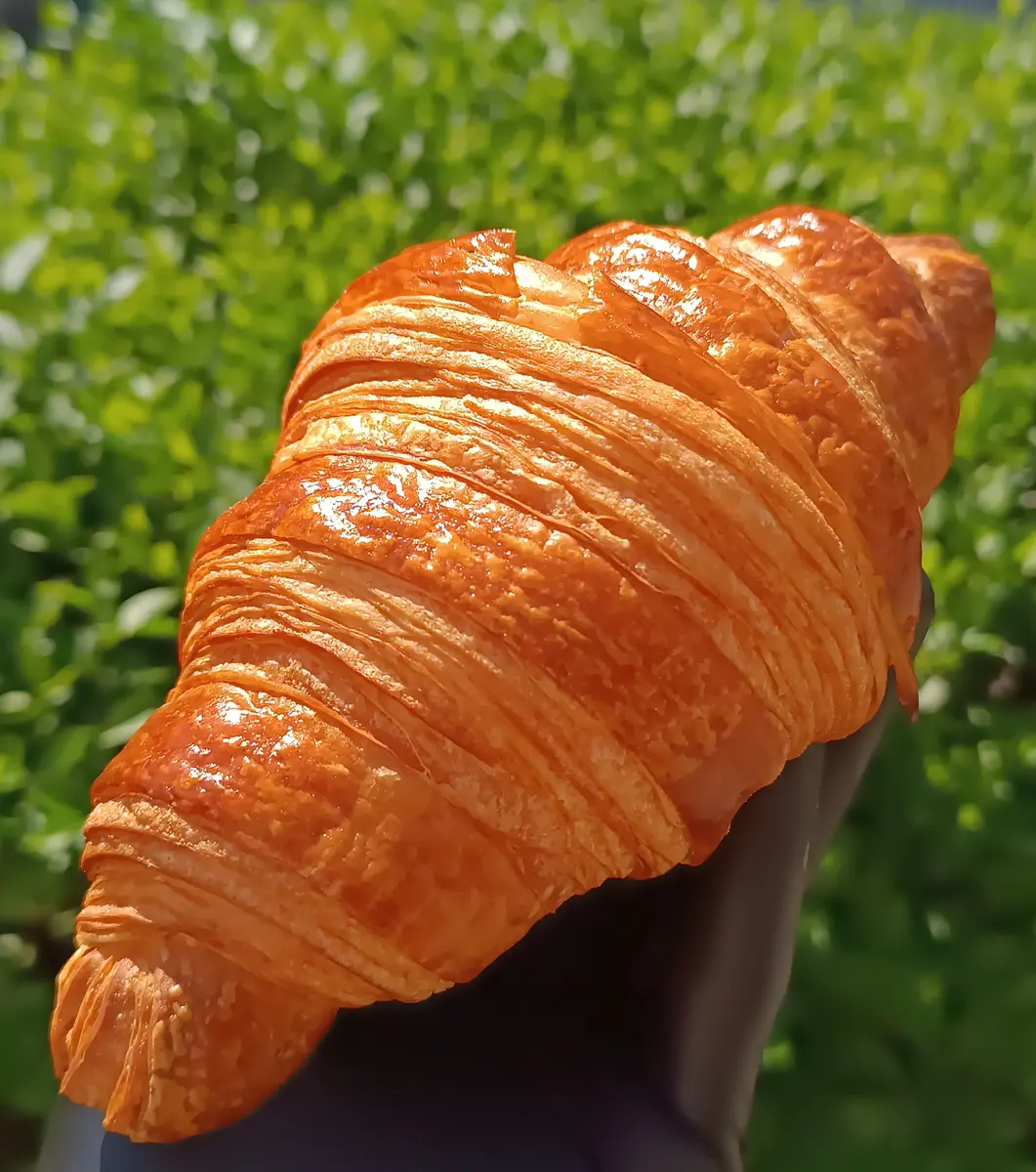
I judge a croissant by balance rather than by one dramatic feature. I want a crisp, deeply golden shell, clear laminated layers, a light elastic interior and butter that tastes clean rather than greasy. The real work is not simply adding more butter. It is keeping dough strength, butter plasticity, fermentation and rolling in balance from the first mix to the oven.
My croissant formula
For approximately 1.12 kg dough before egg wash:
- Strong white or baker's flour — 500 g
- Whole milk — 250 g
- Cold water — 40 g
- Granulated sugar — 55 g
- Fine salt — 10 g
- Fresh yeast — 15 g
- Unsalted butter in the dough — 25 g
- Unsalted cultured or high-fat butter for lamination — 225 g
- Egg wash — as needed
This is the formula I use here as a reliable classical reference. I keep the dough moderately enriched and reserve most of the butter for lamination. That gives me enough dough strength to hold distinct layers while still producing the tenderness and flavour I expect from a French croissant.
Method
- Mix the flour, milk, water, sugar, salt, fresh yeast and 25 g dough butter until the dough is coherent, smooth and moderately developed. I do not chase maximum gluten development at this stage because the dough still has to survive lamination without becoming excessively elastic.
- Flatten the dough into a rectangle, cover it and chill thoroughly. A short initial fermentation followed by an overnight cold rest gives the dough time to relax and makes the next day's lamination much easier to control.
- Shape the 225 g lamination butter into an even rectangle. It should be cold but plastic: it must bend under pressure without cracking, yet it must not smear or look oily.
- Lock the butter evenly inside the chilled dough and seal the packet neatly. The butter and dough do not need to be the same temperature, but they must have compatible firmness.
- Roll progressively into a long rectangle and give one simple turn. Brush away loose flour before folding. Chill whenever the dough resists or the butter begins to soften.
- Repeat until you have completed three simple turns in total, resting between turns as needed. I prefer controlled rolling to forcing the dough through a fixed schedule.
- After the final rest, roll the dough to approximately 2.5–3 mm. Keep the sheet even from centre to edges.
- Cut clean triangles with a sharp blade. Stretch only very gently if needed, then roll from the base toward the tip without compressing the layers. Place the tip underneath so the croissant does not unroll in the oven.
- Proof until the croissants are visibly expanded, aerated and delicate. A practical proofing environment is around 26–28°C / 79–82°F, but I stay toward the cooler end whenever the butter begins to look too soft. Do not use time alone as the deciding test.
- Brush gently with egg wash without flooding the cut laminated edges.
- Bake at approximately 200–210°C / 392–410°F in a conventional oven or 190–200°C / 374–392°F with fan, adjusting for size and oven behaviour. Bake until deeply golden and crisp, with the internal structure fully set rather than merely pale and expanded.
- Cool on a rack before judging the crumb. The centre continues to release steam and set during the first minutes after baking.
Why butter plasticity matters more than a single temperature
I do not treat butter temperature as a magic number because two butters can behave very differently at the same temperature. What matters is plasticity. The butter must deform at roughly the same rate as the dough around it.
If the butter is too cold, it fractures into plates and pieces. If it is too warm, it smears into the dough. Both destroy the continuous layers that later create lift.
How many turns should croissant dough have?
For this formula I use three simple turns as a clear classical reference. That gives a controlled layer structure without requiring an unnecessarily complicated sequence.
The number of turns is only useful if the layers remain intact. Three perfect turns are more valuable than extra turns made while the butter is breaking or smearing.
Why I rest the dough between turns
Resting has two jobs. It lets the gluten relax so the dough can be rolled evenly, and it brings the butter back into a safe working condition before the next pass.
When dough keeps springing back, I do not force it. Excessive pressure compresses layers, distorts thickness and often makes the final crumb less open rather than more refined.
How thin should croissant dough be before shaping?
I use approximately 2.5–3 mm as a practical final thickness. Much thicker dough can produce a heavy centre; excessively thin dough is easier to over-compress and can lose the strength needed to hold fermentation gases.
Uniformity matters as much as the number itself. Uneven thickness gives uneven proofing and baking, so I watch the entire sheet rather than only measuring one edge.
How I know croissants are proofed
I look for volume, lightness and movement. Properly proofed croissants are visibly larger, the laminated ridges look expanded rather than tight, and the tray has a gentle wobble when moved.
Under-proofed croissants tend to burst, crack and leak butter aggressively in the oven. Over-proofed croissants feel fragile, spread easily and lose the structural reserve needed for a clean oven spring.
Why I do not proof croissants too warm
High proofing temperature may speed fermentation, but it can soften the butter faster than the dough structure can support it. Once butter migrates into the dough, the lamination damage cannot be repaired in the oven.
I therefore prefer a slightly cooler, longer proof to pushing the dough with aggressive heat. The correct endpoint is more important than the fastest schedule.
Why croissants bake flat
Flat croissants usually point to an earlier process problem rather than to one final mistake. I check dough strength, butter condition, rolling pressure and proofing before changing the oven.
- Dough too weak to hold the laminated structure.
- Butter smeared into the dough during lamination.
- Layers compressed by excessive rolling pressure.
- Croissants over-proofed before baking.
- The shaped dough became too warm and lost definition.
Why butter leaks during baking
Large pools of butter are a warning sign, but they do not automatically mean the oven is too hot. The damage often happened earlier.
- Butter shattered during lamination and created discontinuous layers.
- Butter became too soft and was absorbed into the dough.
- Croissants were under-proofed and expanded too aggressively in the oven.
- Proofing temperature was high enough to weaken the butter layers.
- The baking profile was poorly matched to the croissant size.
Why there is no open honeycomb
A good croissant does not need cartoonishly large holes, but it should show clear laminated structure and a light interior. I judge the crumb together with eating quality rather than chasing a photograph.
- Butter smeared into the dough.
- Layers were compressed by rolling.
- Fermentation was weak.
- Final proof was incomplete.
- The dough was shaped too tightly.
- The final sheet thickness was poorly matched to the formula.
Why croissants crack on the surface
Surface cracking most often tells me the shaped dough went into the oven with too much internal tension or too little proof. A dry skin during proofing can make the problem worse.
- Under-proofing.
- Surface drying.
- Shaping with excessive tension.
- Dough rolled too tightly.
Can I freeze croissants?
Yes. For home production I prefer freezing after shaping and before the final proof. Freeze the shaped croissants quickly and well covered, then thaw slowly under refrigeration before completing the final proof.
Baked croissants also freeze well. Cool completely, wrap airtight and freeze. Reheat briefly in a moderate oven after thawing to restore crispness rather than microwaving, which softens the laminated shell.
Croissant vs puff pastry
Both are laminated, but croissant dough is fermented and contains yeast, sugar and a small amount of enrichment in the dough itself. Puff pastry relies mainly on steam between dough and butter layers for expansion.
That means croissant quality depends on fermentation and proofing as well as lamination. Perfect folds cannot compensate for weak fermentation, and a perfect proof cannot repair destroyed butter layers.
What I look for in the finished croissant
I want an even deep-golden colour, crisp outer layers, visible separation through the sidewalls and a centre that feels light for its size. The crumb should be elastic and clearly laminated rather than cakey or bread-dense.
The best croissant is not the one with the largest single cavity. It is the one in which dough strength, fermentation, butter and baking feel integrated from the first bite to the last.