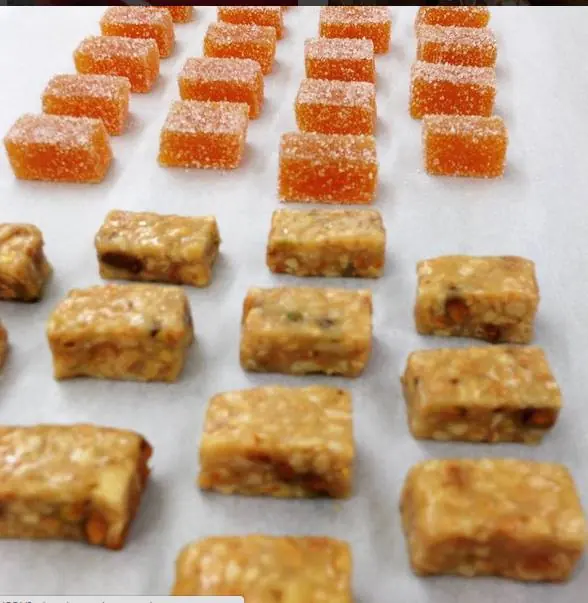
Fruit gels look simple, but the texture of a fruit layer depends on several decisions: which gelling agent you choose, how acidic the fruit is, how much soluble solid is present, how the gel is heated and cooled, and what texture you want in the finished dessert.
The first question is not ‘Which gelling agent is best?’ It is ‘What texture and behaviour does this layer need?’
Pectin
Pectin is especially useful for fruit preparations because it works naturally with the acidic, water-rich environment of fruit. But pectin is not one single ingredient with one universal method.
High-methoxyl pectin typically needs the right combination of acidity and soluble solids to form a gel. Low-methoxyl pectin can form gels through calcium-mediated cross-linking and may work in lower-sugar systems. Different commercial pectins are therefore not interchangeable simply because they share the same name.
In professional pastry, I choose the pectin by the required texture: soft insert, cuttable gel, glaze, confit or low-sugar fruit layer.
Gelatin
Gelatin produces a soft, elastic gel that melts readily in the mouth. It is useful when I want a delicate texture rather than a firm, brittle cut.
Its final strength depends on concentration, bloom strength, temperature history and the rest of the formulation. For mousse cakes, gelatin can be effective when the fruit insert should remain tender and integrate smoothly with creams or mousses.
Agar
Agar produces a firmer, more brittle gel and generally sets at a higher temperature than gelatin. It can be useful for clean cuts and certain fruit preparations, but its texture is quite different from the elastic softness of gelatin.
Agar is not simply a vegan substitute for gelatin in a one-to-one sense. Substituting one for the other changes the eating experience, set temperature and handling.
How fruit changes the result
Fruit is not a neutral liquid. Different fruits bring different levels of acidity, natural pectin, sugars, minerals, fibre and suspended solids. Raspberry purée and mango purée therefore do not behave identically in the same formula.
Acidity matters particularly in pectin systems. A professional recipe must be designed around the specific pectin and fruit rather than around a generic grams-per-kilo rule.
Fruit gel, confit, glaze and insert are not the same job
The terms are often used loosely, so I separate them by function before I choose the hydrocolloid. A fruit gel is the broad technical category: fruit is given a controlled gelled structure with pectin, gelatin, agar or another suitable system.
A fruit confit is usually a concentrated fruit preparation in which fruit solids, sugar, acid and often pectin are balanced for a spoonable or cuttable texture. I want it to remain recognisably fruit-forward rather than eat like a rigid jelly.
A glaze has a different job. It must spread or pour at the application temperature, form a thin continuous coating and keep an attractive surface after setting. A formula that makes an excellent 10 mm insert can be completely wrong as a glaze because thickness, flow and final bite are different.
An insert describes where and how the fruit preparation is used, not one specific gelling chemistry. An entremet insert may be a gel, confit or combined pectin–gelatin system. I design it for its real thickness, freezing, unmoulding, thawing, cutting and interaction with the surrounding mousse, crémeux or sponge.
This distinction prevents one of the easiest pastry mistakes: finding a successful fruit preparation and transferring its pectin percentage to a different job simply because both are called gel.
The controls I use after choosing pectin
Once I choose a pectin system, I stop treating dosage as the only control. I record the exact pectin product, because Pectin NH, Pectin Jaune and other commercial pectins can require different soluble-solids, acidity, calcium and process conditions.
I measure pH when acidity affects the selected system, and I keep that separate from taste. I also track Brix or the relevant soluble-solids endpoint when concentration is part of the gel mechanism. A low pH cannot compensate for the wrong solids, and a correct Brix cannot repair pectin that was clumped or incompletely hydrated.
For a frozen insert I validate the complete thermal cycle. A preparation can set beautifully in the refrigerator and still release water, soften or change its cut after freezing and thawing. I therefore test the real layer thickness and judge it again at serving temperature.
Choosing the system
These are starting points, not universal rules. The final decision depends on the fruit, sugar level, acidity, storage conditions and the dessert around it.
- For a soft, melt-in-the-mouth insert: gelatin may be appropriate.
- For a fruit-forward, cuttable or glaze-like texture: the correct pectin is often preferable.
- For a firmer, more brittle plant-based gel: agar can be useful.
Common mistakes
Using the wrong pectin type is one of the most common failures. Another is treating all fruits as if their acidity were the same. Overdosing agar can create an unpleasantly brittle gel, while too much gelatin can produce a rubbery texture. With any hydrocolloid, more is not automatically better.
How I choose the gelling system
I design the fruit layer from the eating experience backwards. Should it melt into the mousse? Should it hold a clean slice? Should it remain spoonable? Should it withstand freezing and thawing? Once that is clear, the choice of gelling system becomes much easier.
Choose by texture and service
A good fruit gel should taste first of fruit, not of the technology used to hold it together. The gelling agent is there to create the right structure while interfering as little as possible with flavour and mouthfeel.