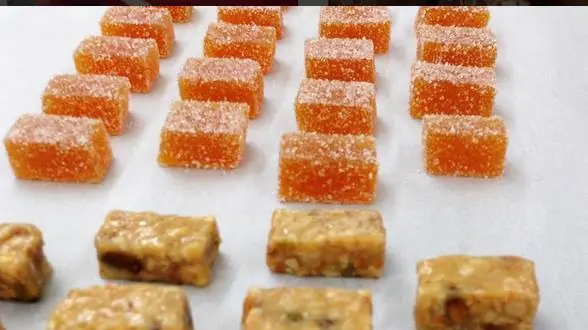
Pectin Jaune, or yellow pectin, is the pectin I associate most strongly with pâte de fruit, moulded fruit confectionery and firm fruit fillings. It is designed to set in an acidic preparation with a high concentration of soluble solids.
It is not a general-purpose pectin for every fruit gel. Its sugar, acidity, temperature and process requirements are part of the structure, so I choose it only when the finished product needs the firm, stable and non-remeltable character this system creates.
What Pectin Jaune is
Sosa describes its Yellow Pectin as a high-methoxyl pectin with retardant salts. High-methoxyl pectin forms a gel when sufficient soluble solids reduce available water and the pH is brought into the appropriate acidic range.
The retardant system gives the pastry chef enough working time to cook, acidify, deposit or mould the preparation before the network becomes fully established. The exact blend belongs to the commercial product, so I keep the supplier name attached to the recipe.
What it is used for
These applications share a concentrated fruit-and-sugar environment. A soft mousse insert or low-sugar glaze may need a different pectin family.
- Pâte de fruit with a clean, firm cut.
- Moulded fruit jellies and confectionery.
- High-solids jams or fruit preparations designed around HM pectin.
- Bake-stable fruit fillings when the selected product is specified for that use.
- Fruit layers that must remain stable rather than remelt during service.
The Sosa working specification
For its Yellow Pectin, Sosa publishes a dosage of 1–2%, total soluble solids above 55%, a suitable pH of 3.1–3.8 and a recommended activation temperature of 90°C. It instructs the user to mix the pectin with sugar, incorporate it into the fruit under strong agitation, bring the preparation to the boil and add the acid at the end.
Those values describe the current Sosa product, not every yellow pectin sold by every manufacturer. If I change supplier, I verify the new technical sheet and run a test rather than copying the old numbers.
Why soluble solids matter
A refractometer reading is more useful than cooking time alone because water loss changes with pan geometry, batch size, heat input and evaporation. The pectin network needs the correct concentration; a batch can boil vigorously and still be below its target solids.
Sugar is not present only for sweetness. In an HM-pectin system it helps control water availability and enables gel formation. Reducing sugar without redesigning the pectin system can leave the product weak even when the pH appears correct.
Why acidity matters
Acid brings the pectin chains into the condition required for the concentrated system to gel. If the preparation is not acidic enough, the network may remain weak. If acid is added too early, the batch may begin setting before cooking and depositing are complete.
Fruit acidity varies naturally by type, origin and ripeness. I measure and adjust the complete formula instead of assuming that every raspberry, apricot or mango purée contributes the same pH.
Why I add acid at the end
Sosa specifies acid addition as the final step after cooking. This preserves working time: the pectin can hydrate and the batch can reach its solids target before acidity completes the gel conditions.
Once acid is incorporated, I work efficiently. The preparation should move directly to the frame or mould because cooling and gel development reduce the time available for clean depositing.
How I disperse Pectin Jaune
Adding pectin directly to wet fruit creates fish-eye lumps: the outside hydrates while dry powder remains trapped inside. A proper dry blend prevents this more reliably than aggressive blending later.
- Weigh the pectin, fruit, sugars and acid solution accurately before cooking.
- Dry-blend the pectin thoroughly with part of the sugar.
- Create strong movement in the fruit base before adding the dry blend.
- Rain the mixture in gradually so each particle can disperse separately.
- Continue agitation while heating to the activation conditions specified for the product.
- Cook to the formula's measured soluble-solids target.
- Add the prepared acid solution at the final stage, mix uniformly and deposit immediately.
Temperature and activation
The pectin must hydrate and activate before the final gel can form. Sosa recommends 90°C activation for its product, while the final gel temperature depends on pH and sugar concentration.
I do not use temperature as the only endpoint. Heat activates and concentrates the preparation, but soluble solids and pH decide whether the formula has reached its intended balance.
Why the set is thermo-irreversible
Sosa classifies its Yellow Pectin gel as thermo-irreversible. Once the network forms, reheating does not return it to the original fluid state in the way a thermoreversible nappage can be remelted and reset.
That stability is useful for confectionery and bakeable fillings, but it also means a prematurely set batch cannot simply be warmed back to perfect working condition. Process organisation is part of the recipe.
Pectin Jaune versus Pectin NH
Pectin NH is commonly selected for fruit nappages, confits and inserts where a softer, thermoreversible set and freeze-thaw handling are valuable. It works in a different balance of sugar, acidity and calcium depending on the specific product.
Pectin Jaune is chosen for high-solids, acidic preparations such as pâte de fruit and creates a firmer, non-remeltable structure. They are not interchangeable at the same weight.
Pectin Jaune versus Pectin X58
Pectin X58 is designed for calcium-rich and often dairy, chocolate, caramel or nut-based glazes and creams. It is commonly thermoreversible and suited to formulations in which available calcium is central.
Pectin Jaune belongs to the high-sugar, acidic fruit-confectionery system. Substituting X58 changes the gelling mechanism, the process and the finished texture.
Pectin Jaune versus gelatin and agar
Gelatin produces a soft elastic gel that melts readily in the mouth. Agar produces a firm, more brittle gel with its own activation and setting behaviour. Neither recreates the concentrated fruit texture of a classic HM-pectin pâte de fruit.
A replacement is therefore a reformulation, not a conversion ratio. I decide first whether the product should be chewy, tender, brittle, meltable or bake-stable, then choose the gelling system.
Can I reduce the sugar?
Not by simply removing sugar from a Pectin Jaune formula. Lowering soluble solids changes the mechanism that allows HM pectin to set and also changes water activity, flavour, yield and shelf behaviour.
For a genuinely lower-sugar product, I choose a pectin system intended for lower soluble solids and develop the recipe around that system. I do not ask Yellow Pectin to work outside its designed environment.
Can Pectin Jaune be baked or frozen?
Sosa specifies its Yellow Pectin as bakeable and highly resistant to freezing. Those properties can make it useful for stable fruit fillings and production that includes frozen storage.
I still test the complete product. Fruit fibre, free water, sugar crystallisation and the surrounding pastry can change during baking or freeze-thaw even when the pectin network remains intact.
Why the pâte de fruit does not set
- The soluble-solids target was not reached.
- The pH remained outside the product's working range.
- Pectin was underdosed or weighed against the wrong total batch mass.
- Dispersion or hydration was incomplete.
- Acid was omitted, incorrectly prepared or unevenly mixed.
- The formula was changed to a lower-sugar version without changing pectin systems.
Why it sets in the pan
Premature setting usually means the gelling conditions arrived before the batch was deposited. Acid may have been added too early, the batch may have cooled, or the actual balance of pH and soluble solids may be more reactive than expected.
I prepare frames, moulds and tools before the acid step. Once the final conditions are established, searching for equipment costs the clean working window.
Why the texture is too firm or rubbery
Excess pectin, excessive final concentration or an unsuitable sugar-acid balance can create a heavy texture. More gel strength is not automatically better: pâte de fruit should cut cleanly while still releasing fruit flavour.
I compare the recorded Brix, pH, pectin weight and final yield before changing several variables. Correct diagnosis preserves reproducibility.
Why water leaks from the gel
Syneresis can indicate an unbalanced network, incorrect pH, poor hydration or a formula whose fruit, sugar and pectin are incompatible. Storage temperature and condensation can make the surface problem appear worse.
I evaluate both the gel and its storage conditions. Adding more pectin without understanding the cause can make the texture firmer while the water problem remains.
Can I substitute another yellow pectin?
Possibly, but only after comparing supplier specifications. Two bags carrying a similar name can contain different retardant systems and recommend different doses, solids or acidity.
For production, the ingredient line in my formula includes the manufacturer and product reference. If either changes, I verify activation, working time, set and storage before approving the substitution.
My final rule
I choose Pectin Jaune when I intentionally want a concentrated, acidic, firm fruit gel such as pâte de fruit. I control it through accurate weighing, good dispersion, measured soluble solids, measured acidity and efficient depositing after the final acid addition.
The pectin does not replace process control. When sugar, pH, temperature and timing are designed together, the gel supports a clear fruit flavour instead of becoming merely hard or sweet.