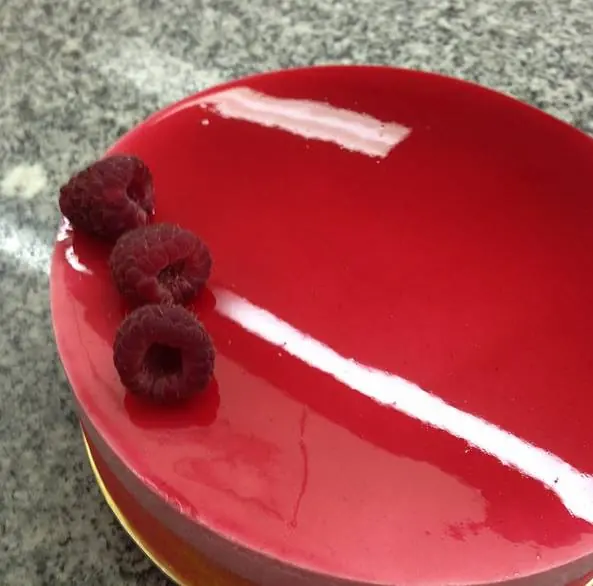
Yes, mirror glaze can often be cooled, stored and warmed again. But I do not treat every leftover glaze as automatically reusable.
The first question is not how many days it has been in the refrigerator. I ask where the glaze came from. A clean portion that never touched the cake, rack or tray has a very different history from glaze collected after the pour.
First: clean reserve or tray runoff?
If I know that I will have extra glaze, I pour a clean reserve into its own container before glazing the cake. That portion has not touched condensation, cake crumbs, mousse, the rack, my scraper or the work surface. It is the best candidate for controlled storage and reuse.
Tray runoff is different. It may look perfectly clean, but it has passed over the cake and production equipment. It may contain water from condensation, crumbs or traces of other components. I never pour it straight back into the clean reserve and pretend that nothing changed.
In a tightly controlled professional setup, runoff may be collected separately and assessed under the kitchen's food-safety plan. At home, or whenever its history is uncertain, the safer decision is not to reuse it.
How I store a clean reserve
I transfer it to a clean, food-safe container, cover it and label it with the batch date, formula and exact products. I do not leave a deep jug of warm glaze on the bench for hours.
General FDA guidance says foods requiring refrigeration should be refrigerated within two hours and kept at 4°C / 40°F or below. That is the baseline I follow while the glaze's own validated shelf life is still unknown.
Covering matters for quality as well as hygiene. It protects the glaze from refrigerator odours, surface drying and accidental contamination. If I use film, I place it directly on the surface only when the film is suitable for food contact and the glaze has cooled enough for that material.
How long does mirror glaze keep in the refrigerator?
I do not treat this glaze as shelf-stable simply because it contains a large amount of sugar. It also contains water and condensed milk, and different neutral glazes behave differently. I label every reserve with its production date and keep its full temperature and handling history.
A defensible shelf life belongs to the complete product and process: ingredients, water activity, possibly pH, heating, hygiene, packaging, refrigerator temperature and the way it is handled after opening. A general leftovers chart cannot validate this particular glaze.
Until that work is done, I use a conservative kitchen rule, keep the cold chain documented and do not sell a guessed number as scientific fact. If the glaze is for commercial production, the shelf life should be set through the applicable local food-safety system and product-specific validation.
Can I freeze it?
Freezing can be useful when the clean reserve will not be needed soon, but I treat it as a quality test, not a promise that every mirror glaze freezes equally well. The exact chocolate, gelatin and neutral glaze can change what happens after thawing.
I freeze a small labelled sample in a shallow airtight container. I record the condition before freezing, then thaw it in the refrigerator. I do not thaw it for hours on a warm counter: the outside warms long before the centre, and the uncontrolled temperature history makes both quality and safety harder to judge.
After thawing, I look for free water, separation, a rubbery mass, graininess or an unusual surface. Then I warm and re-emulsify it, pour it over a test surface and compare the flow, opacity, shine and set with a fresh or refrigerated control. That complete test tells me more than a smooth appearance in the container.
How I reheat mirror glaze
I warm it gently and evenly. The goal is to restore fluidity, not to boil it again. Aggressive heat can create hot spots, evaporate water at the surface and make the glaze harder to reproduce.
I stir between short, controlled heating intervals so the warm edges and cooler centre become one temperature. If the glaze needs blending, I use a tall narrow container, keep the blender head fully submerged and avoid a vortex. Reheating is a common moment to introduce the microbubbles that later make the finish look hazy.
Before pouring, I check the ribbon rather than trusting one universal temperature. It should flow continuously, cover without becoming transparent and level before it sets. The correct working window still depends on the exact chocolate, neutral glaze and gelatin strength.
Should I add water if reheated glaze is too thick?
Not automatically. A cold glaze can look too thick simply because the gelatin and fat are firm. I warm it evenly first and reassess.
If it remains heavy at its normal working condition, I check its history. Was it heated uncovered? Was it boiled again? Was a different chocolate, neutral glaze or gelatin used? Adding water may loosen the glaze, but it also changes concentration, opacity, setting and food-safety characteristics. It is a formulation correction, not a harmless shortcut.
How many times can I reheat it?
I do not use a fixed number as a guarantee. One careful cycle and three badly controlled cycles are not equivalent.
Each cycle creates another chance for contamination, evaporation, local overheating and added air. It also makes the batch history harder to reconstruct. In production I portion the clean reserve before storage so I warm only what I expect to use.
I record every thaw and reheat. If I cannot say how long the glaze has been out, how it was handled or how many cycles it has completed, I do not use it on a customer's cake.
A separated glaze is not automatically spoiled—but it has not passed
Some separation after cold storage may be a physical emulsion problem and can sometimes improve with gentle warming and careful blending. That does not prove the glaze is safe, and it does not prove that it will give a good finish.
Odour and appearance can identify obvious spoilage, but they cannot detect every food-safety hazard. I discard glaze with mould, an unexpected fermented smell, gas, contamination or an unknown temperature history. When I am uncertain, I do not taste it to decide.
My small reuse test
- Confirm that the glaze is a clean reserve with a known batch history.
- Check the date, storage temperature and exact products on the label.
- Thaw under refrigeration if frozen.
- Warm gently, stir between intervals and avoid boiling.
- Re-emulsify only if needed, with the blender head submerged.
- Check for separation, unusual odour, gas, mould or contamination.
- Test the ribbon, coverage, opacity, leveling and shine on a small frozen surface.
- Use only the portion required; keep unused clean reserve separate from tray runoff.
What I still need to validate for this formula
- The exact chocolate product.
- The exact neutral glaze and its manufacturer guidance.
- The Bloom strength and sheet grade of the 22.5 g leaf gelatin.
- Water activity and any other safety controls required for the intended production.
- A defined refrigerator shelf life under the real packaging and hygiene process.
- Freeze–thaw quality over the intended storage period.
- The maximum reheating history that still gives an acceptable ribbon, opacity, shine and set.
The short answer
Store only a clean, labelled reserve as a controlled batch. Refrigerate promptly at 4°C / 40°F or below, or freeze a small portion only after deciding how it will be tested. Thaw in the refrigerator, warm gently, blend without air and judge the glaze on a test pour.
Never mix tray runoff into the clean reserve. If I cannot confirm when a batch was made, how cold it remained or how it was handled, I discard it.