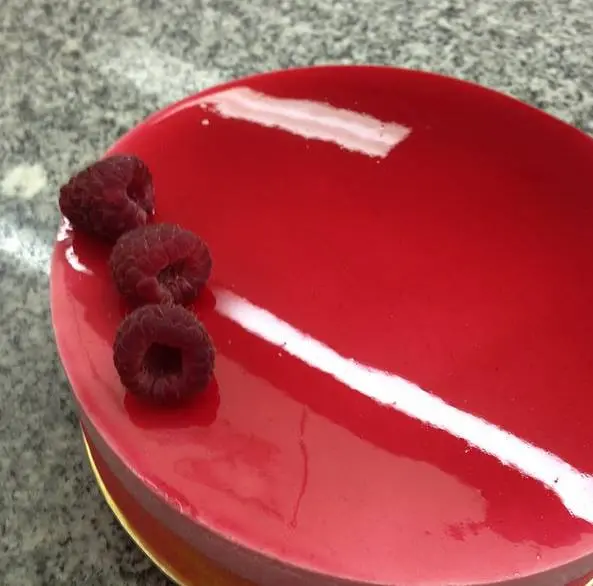
When a mirror glaze looks dull, I first ask when the shine disappeared. A glaze that is already dull in the jug has a different problem from one that looks glossy after pouring and becomes cloudy during thawing.
That timing is the fastest diagnostic tool. It tells me whether to inspect the glaze itself, the frozen surface, the pour or the conditions after glazing.
What creates the mirror effect
A mirror finish needs a continuous, smooth surface. Light reflects cleanly when the glaze has leveled without ridges, bubbles, droplets or roughness. The effect is strengthened by even colour and sufficient opacity underneath the reflection.
Shine is therefore not supplied by one magic ingredient. It is the visible result of formula, emulsion, surface preparation, flow and storage working together.
If the glaze is already dull in the jug
I inspect it for foam, microbubbles, graininess or separation. Fine air can make a glaze look lighter and less clear even before it reaches the cake. An incomplete or damaged emulsion can also prevent a uniform surface.
I blend calmly with the head submerged and without a vortex. If the glaze has been heavily aerated, I do not assume that longer blending or straining will restore the original finish.
If it is glossy in the jug but dull on the cake
Then I examine the cake and the moment of the pour. Mirror glaze reproduces the surface below it. Small waves, unmoulding marks, frost or a rough mousse finish remain visible through the coating.
I also check viscosity. A glaze that is too thick cannot level completely and leaves fine texture or ridges. A glaze that is too thin may give weak colour and insufficient visual depth. Both can reduce the mirror effect for opposite reasons.
Microbubbles can remove shine without looking like large bubbles
Large bubbles are obvious. Very small bubbles may appear only as a hazy or satin surface. They break the visual continuity of the coating and scatter the reflection across thousands of tiny points.
This is why the instruction to blend without adding air is not merely cosmetic. The glaze can look smooth from a distance and still lose clarity because of microbubbles introduced in the jug.
A thick glaze can look smooth but not reflective
When the glaze is marginally too cool or too strongly gelled, it may cover the cake without leaving dramatic ridges. Yet it can retain a faint surface texture because it stopped moving before it became completely level.
I look at the ribbon immediately before pouring. If gentle warming restores clean self-leveling, temperature was probably the main cause. If it remains heavy, I investigate gelatin strength, chocolate, neutral glaze and syrup concentration.
Condensation can make a correct glaze turn dull
A freshly glazed cake may look excellent and then lose shine as it thaws. In that case I look for moisture. Warm humid air meeting the cold surface can create droplets or a fine water film over the glaze.
The coating may still be structurally correct, but the water changes what the eye sees. I thaw the cake slowly under refrigeration and control the move into warmer air instead of treating this as a formula failure.
The exact chocolate and neutral glaze matter
My formula contains 225 g chocolate and 90 g neutral glaze. Changing either product can alter colour, opacity, flow and surface character. Two glazes made to the same gram weights are not necessarily visually equivalent when the products differ.
I record the exact products used in a successful batch. If the finish changes after a substitution, I test that substitution rather than adjusting several other ingredients at once.
Repeated reheating is a clue, not an automatic explanation
When a glaze has been cooled, warmed and blended several times, I note that history. Repeated handling can introduce air, create local overheating or change concentration if the glaze is left uncovered and heated aggressively.
I do not claim that every reheated glaze must be dull. I compare it with a controlled batch and record the actual handling before deciding that reheating was responsible.
Storage and physical contact after glazing
A reflective finish is easily marked. Fingers, a box side, plastic film or a decoration dragged across the surface can create local dull patches even when the glaze itself is correct.
I give the cake enough clearance, avoid covering material that touches the glaze and place the chocolate decoration deliberately. A handling mark is not repaired by changing the next batch's formula.
Can I polish or reglaze a dull cake?
I do not polish mirror glaze with oil or water. That creates another surface layer, changes the appearance temporarily and may affect flavour or handling.
A second coat can make the cake heavy, overly sweet and visually thick. I would only reglaze after a controlled test confirms that the new layer will adhere and remain thin. For production, correcting the original cause is usually more reliable than building another coat over the defect.
A quick diagnosis in the kitchen
- Dull in the jug: inspect microbubbles, foam, graininess and emulsion.
- Glossy in the jug but dull immediately on the cake: inspect cake smoothness and glaze viscosity.
- Glossy after pouring but dull during thawing: investigate condensation and the move into warmer humid air.
- Only touched areas are dull: diagnose handling or contact with packaging and decoration.
- The finish changed with a new chocolate or neutral glaze: compare the exact products before altering the formula.
- The surface is satin with faint texture: check whether the glaze set before fully leveling.
What I record
- Whether the glaze was glossy before pouring.
- Visible bubbles, foam, graininess or separation in the jug.
- The ribbon and temperature immediately before the pour.
- The smoothness and dryness of the frozen cake.
- Exact chocolate, neutral glaze and gelatin specification.
- When the dullness appeared: immediately, during thawing or during service.
- Room temperature, humidity and any physical contact with the surface.
The short answer
If the glaze starts dull, inspect air and emulsion. If it becomes dull on the cake, inspect surface smoothness and viscosity. If it loses shine later, investigate condensation, storage and handling. The time at which the shine disappears usually points to the correct branch of the diagnosis.