My working sequence
- Assemble only with components already validated for freezing and thawing.
- Place the cake level on a rigid freezer-safe tray and begin freezing without an avoidable delay.
- Freeze until the centre—not only the surface—is completely solid.
- Protect the frozen cake from drying, odours and temperature cycling without placing wrapping against a delicate surface.
- Unmould and apply the mirror glaze while the cake is fully frozen.
- Transfer the finished cake to refrigeration on a level board, protected from contact and strong airflow.
- Thaw completely under refrigeration at 5°C / 41°F or below as a conservative food-safety boundary, subject to the applicable local HACCP plan.
- Judge texture, cut and stability only at the validated chilled serving condition.
Freezing an entremet is not simply storage between assembly and service. It is part of the method. The mousse must set, the insert must remain cohesive, the interfaces must stay closed and the water released during thawing must remain controlled inside each component.
I therefore validate one complete route: assembly, freezing, frozen storage, unmoulding, glazing, refrigerated thawing and service. A component that looks perfect before freezing has completed only the first part of the test.
The cake system this method must protect
Each layer responds differently to ice, temperature and water movement. The mousse can lose volume, the fruit gel can purge, the crémeux can become grainy or greasy, the sponge can absorb moisture and the Feuilletine can lose its crispness. The method has to preserve the composition, not only keep the outside cold.
- Dark-chocolate and tonka mousse forming the outside wall
- A completely frozen insert of mango–passion fruit gel, milk-chocolate crémeux and chocolate sponge
- A chocolate-bound Feuilletine crunch closing the base
- Mirror glaze applied to the completely frozen cake
- Tempered-chocolate decoration added before the documented refrigerator thaw
Before freezing: prepare the freezer, not only the cake
I prepare the ring, rigid tray and freezer space before the mousse is finished. The assembled cake should not wait on the bench while I rearrange shelves or search for a level surface.
The tray must stay flat and allow the ring to remain level. I do not crowd a newly assembled cake between warm products or block the airflow of the equipment. Freezer load and recovery after the door closes belong in the production record.
A blast freezer and a domestic or static freezer do not produce the same freezing curve. I do not transfer a time from one machine to another and call it a specification.
What completely frozen means
A firm surface is not proof that the centre is frozen. The insert is the slowest and most important part of this geometry: it contains several dense layers inside an insulating mousse shell.
I establish the freezing time through a sacrificial control made in the same diameter, height and layer thickness. Where appropriate, I record the centre temperature with a calibrated probe in that control rather than puncturing a sale cake.
I then repeat the validation under a realistic freezer load. The established time includes a safety margin defined by the production system, but it remains specific to the product and equipment.
How I protect the cake in frozen storage
Frozen air can dry exposed mousse, pick up odours and damage delicate surfaces. Once the cake is structurally secure, I protect it in a clean closed container or packaging system that does not touch the surface.
I label the cake and prevent repeated door exposure or movement between warmer and colder zones. Temperature cycling is not harmless simply because the cake remains below 0°C / 32°F.
The shortest-lived and least freeze-stable component determines the storage decision. I do not publish a universal frozen shelf life for a mixed entremet without microbiological, sensory and structural validation.
When I unmould, glaze and decorate
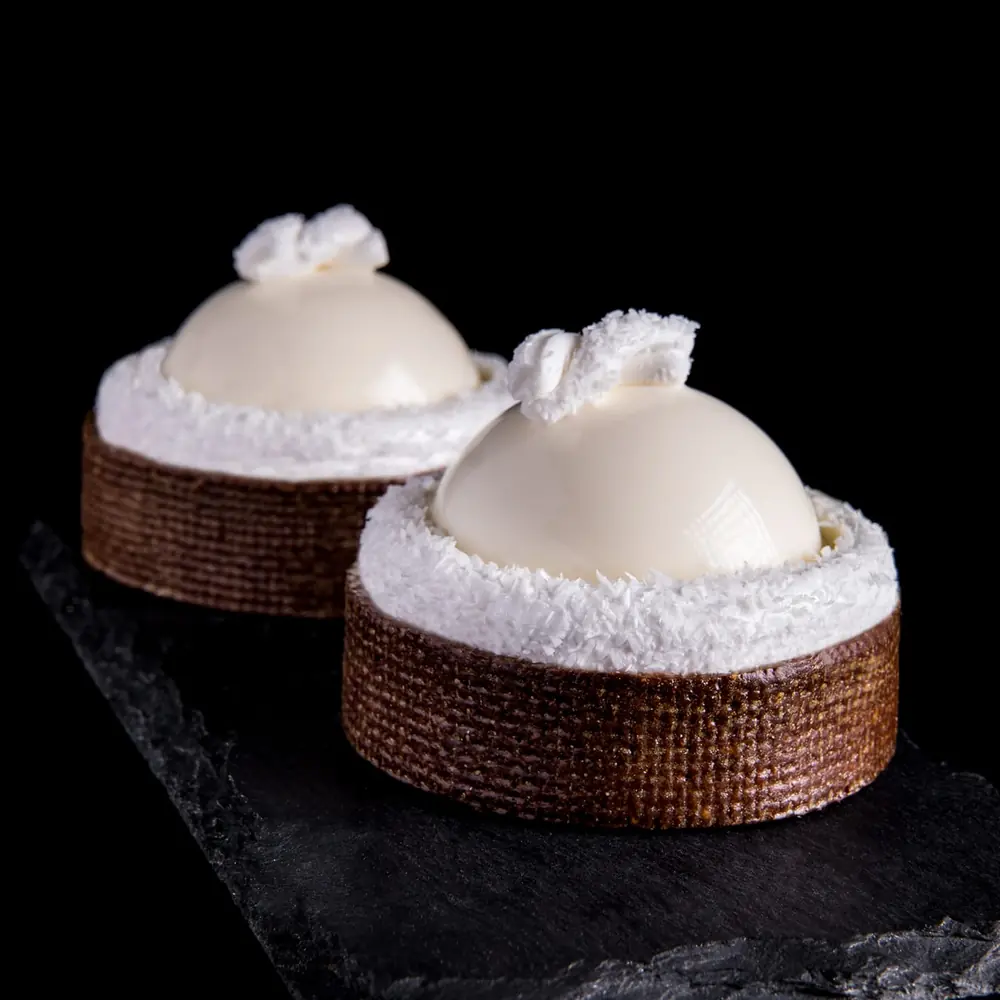
I remove the metal ring and acetate while the cake is completely frozen and supported on a rigid board. This gives the mousse its best chance to retain the precise ring shape during handling.
For the Chocolate Tonka & Passion Fruit Cake, I apply the mirror glaze to the frozen surface, add the tempered-chocolate decoration and then begin the refrigerator thaw. The glaze has its own validated working condition; the frozen cake is not an excuse to use glaze at any temperature.
I minimise the time between freezer, unmoulding and refrigeration. If loose frost, surface water, a crack or a pulled mousse edge appears, I stop and diagnose it rather than hiding the evidence beneath glaze.
How I thaw the finished entremet
I thaw the cake under refrigeration on its final level board, protected by a cake box or cover that cannot touch the glaze or decoration. Strong direct airflow can dry the surface; a sealed film touching the glaze can destroy it.
As a conservative hygiene reference, the FDA Food Code recognises thawing under refrigeration that maintains time/temperature-controlled food at 5°C / 41°F or below. The applicable local regulation and the bakery's HACCP plan still govern the actual operation.
I do not thaw this dairy-and-fruit entremet on the counter. A warm-room shortcut changes both food-safety control and texture: the exterior warms while the dense centre may still be frozen.
How long does thawing take?
There is no honest universal answer. Diameter, height, insert mass, frozen starting temperature, refrigerator airflow, box design and refrigerator load all change the time.
Valrhona's Tiramisu method places the finished frozen dessert in the refrigerator the day before service. That is a useful professional example, not a transferable timetable for every cake.
I validate my own schedule with an identical sacrificial cake. I check the centre, cut quality, mousse texture, gel texture and Feuilletine at planned intervals. The approved time is the shortest interval that gives a completely thawed, stable and pleasant slice throughout the real product.
Condensation: where the water comes from
Condensation is water from surrounding air collecting on a surface colder than the air's dew point. It is not water leaking out of the recipe, although both problems can occur at the same time.
I reduce unnecessary exposure to warm humid air and move the glazed frozen cake promptly into refrigeration. If droplets appear, I do not wipe the glaze: wiping can leave bare, dull or streaked areas without correcting the environment.
A clear surface droplet points towards condensation. A coloured or syrupy line emerging from one layer points more strongly towards purge or separation inside the cake.
Read the failure after the complete cycle
- Mousse is dense, grainy, greasy or collapsed: return to emulsion, cream aeration, folding, gelatin control, chocolate identity and service temperature.
- Fruit gel has a wet halo or shrinks: return to pectin identity, gelatin, pH, Brix, final yield and freeze–thaw stability.
- Crémeux is grainy, greasy or too soft: investigate its emulsion and formula rather than extending the thaw blindly.
- Sponge becomes wet: investigate purge and water movement from neighbouring layers.
- Feuilletine loses crispness: investigate moisture migration, barrier design, holding time and storage—not freezing alone.
- A flat boundary opens: use the layer-separation diagnosis and inspect both fracture faces.
- The cake bulges or sinks: separate a whole-mousse failure from an off-centre insert or local wet interface.
- The cake cracks: record whether it happened during removal, transfer or thawing and identify which material fractured.
- Only the glaze becomes dull, patchy or wet: diagnose glaze application and condensation before changing the cake interior.
Can I refreeze a thawed entremet?
I do not use refreezing as a routine quality correction or as proof that a failed cake has recovered. A second cycle can change ice structure, moisture distribution, interfaces and texture while making the original failure harder to read.
Whether a particular product may be refrozen safely is a food-safety decision governed by its ingredients, temperature history, time outside control and the bakery's validated HACCP procedure. It cannot be answered responsibly from appearance alone.
For production development, I design and approve the cake for its intended number of cycles. The normal target is one controlled freeze followed by one controlled refrigerated thaw.
The smallest useful validation
I produce three identical small controls with the same layer thickness and component batches. One is cut before freezing, one after complete freezing and one after the planned refrigerated thaw and service window.
I weigh and photograph them, record height and diameter, and compare every layer in the centre and at the edge. A separate sacrificial control can carry the temperature probe used to establish the centre curve.
If the test fails, I change one variable: freezer load, geometry, protection, thawing time, refrigerator condition or the specific component identified by the evidence. I do not modify the whole cake at once.
What I record
- Cake diameter, height, total mass and thickness of every layer
- Component batch identities and their condition at assembly
- Time from finished mousse to freezer entry
- Freezer type, set point, actual temperature record, load and product position
- Validated centre-freezing time from a same-geometry control
- Frozen packaging, storage duration and any temperature cycling
- Time outside the freezer for unmoulding, glazing and decoration
- Refrigerator temperature, box or cover, thawing time and service window
- Centre and edge texture, liquid release, dimensions and every visible defect after thawing
My rule for this cake
I assemble the Chocolate Tonka & Passion Fruit Cake upside down, freeze the complete ring until solid, unmould and glaze it while frozen, add the tempered-chocolate decoration and thaw it slowly under refrigeration.
The process is approved only when the mousse remains light, the gel is juicy without purge, the crémeux is smooth, the sponge is tender, the Feuilletine remains crisp, the interfaces stay closed and the cake holds its clean shape at service.
The short answer
Freeze the real geometry until its centre is completely solid, protect it from drying and cycling, unmould and glaze it while frozen, then thaw it fully under controlled refrigeration. Do not copy a number of hours from a different cake or freezer.
The correct schedule is the one validated by the centre and the final slice—not by a hard surface or a freezer display.