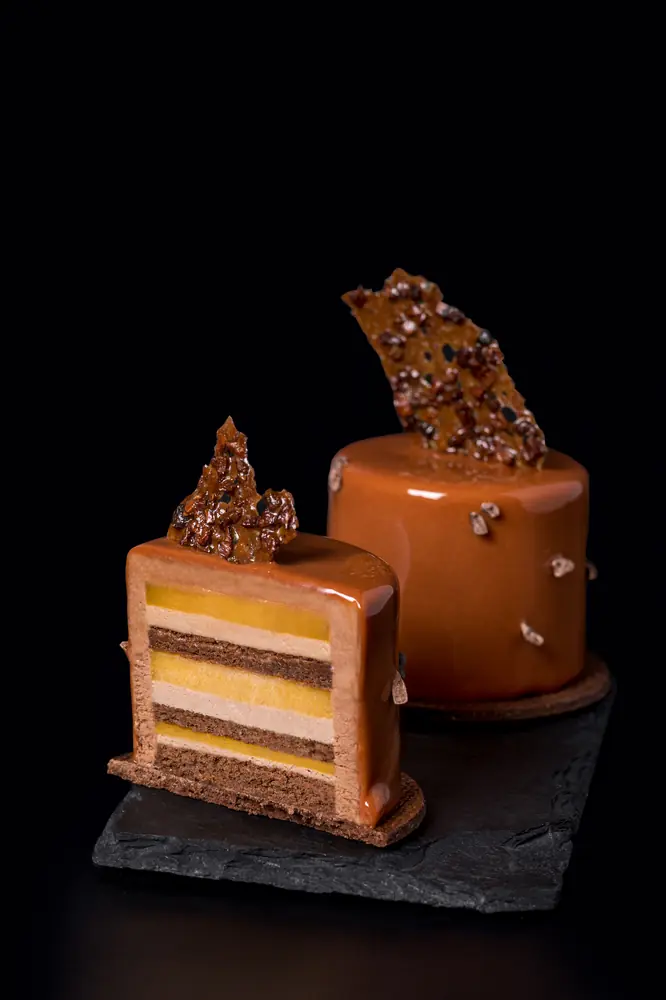
When an entremet tastes unbalanced, I do not immediately change the recipe. First I cut it. A layer may be perfectly formulated and simply too thick for the other components.
For the Chocolate Tonka & Passion Fruit Cake, the complete bite should move from dark chocolate and restrained tonka into bright fruit, rounded milk-chocolate crémeux, tender sponge and a brief crisp finish. If one layer stays in the mouth long after the others disappear, geometry is one of the first things I check.
My quickest useful test
- Weigh every deposit during assembly instead of relying on eye level alone.
- Record ring diameter, insert diameter and intended finished height.
- After thawing, cut through the centre with a clean warm knife.
- Photograph the cross-section square-on beside a ruler and measure several positions.
- Taste a complete vertical forkful at the intended serving temperature.
- Describe which component arrives first, which dominates and what remains at the end.
- Change one deposit weight or layer thickness in the next trial; keep the formulas unchanged.
Weight and thickness answer different questions
Deposit weight is the best production control because it can be checked while I work. Thickness shows what the diner actually encounters. Density connects the two: the same mass of aerated mousse occupies more volume than a dense crémeux or fruit gel.
That is why I never copy a gram weight from a different mould and expect the same layer. Diameter, wall clearance, insert shape and component density all matter. A professional formula that specifies both deposit and mould geometry is useful precisely because those values belong together.
How I diagnose dominance
- Fruit dominates: check gel thickness before lowering acidity or sugar. A thin intense gel can be more balanced than a thick mild one.
- Chocolate dominates: check the outer mousse volume, serving temperature and couverture before weakening the cocoa flavour.
- Crémeux feels heavy: check its height and the size of the forkful; excess thickness can read as sweetness and fatness.
- Sponge feels dry: check its thickness, bake loss and contact with wet layers before adding syrup.
- Crunch is hard to cut: check thickness and chocolate proportion before changing the entire crisp recipe.
- Tonka dominates: correct its controlled aromatic dose; geometry cannot rescue an excessive addition.
One-variable trials
I make a control and one or two deliberate variations. For example, I keep every component identical and reduce only the fruit-gel deposit. If the cake becomes clearer without losing freshness, I have evidence that the issue was proportion rather than the gel formula.
Changing acidity, sugar, gelatin and thickness at the same time produces a different cake but teaches me almost nothing. Small controlled trials create knowledge I can reuse in the next entremet.
What can distort the measurement
- An insert set on a tilted tray gives different thicknesses across one cake.
- A mousse deposited after it has begun to set traps voids and changes the apparent level.
- Pressing the insert too deeply pushes mousse upward and alters the base-to-centre ratio.
- A compressible crunch or sponge changes height during assembly.
- A warm or partly thawed slice smears boundaries and makes layers look thicker.
- Measuring only the edge misses a domed or sunken centre.
My production record
- Formula version and component batch
- Ring, insert and final-cake dimensions
- Deposit weight for every layer
- Measured centre and edge thickness after thawing
- Freeze, thaw and serving temperatures
- Sensory order: first impression, middle, finish and aftertaste
- Single variable changed and the decision from the trial
My working rule
Before reformulating a good component, I ask whether there is simply too much of it. I control deposits by weight, verify the finished cross-section and taste the complete vertical bite. Balance belongs to the relationship between layers, not to any layer in isolation.