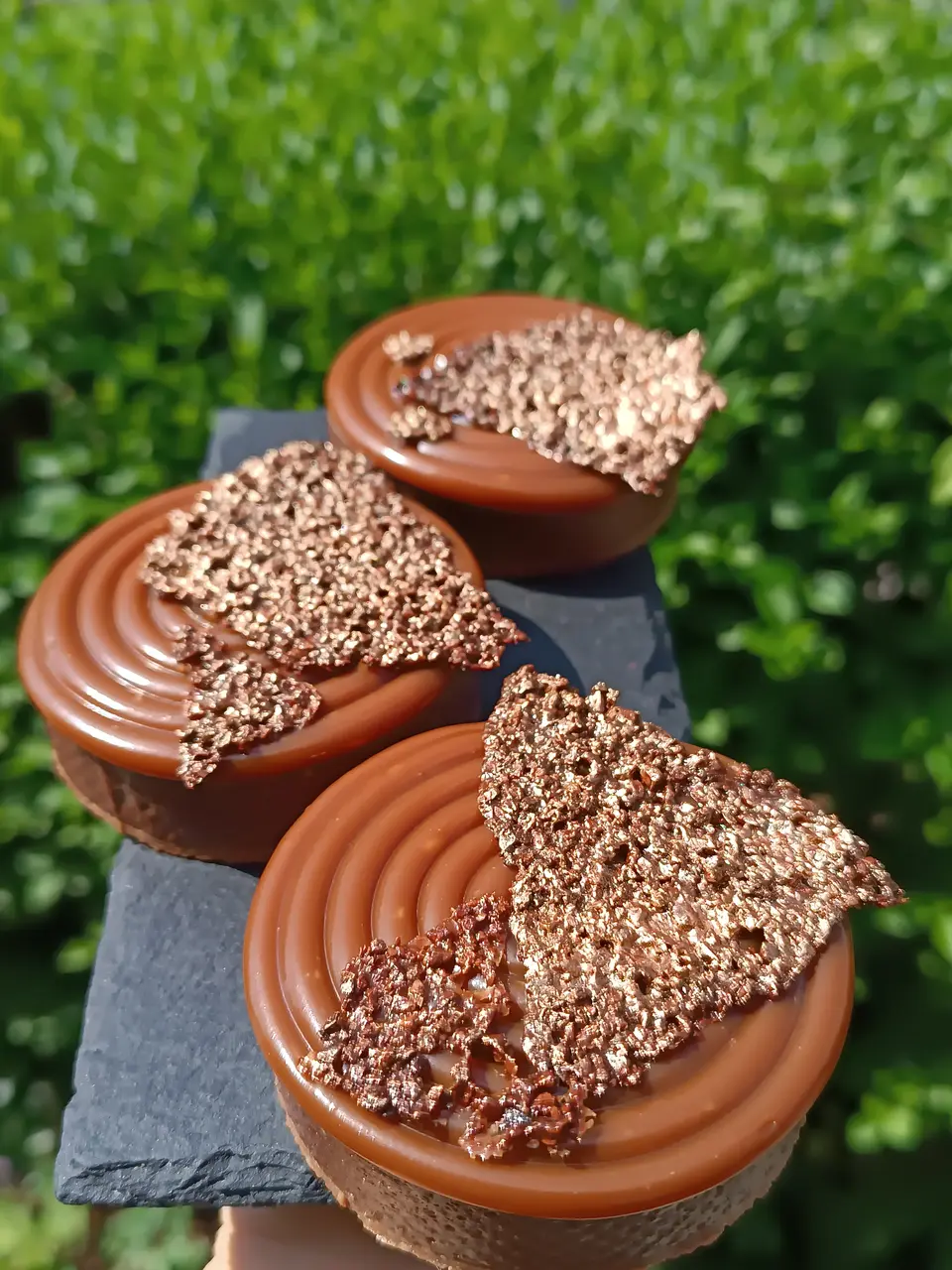
That is the texture I mean when I talk about crémeux: smooth and dense, with enough body to hold its place in a dessert, but soft enough to melt as you eat it. It should not feel like a sauce, and it should not leave a rubbery layer on the palate.
The name describes a family of creams, not a single recipe. Chocolate crémeux is often made by emulsifying crème anglaise with chocolate. A fruit version needs a different balance because the purée brings water and acidity, but very little fat. What matters is how the finished cream behaves, not simply what it is called.
Choosing the texture
In a cake, I choose crémeux when I need a concentrated, creamy bite between lighter layers. Mousse does a different job: its air gives volume and lightness. Put the two together and the contrast becomes clear. The mousse feels airy around the insert; the crémeux gives a denser centre that softens quickly in the mouth.
Ganache is closer, because both preparations involve an emulsion with chocolate. The difference is in the base. Ganache usually starts with cream or another liquid, while chocolate crémeux commonly starts with an egg-thickened custard. For a custard-soft centre, I would begin with crémeux; for a more direct chocolate flavour and a firmer line, I would consider ganache.
That is a starting point, not a rule about firmness. A soft ganache can be looser than a strongly set crémeux. The chocolate, the amount of liquid and the serving temperature all affect the bite, so the names alone cannot tell you whether two recipes are interchangeable.
Pastry cream is different again. It is normally thickened with starch as well as egg, which gives it the body needed for fillings such as choux or fruit tarts. Chocolate crémeux often contains no starch. I would not replace pastry cream with it without checking whether the recipe can hold in that particular dessert.
Making chocolate crémeux
I begin with the custard. The yolks and sugars are mixed without whipping, then tempered with the hot dairy. During cooking, the spatula needs to reach the base and corners of the pan: a smooth custard can still develop cooked particles where the heat is concentrated.
The finishing temperature belongs to the recipe. The milk-chocolate reference formula in my Pastry Journal uses 82°C / 180°F; L’École Valrhona's general chocolate-crémeux method uses 84°C / 183°F for its own system. Those are two different instructions, not temperatures to average. The custard should lightly coat the spatula and stay smooth, without boiling.
Once it is cooked, I strain it into the prepared chocolate. Adding the hot custard progressively and stirring from the centre gives a useful visual checkpoint: a glossy, elastic centre begins to form. It can look quite thick at first. As the remaining custard is incorporated, the mixture becomes more fluid and even.
This is where emulsion matters. Mixing until everything is brown is not enough; the water-rich custard and the fat in the chocolate need to form a fine, uniform structure. If the chocolate is too cold, some of its cocoa butter can start crystallising before that structure has formed. Valrhona's method keeps the developing emulsion above 35°C / 95°F; that is not a universal pouring temperature for every crémeux.
A submerged immersion blender finishes the work without drawing air into the cream. A tall jug helps keep the head below the surface. Lifting it through the surface leaves bubbles that can still be visible when the frozen insert is cut.
The warm mixture is not its final texture. As it cools, the fats crystallise and any gelatin in the formula sets. Some recipes call for overnight refrigeration before shaping and freezing; others specify pouring straight into an insert mould. I keep the complete recipe and its cooling sequence together rather than borrowing a convenient step from another method.
When the texture is not right
A crémeux that looks runny while warm may simply not have set yet. If it is still too soft after the prescribed cooling, I go back to the formula and process before adding anything: did the custard reach its endpoint, was the specified couverture used, and has the cream had enough time to set?
Chocolate is not an interchangeable setting ingredient. Changing the couverture changes the balance of cocoa butter, cocoa solids, sugar and, for milk chocolate, milk solids. If the recipe contains gelatin, its notation matters too: prepared gelatin mass is not the same quantity as dry gelatin. In a fruit crémeux, a change of purée can also change the amount of water the formula has to hold.
With a grainy crémeux, the first question is where the grains came from. Cooked yolk particles suggest excessive or uneven heat in the custard. Unmelted chocolate or early cocoa-butter crystallisation can also leave a rough texture. Straining is useful, but it cannot turn a badly scrambled custard back into a smooth base.
An oily surface or visible beads of fat point more strongly towards a split emulsion. Compatible temperatures and controlled blending matter here; extra gelatin will not repair an emulsion that never formed properly. Adding more milk, cream or chocolate also changes the formula, even if it seems to hide the problem.
Freezing and the finished dessert
Crémeux can be frozen when the formula and method are designed for that use. For an entremet, freezing makes the insert firm enough to unmould and place inside the mousse. It is a handling stage, not the texture I want the guest to eat.
The useful test comes after refrigerator thawing, at the temperature at which the cake will be served. The layer should cut cleanly without releasing water, then soften on the palate. An insert that looks perfect while frozen may still leak, feel grainy or remain too firm once the cake is thawed.
In my Chocolate Tonka & Passion Fruit Cake, the milk-chocolate crémeux layer is approximately 10 mm. It sits between the dark chocolate elements and the sharper mango and passion fruit gel. That thickness belongs to this cake; it is not a standard to apply to every insert.
For a new cake, I record the mould diameter and the amount deposited, then look at the thawed cross-section and taste a complete vertical forkful. If the creamy layer overwhelms the mousse, sponge or fruit, changing the deposit may be enough. A sound formula does not always need reformulating.
A tart or plated dessert can use the same contrast on a smaller scale: a smooth cream beside a crisp shell, fruit or a crunchy element. The formula still has to suit the application, especially if the cream will be piped rather than held inside a cake. For me, a good crémeux is not just smooth in the jug. It has to keep that smoothness through setting, assembly and serving.