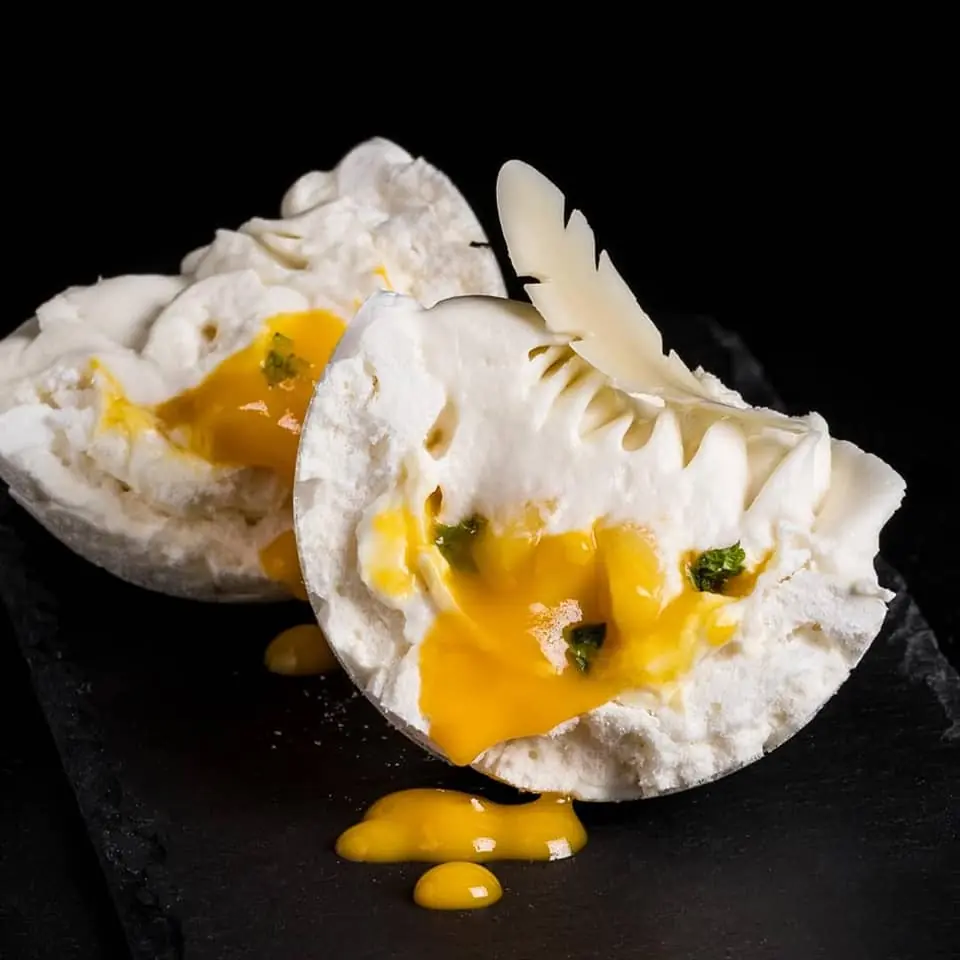
A good Pavlova should not eat like a completely dried meringue. I want a thin, crisp shell that fractures under the spoon, with a soft, marshmallow-like centre underneath. I finish it with softly whipped cream and fresh fruit so the sweetness of the meringue is balanced by dairy and acidity.
My Pavlova formula
Yield: one 20 cm / 8-inch Pavlova, approximately 8–10 servings.
- 150 g egg whites, at room temperature
- 300 g caster sugar
- 7 g cornstarch
- 7 g white-wine vinegar or fresh lemon juice
- 5 g vanilla extract, optional
- 300 g whipping cream, about 35% fat, cold
- 15 g icing sugar for the cream, optional
- Fresh berries, passion fruit, kiwi, peaches or other tart fresh fruit, as needed
How I make Pavlova
I heat the oven to 160°C / 320°F and line a flat tray with baking parchment. I mark a circle about 20 cm / 8 inches across as a guide, then turn the paper over so the pencil or ink does not touch the meringue.
I put the egg whites in a perfectly clean, grease-free bowl and begin whipping at medium speed. Once the whites form a stable foam and begin to hold soft peaks, I start adding the caster sugar gradually rather than all at once. I give each addition enough time to dissolve before adding more.
I continue whipping until the meringue is glossy, dense and holds firm peaks. When I rub a small amount between my fingers, I should not feel obvious sugar crystals. Undissolved sugar is one of the main causes of syrupy beading and weeping later.
I mix the cornstarch with the vinegar or lemon juice, then fold it gently through the finished meringue together with the vanilla if I am using it. I stop as soon as it is evenly distributed.
I spoon the meringue into a thick 20 cm / 8-inch round with the sides slightly higher than the centre. As soon as it goes into the oven, I reduce the temperature to 130°C / 266°F and bake for approximately 75–90 minutes. I want a dry, pale shell while the centre remains softer than a fully dried meringue.
I switch off the oven and cool the Pavlova gradually inside. Once completely cool, I whip the cold cream to soft-to-medium peaks, spread it into the centre shortly before serving and finish with fresh fruit.
What makes Pavlova different from French meringue?
The starting point is related: egg whites and sugar are whipped into a stable foam. A classic dried French meringue is usually dried until the interior is crisp, while Pavlova deliberately preserves a soft centre.
The cornstarch and acid support that texture, but they do not create it alone. Shape, baking profile and retained moisture are just as important.
Why I use about twice as much sugar as egg white
Sugar is structural as well as sweetening. It increases viscosity, stabilizes the foam and helps create the crisp shell as moisture leaves the surface. With 150 g egg whites and 300 g sugar, this formula uses a classic 2:1 ratio.
Reducing the sugar heavily does not simply make the same Pavlova less sweet; it changes stability, drying and final texture.
Why I add the sugar gradually
I first establish the egg-white foam, then add the sugar progressively. The finished meringue should be glossy rather than dry or clumpy, and I should not feel coarse sugar crystals between my fingers.
What do cornstarch and vinegar do?
Cornstarch binds some free moisture and supports the soft interior. The acid lowers the pH and makes the egg-white proteins less prone to tightening aggressively during whipping and heating.
I keep both quantities small. Too much starch can taste chalky or pasty, while too much acid can affect flavour and weaken the surface. White-wine vinegar or lemon juice both work.
Troubleshooting my tested Pavlova
Before I change the formula, I compare the failed Pavlova with the method above: 150 g egg whites, 300 g caster sugar, gradual sugar addition, glossy firm peaks, a thick 20 cm shape, 130°C / 266°F after loading and gradual cooling. Cracking, weeping and a hollow or wet centre can look related, but they point to different stages of the process.
Why does Pavlova crack?
Some cracking is normal because the shell dries and contracts around a softer centre. Large structural cracks are more often associated with excessive oven heat, sudden temperature changes, an unstable foam or a very wet centre. I use a moderate bake and gradual cooling to reduce the stress on the shell.
Why does Pavlova collapse?
A slight settling in the centre is normal. A dramatic collapse usually points to a meringue that was not sufficiently stable, sugar that was not properly dissolved, underbaking or sudden cooling. Overwhipped egg whites can also create a weak final structure, so I stop at glossy firm peaks rather than dry, granular foam.
Why is my Pavlova sticky or weeping?
Pavlova is highly hygroscopic, so humid weather can make the shell sticky even when the bake was technically correct. Weeping can also come from undissolved sugar, overbeating, or assembling with cream too far in advance.
Amber or clear syrup beads usually mean part of the sugar has separated from the foam. I first check sugar dissolution, crystal size and whether the sugar was added too quickly.
Why is my Pavlova hollow inside?
A Pavlova naturally contains air and the centre should be soft, so I do not expect a completely solid cross-section. The problem is a large empty cavity under the shell with the soft centre collapsed at the bottom.
When that happens, I first check the foam and the bake rather than adding more starch. Sugar added too quickly or left partly undissolved can give an unstable structure; very aggressive heat can set and expand the outside before the centre is ready; and underbaking can leave the interior unable to support the shell as it cools. I keep the meringue glossy, shape it thickly and use the same low bake and gradual cooling described in my method.
A hollow centre accompanied by syrup or a wet lower layer makes me check sugar dissolution and drying first. A clean crisp shell with a soft marshmallow centre is the target; a perfectly uniform interior is not.
What changes when the weather is humid?
Humidity changes Pavlova quickly because its high sugar content attracts water from the air. On a humid day, a shell that left the oven crisp can become tacky during cooling or storage. I do not automatically bake hotter to compensate, because extra heat can brown the shell and increase cracking.
I cool the Pavlova in the oven as planned, then move the completely cool shell into an airtight container as soon as practical. I keep cream and cut fruit off the shell until close to service. If the kitchen is very humid, I judge the shell shortly before assembly rather than assuming yesterday's storage result will repeat.
Why did my Pavlova turn beige or brown?
The oven is probably too hot or the Pavlova is too close to a strong heating element. I want a pale ivory shell, not caramelization. I treat 130°C / 266°F as a starting point and adjust for the real behaviour of the oven.
Why is the centre completely dry?
The Pavlova has been baked too long, dried too gently for too long, or shaped too thinly. A thin disc behaves more like a dried meringue because moisture has a short path to escape. I keep the round fairly thick so the shell can dry while the centre remains soft.
Why is the centre raw or liquid?
The centre should be soft, but it should not remain fluid egg foam. If it is wet and unstable rather than marshmallow-like, it needs more baking time or a slightly lower, longer drying stage. Large or very tall Pavlovas naturally require longer.
Do egg whites need to be at room temperature?
Room-temperature whites usually whip more readily, but cleanliness matters more. Any trace of yolk, fat or grease can interfere with the foam. I separate eggs while cold, then let the measured whites lose their refrigerator chill before whipping.
Can I use pasteurized carton egg whites?
Sometimes, but performance varies by brand and processing method. Some pasteurized whites whip well while others produce less volume. For the most predictable Pavlova I prefer fresh shell egg whites, or I test the specific carton product before relying on it.
What fruit works best on Pavlova?
I prefer fruit with acidity because the meringue is deliberately sweet. Berries, passion fruit, kiwi, citrus, sour cherries, peaches and plums all work well depending on the season.
I avoid adding very juicy fruit too early because moisture quickly softens the shell.
How sweet should the whipped cream be?
Very lightly sweetened, if at all. The shell already carries a high sugar load, so I often use unsweetened cream or only about 15 g icing sugar for 300 g cream.
Can I make Pavlova ahead?
Yes. The plain shell can be baked a day ahead in dry weather. Once completely cool, I keep it airtight at room temperature. I do not refrigerate the undecorated shell because refrigerators are humid.
Once topped with cream and fruit, Pavlova must be refrigerated and the shell will soften progressively, so I assemble it close to serving.
How I store Pavlova without losing the crisp shell
I store only a completely cool, undecorated shell. Any residual warmth trapped in a container creates condensation, so I let the Pavlova cool fully before sealing it airtight at room temperature.
I keep it away from steam, refrigeration humidity and uncovered fruit. I add whipped cream and fruit shortly before serving. Once decorated, I refrigerate for food safety, accepting that the shell will progressively soften as moisture moves from the cream, fruit and refrigerator air.
If I bake the shell a day ahead, I treat its condition at assembly as the final check: crisp surface, no syrupy beads and no damp base. Storage protects a good bake; it cannot repair undissolved sugar or an underbaked centre.
Can Pavlova be frozen?
I do not consider freezing a finished decorated Pavlova the best method because thawing introduces moisture and changes the shell texture. I prefer to make the dry shell ahead and store it airtight in a low-humidity environment.
What is the difference between Pavlova and meringue nests?
Meringue nests are usually smaller and are often dried more completely. Pavlova is larger, thicker and intentionally preserves a soft centre. Similar ingredients can therefore produce a different dessert because geometry and baking endpoint are different.
How I control the shell and centre
I judge Pavlova by contrast rather than perfect appearance. A few cracks are normal. What matters is a shell crisp enough to fracture, a centre that is soft rather than raw, lightly whipped cream and fruit acidic enough to balance the sweetness.
The technique becomes much more reliable once sugar dissolution, oven temperature and cooling are treated as structural controls rather than minor details.