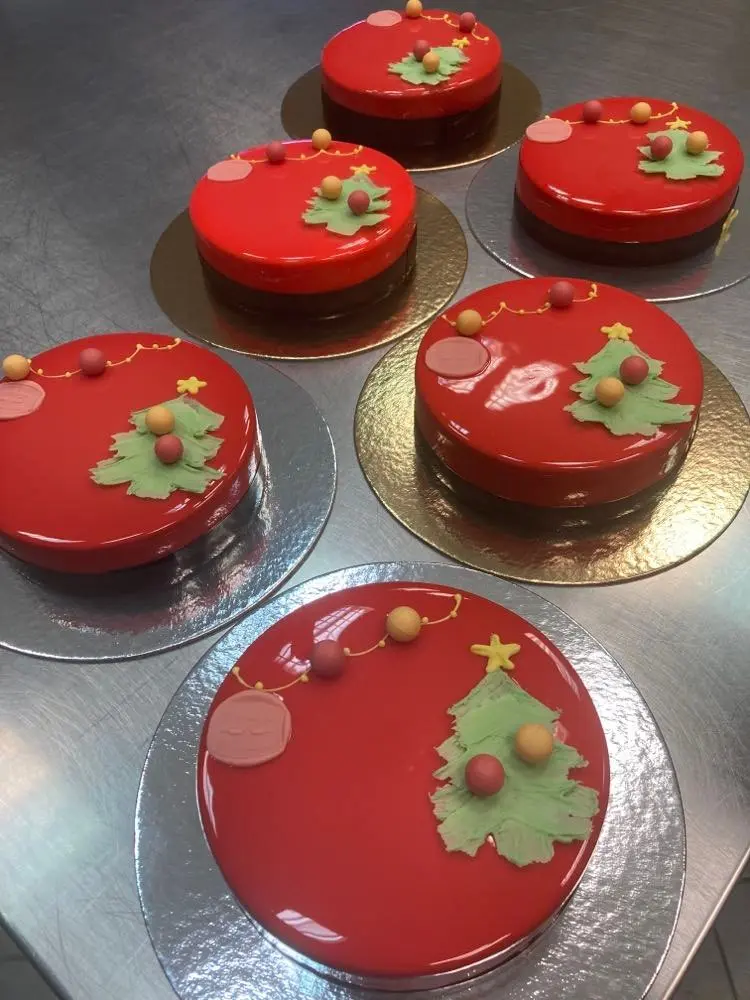
A mirror glaze can fail in two ways that look almost identical from a distance. It can be too fluid to remain on the cake, or it can form a proper layer that simply does not have enough colour and opacity to hide what is underneath.
I diagnose those separately. If most of the glaze ends up on the tray and the coating is physically thin, I investigate flow and setting. If the layer stays in place but the cake still shows through, I investigate the chocolate, colour and contrast beneath it.
First decide: is the layer too thin, or only too transparent?
I look at the lower edge and the tray. A large amount of fast-moving glaze, bare shoulders and almost no coating on the sides indicate that the glaze did not set quickly enough.
If the coverage is even and the edge has a normal layer, but the mousse colour remains visible, the problem is more likely opacity. Making the glaze colder may thicken the layer, but it does not correct an unsuitable chocolate or colour system.
Cause 1: the glaze is too warm
A glaze that is too warm can flow like a thin sauce. It reaches the frozen surface but runs away before enough structure develops to hold an even coating.
I let it cool gradually, stir without adding air and test the ribbon again. I am looking for continuous flow with some body, not for a fixed temperature copied from another formula.
Cause 2: the cake is not completely frozen
The frozen surface is part of the process. It removes heat from the glaze quickly and helps establish the coating. A cake that is only firm or partly frozen gives the glaze more time to remain mobile and slide toward the base.
I check the centre and the complete assembly, not only the outside. If the entremet is not frozen solid, I do not try to compensate by making the glaze excessively cold. I correct the cake condition first.
Cause 3: the gelatin gives less setting power
My formula uses 22.5 g leaf gelatin weighed dry before soaking. A weaker leaf product, an inaccurate weight or confusion between dry gelatin and prepared gelatin mass can leave the glaze with less structure than intended.
I verify the packet, grade or Bloom strength and the dry weight. I do not add extra gelatin directly to a finished batch without testing because that can turn a fluid glaze into a rubbery one.
Cause 4: the chocolate has changed the flow or opacity
The formula contains 225 g chocolate, and the exact product matters. Chocolate families differ in cocoa particles, cocoa butter, sugar and milk solids. A substitution can change both how fast the glaze flows and how well it covers the colour underneath.
Dark chocolate may give strong colour but different flow from milk or white chocolate. White and milk chocolates bring their own opacity and sweetness, but two products with similar labels can still behave differently. I record the exact product rather than treating all chocolate as interchangeable.
Cause 5: the neutral glaze is different
The 90 g neutral glaze contributes structure and shine, but commercial products are not identical. If the brand or product changes, its solids and gelling behaviour may change the final viscosity.
I compare the specification and previous batch record before adjusting the quantity. A product substitution is a controlled test, not a silent one-for-one replacement.
Condensation causes slipping, not simply low viscosity
A wet film on a frozen entremet can make a correctly prepared glaze lose adhesion in patches. This often produces bare areas or sliding that may be mistaken for a thin glaze.
I prepare the rack, tray and glaze before taking the cake from the freezer. If condensation is already visible, I do not pour and hope that the glaze will hide it. The surface must be smooth, dry and sound before glazing.
Pouring too little can create thin coverage
Mirror glaze needs enough excess to travel across the top and down the sides in one movement. Trying to cover a cake with the exact final coating weight encourages scraping, repeated passes and bare shoulders.
The unused glaze on the tray is part of achieving an even pour. I prioritise complete coverage, then allow the excess to drain rather than trying to stretch a small quantity over the cake.
Can I simply cool it until it becomes thicker?
Only if excess warmth is the cause. Cooling a correct glaze restores body. Cooling a weakly structured or low-opacity formula may only delay the pour and create a different defect: ridges that set before they can level.
This is why I test the ribbon and diagnose the products. The goal is not maximum thickness; it is the narrow point where the glaze covers, remains on the cake and still levels cleanly.
A quick diagnosis in the kitchen
- It runs quickly into the tray: let the glaze cool and test the ribbon again.
- It behaves normally but slides from the cake: check whether the entremet is fully frozen and dry.
- It stays on the cake but the base colour shows through: investigate chocolate, colour and opacity.
- A new gelatin gives a weaker set: verify Bloom strength and dry weight before changing the recipe.
- A new neutral glaze changes the flow: compare the exact product specification.
- Coverage fails only around shoulders and sides: check pour volume, speed and whether one continuous pass was completed.
What I do not change blindly
I do not add gelatin merely because the glaze ran once. I do not add more chocolate solely to hide the cake. I first identify whether the failure came from temperature, cake condition, adhesion or opacity.
Once the cause is clear, I change one variable and repeat the real process on a fully frozen test piece. That produces useful production knowledge instead of another unexplained version of the formula.
The short answer
If the glaze runs away, check its flow and the frozen cake first. If the coating stays but looks transparent, check chocolate and opacity. Gelatin strength, neutral glaze and condensation are separate possibilities; diagnose them before changing the quantities.