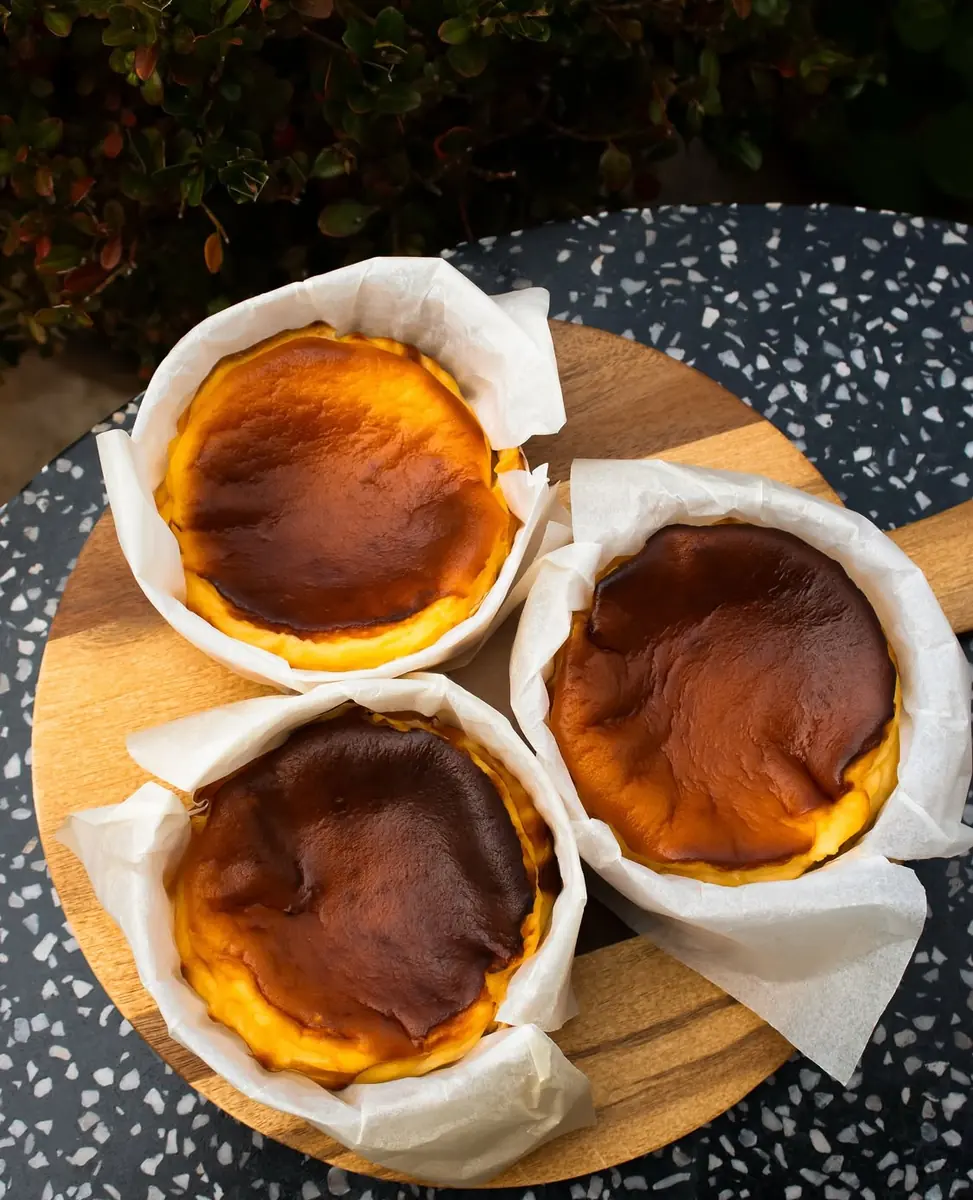
Basque cheesecake is one of the rare cakes where the dark top is not a mistake. I want a deeply caramelised surface, a custardy centre and no biscuit crust. The contrast between the almost bitter caramel notes outside and the soft dairy filling inside is what makes the cake distinctive.
My Basque cheesecake formula
Yield: one 20 cm cheesecake, about 8–10 servings.
- 570 g full-fat cream cheese
- 230 g caster sugar
- 4 large eggs, about 200 g without shells
- 285 g heavy cream, about 35% fat
- 10 g plain flour
- 1 g fine salt
How I make Basque cheesecake
I bring the cream cheese, eggs and cream close to room temperature. This helps me make a perfectly smooth batter without needing to whip extra air into it.
I line a 20 cm springform tin with two overlapping sheets of baking parchment, leaving the paper several centimetres above the rim. The wrinkles are part of the cake’s character and make the very soft cheesecake easier to unmould.
I mix the cream cheese until smooth, then add the sugar. I add the eggs one at a time, mixing only until each disappears into the batter. I sift in the flour and salt, then mix in the cream. The finished batter should be glossy, homogeneous and fluid, but not foamy.
I pour the batter into the tin and tap it lightly on the worktop to release large bubbles. I bake it in a fully preheated conventional oven at 210°C / 410°F for about 35–45 minutes.
The clock is only a guide. I remove the cake when the top is a very deep mahogany brown, the outer ring is set and the centre still trembles strongly when I move the tin. It should look softer than a conventional baked cheesecake because the centre continues to set as it cools.
I leave it in the tin for at least four hours before cutting. At room temperature the centre is at its softest and most custardy. For cleaner slices, I chill the fully cooled cake and then let the slices warm before serving.
Why is Basque cheesecake baked so dark?
The high heat creates fast browning on the exposed top while the centre remains soft. This is the opposite of a New York-style cheesecake, where gentle heat and often a water bath are used to prevent browning. Here, the caramelised top is part of both the flavour and the structure.
Why is there no crust or water bath?
The parchment-lined cake sets directly against the tin and forms its own browned exterior. A water bath would slow surface browning and work against the result I want.
Do I need flour in Basque cheesecake?
Basque cheesecake can be made without flour, and some excellent modern formulas do exactly that. For this version I use a very small amount because it supports the soft centre without making the cheesecake cakey.
Should I use cream or sour cream?
For this version I use heavy cream because it keeps the dairy profile close to the San Sebastián style. Sour cream gives more acidity and produces a different but legitimate variation.
Why does Basque cheesecake sink?
It rises while hot and then contracts as steam leaves and the egg structure cools. A sunken centre is normal. I do not try to prevent it the way I would with a classic smooth-topped cheesecake.
Why is my top not dark enough?
First check the oven temperature and rack position. Basque cheesecake needs strong surface heat. Keep the parchment from towering unnecessarily above the batter because it can shield the surface. Do not keep baking only for colour once the centre is already firm, because that trades the creamy interior for a darker top.
How do I know when the centre is done?
The edges should be visibly set, but the centre should still move as one soft mass when the tin is shaken gently. If the entire cake looks firm in the oven, it will usually be firmer than I want after cooling.
Can the centre be too runny?
Yes. Soft and custardy is different from liquid. If the cake is still flowing after it has cooled fully, it was underbaked. Oven calibration, pan diameter and batter depth all change the time, which is why I rely on movement and surface colour as well as minutes.
Why is my batter lumpy?
Cold cream cheese is the usual reason. I let the dense ingredients lose their refrigerator chill and make the cheese smooth before adding eggs and cream.
Should I whip the batter?
No. I mix until smooth, not until aerated. Too much air can create large bubbles, exaggerated rising and unnecessary cracking.
Can I add vanilla?
Yes. Real vanilla works naturally with the caramelised dairy flavour, but I treat it as a controlled variation rather than part of the base formula. Fresh raspberries are also a useful contrast because their acidity cuts through the richness.
Can I make Basque cheesecake ahead?
Yes. I cool it completely before covering and refrigerating it. The texture becomes firmer when cold, so for the softest centre I let the cake come closer to room temperature before serving.
Can I freeze Basque cheesecake?
Individual cooled slices can be frozen well wrapped for short-term storage. Thaw them slowly in the refrigerator, then bring them toward serving temperature. The texture can be slightly denser after freezing, so fresh cheesecake gives the clearest custardy texture.
What is the difference between Basque cheesecake and classic cheesecake?
Basque cheesecake is crustless, baked hot and intentionally dark, with a soft centre and rustic sunken shape. Classic American cheesecake is usually baked more gently, often with a crust and sometimes with a water bath, to create a pale, even and more uniformly set texture.
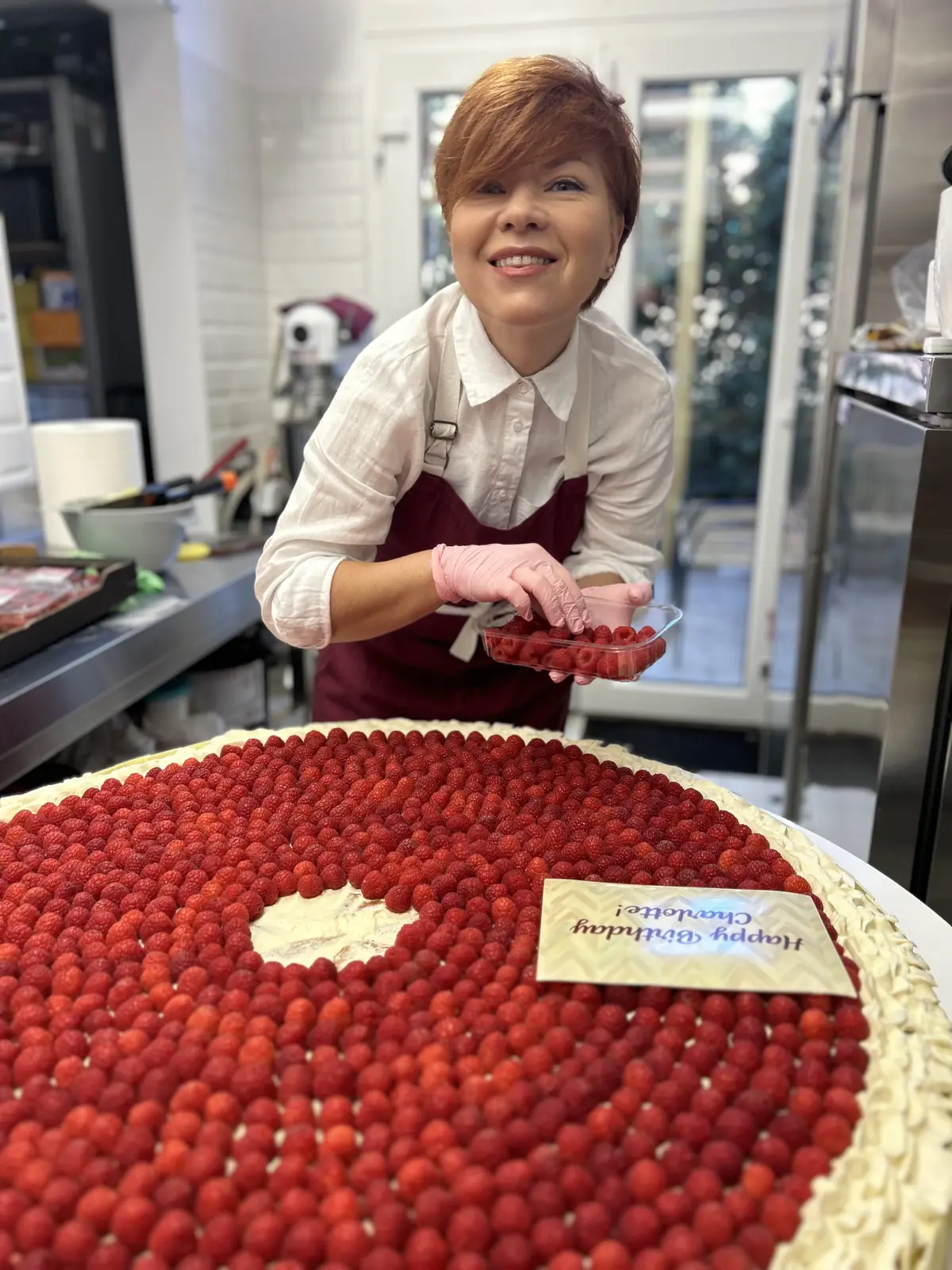
Controlled variation: real vanilla and raspberries
For a fragrant variation, I add real vanilla to the cream and serve the cake with fresh raspberries. I keep the base formula unchanged so the vanilla and fruit do not interfere with the set.