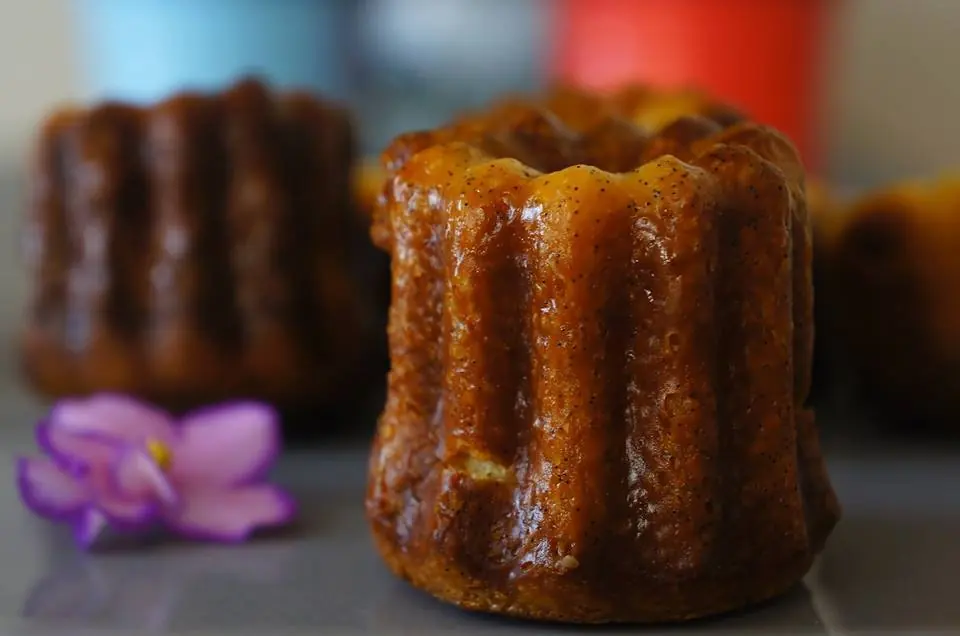
Canelés look simple, but they depend on a very particular balance: a thin batter, a long cold rest, a conductive mould and enough heat to create a deeply caramelized shell before the centre dries out. I want them almost mahogany outside, with a soft, fragrant interior scented with vanilla and rum.
My canelé formula
For approximately 24 standard canelés, depending on mould size.
- 1000 g whole milk
- 50 g unsalted butter
- 1 vanilla bean
- 180 g T55 flour or plain flour
- 500 g granulated sugar
- 100 g egg yolks
- 100 g whole eggs
- 50 g dark or amber rum
- A very thin coating of butter, or butter and beeswax, for the moulds
1. Infuse the milk
Split the vanilla bean and scrape out the seeds. Heat the milk with the butter, vanilla seeds and pod until the butter has melted and the milk is hot. I do not need to reduce the milk; the goal is simply to infuse the vanilla and dissolve the butter.
2. Mix without aerating
Combine the flour and sugar. Add the whole eggs, yolks and rum and mix until smooth. I avoid whipping air into the batter because canelé batter should behave more like a thin custard than a cake batter.
Gradually add the warm milk while mixing gently. Strain the batter so it is completely smooth.
3. Rest the batter
Cover and refrigerate for at least 12 hours. I prefer about 24 hours when possible. The batter can rest up to about 48 hours if kept properly refrigerated.
This rest allows the flour to hydrate fully, lets bubbles disappear and gives the batter a more stable texture in the mould.
4. Prepare the moulds
Copper moulds give the most characteristic crust because they conduct heat very efficiently. Brush them with an extremely thin film of softened butter or a traditional butter-and-beeswax mixture. Too much coating can pool at the base and create greasy or uneven shells.
Silicone moulds are convenient and can work, but they usually give a lighter and softer crust. If I use silicone, I judge colour rather than relying on exactly the same baking time as copper.
5. Fill the moulds
Stir the rested batter gently so any settled solids are evenly redistributed, but do not whip it. Fill each mould to approximately 5 mm below the rim. The headspace matters because the batter expands strongly during the first part of baking.
6. Bake
For conductive moulds, my starting point is 185°C / 365°F in a convection oven for about 45 minutes.
This is a starting profile, not an absolute rule. Canelés are very sensitive to mould material, oven airflow and real oven temperature. Some ovens and moulds perform better with a hotter initial phase before the temperature is reduced.
The canelés are ready when the exterior is a deep mahogany brown rather than simply golden, the ridges are evenly coloured and the centre has set without becoming dry.
7. Unmould and cool
Let the canelés settle briefly, then unmould onto a wire rack. Do not leave them steaming inside the moulds for a long time because trapped moisture softens the crust.
Why does canelé batter need to rest?
The cold rest allows flour hydration, releases much of the air introduced during mixing and gives the starch, sugar, egg and dairy system time to equilibrate. Overnight is a useful minimum; around 24 hours is my preferred target. Forty-eight hours is also workable when the batter is properly refrigerated.
Why do canelés rise out of their moulds?
A certain amount of lift is normal. Excessive climbing can come from too much air in the batter, insufficient resting, overfilling, an overly aggressive heat shock or a coating layer that is too thick. Change one variable at a time rather than immediately altering the formula.
Why are my canelés pale and soft?
The exterior needs strong heat transfer and enough baking time to caramelize deeply. Pale canelés are usually underbaked, baked in a poorly conductive mould, or baked at an oven temperature lower than the display suggests. Silicone naturally produces a gentler crust than copper.
Why are my canelés burnt outside but raw inside?
The oven may be too aggressive for the mould, or the initial high-heat phase may be too long. Lower the heat after the crust has begun to set and allow the centre enough time to finish baking rather than simply shortening the entire bake.
Why are the centres hollow?
A small open structure is normal, but a large empty cavity usually means the batter expanded rapidly before the structure could set. Excess mixing, trapped air, insufficient resting or excessive initial heat can contribute.
Why do canelés collapse after baking?
They may be underbaked in the centre. If the crust is dark enough but the centre still collapses, reduce the aggressiveness of the early heat and extend the later part of the bake.
Copper, aluminium or silicone moulds?
Copper is my reference for the deepest and most even crust. Aluminium can also conduct heat effectively and is a practical alternative. Silicone is the easiest to handle but gives the least aggressive crust. Changing the material changes the baking behaviour, so timing should always be recalibrated.
Do I need beeswax?
No. Beeswax is traditional and can give a beautifully thin, crisp surface when used correctly, but it is not compulsory. Butter-only methods also work. If using beeswax, keep the coating extremely thin.
Can I make canelé batter ahead?
Yes. This is one pastry where advance preparation is an advantage. Keep the batter refrigerated during the rest and mix gently before filling the moulds.
Can I freeze canelé batter?
I prefer to refrigerate the batter for its normal resting window rather than freeze it. Freezing adds an unnecessary variable to a batter whose texture depends on smooth hydration and predictable expansion.
How should I store baked canelés?
Canelés are at their best relatively soon after baking, when the crust is still crisp and the centre is tender. Humidity softens the shell quickly. If they must be stored, keep them uncovered or only lightly protected for a short period in a dry environment rather than sealing them while warm. Refrigeration generally softens the crust.
How can I refresh a soft canelé?
A short reheating in a hot oven can restore some crispness. Let the canelé cool again before judging the texture, because the shell firms as it cools.
My rule for canelés
I judge a canelé by contrast. The outside should be deeply caramelized and almost glassy at the ridges; the centre should stay soft, moist and aromatic. If the shell is pale, it is not finished. If the inside is dry, the crust came at too high a cost. The recipe works when both textures arrive together.