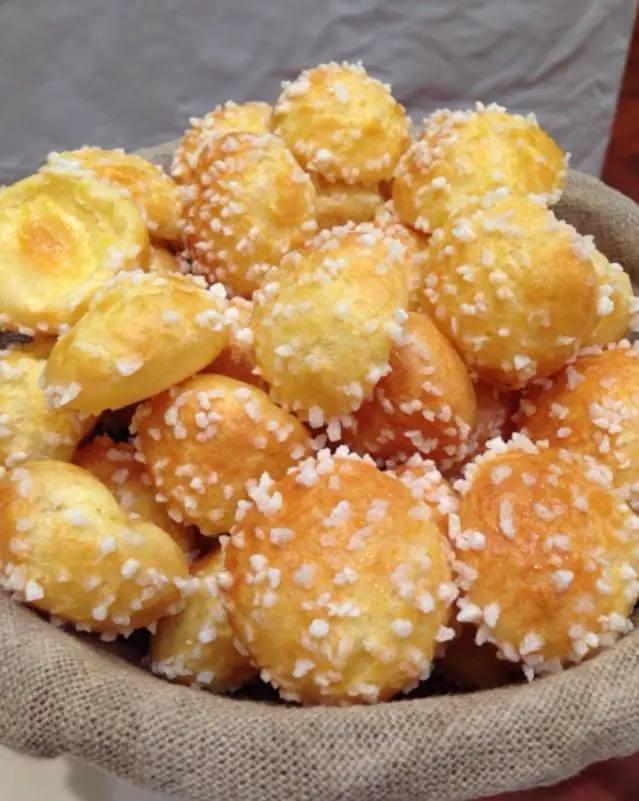
I use pâte à choux when I want a pastry shell that is almost entirely structure: thin outside, hollow inside, crisp enough to hold a filling and light enough not to dominate it. The ingredient list is short, but the method is unforgiving in one important way: the final consistency matters more than blindly adding every gram of egg.
My pâte à choux formula
For approximately 760 g dough:
- Water — 125 g
- Whole milk — 125 g
- Unsalted butter — 100 g
- T55 or all-purpose flour — 150 g
- Whole egg, beaten — up to 250 g
- Fine salt — 5 g
- Granulated sugar — 5 g
I treat 250 g egg as the formula target, not an instruction to force in the final spoonful. How much egg the panade accepts depends on how strongly it was dried, the flour and the batch size.
Method
- Bring the water, milk, butter, salt and sugar to a full boil. The butter should be completely melted before the mixture boils strongly.
- Remove the pan from the heat, add all the flour at once and mix immediately until there is no dry flour.
- Return the pan to medium heat and stir continuously. Dry the panade until it becomes one cohesive mass, pulls cleanly from the sides and leaves a thin film on the bottom of the pan.
- Transfer the panade to a mixer bowl or clean bowl. Mix briefly or let it stand until it is still warm but no longer giving off aggressive steam.
- Add the beaten egg gradually, mixing fully after each addition. Hold back the last portion. The finished paste should be smooth, glossy and fall from the paddle or spatula in a thick V-shaped ribbon.
- Pipe immediately into the shape required. Keep the size and spacing consistent and avoid trapping large air pockets in the piping bag.
- For a reliable starting point, bake at about 170°C / 338°F in a fan oven or 180°C / 356°F in a conventional oven. Do not open the oven during the first expansion and setting phase. For small choux, 25–35 minutes is a useful starting range, but colour, dryness and weight matter more than the clock.
- The shells should be deeply golden, firm and light for their size. If they have good colour but still feel moist inside, pierce or vent them and return them briefly to the switched-off or low oven to dry.
What pâte à choux actually is
Pâte à choux is a cooked dough rather than a conventional batter or pastry. Flour is first hydrated and heated in the saucepan, creating a panade. Egg is then incorporated into that cooked base. In the oven, the large amount of water turns to steam and expands the paste while egg and flour proteins set the final shell.
That is why the formula contains no baking powder and no yeast. Expansion comes mainly from steam. The challenge is to create enough moisture for lift while keeping enough structure to hold the cavity after baking.
Why I use both water and milk
Water-only choux is completely valid. It tends to bake a little crisper and can stay paler. Milk contributes lactose, protein and fat, so it encourages browning and gives a slightly more rounded flavour.
I like a 50/50 mixture for a general-purpose professional choux because it gives me colour without making the shell too tender. If I want an especially dry shell, I can move toward more water. If I want more colour and softness, I can move toward more milk.
Why the flour is added all at once
The flour has to absorb the hot liquid evenly and quickly. Adding it slowly creates a much greater risk of lumps and uneven hydration. I remove the pan from the heat, add the flour in one movement, mix decisively, then return the pan to the heat for drying.
What drying the panade does
Drying does not mean trying to remove all the water. It means reducing free moisture enough that the cooked flour paste can accept the correct amount of egg without becoming loose.
An under-dried panade already contains too much available water, so it reaches piping consistency with less egg. A very dry panade needs more egg. This is why two competent chefs using the same nominal recipe can stop at slightly different egg weights and both be correct.
The visual endpoint is more useful than a rigid time. I want the panade to hold together, pull away cleanly from the saucepan and leave a thin cooked film on the base.
Why I add the egg gradually
This is the most important control point in choux pastry. The paste can move from too stiff to too loose surprisingly quickly near the end.
I beat the eggs first, add them in stages and slow down as I approach the final consistency. The dough may look broken or slippery for a moment after an addition; keep mixing until the emulsion comes back before adding more.
How to know when the choux has enough egg
The classic V test is useful. Lift the paddle or spatula. The paste should fall slowly and form a smooth, thick V or bird's-beak shape rather than breaking off in a rigid lump.
Too stiff and the choux may not expand enough or can burst irregularly. Too loose and it spreads, loses height and becomes difficult to pipe cleanly. The correct paste should be soft enough to expand but strong enough to hold the piped shape.
Why choux rises without baking powder
The dough contains a large proportion of water and egg. In the oven, water turns to steam. Because the paste has already developed a cooked starch structure and later sets through egg and flour proteins, that steam can inflate the shell rather than simply escaping.
The oven therefore has two jobs: create expansion and then dry and set the structure strongly enough that it does not collapse when the steam pressure falls.
Why I do not open the oven early
A choux shell can look fully inflated before its walls are actually strong. If the oven door is opened while the shell is still fragile, the temperature and steam pressure drop rapidly and the structure can collapse.
I wait until the choux is expanded and substantially coloured before any venting. A pale shell is usually not finished, even if its shape looks impressive.
How dark should choux pastry be?
Darker than many home bakers expect. I look for a properly golden to deep golden shell, not a pale beige one. Colour alone is not the only test, but an under-coloured choux is very often also under-dried.
Milk-based doughs colour faster, so the exact shade depends on the liquid balance and oven. The shell should feel firm and light, and the interior should not be wet or gummy.
Why choux collapses after baking
Collapse almost always means the shell did not set or dry enough before leaving the oven. The most common causes are:
- The oven was opened too early.
- The shell was removed while still pale or moist.
- The dough contained too much egg.
- The pieces were piped too large for the chosen baking time.
- The oven temperature was too low to create and then set the structure.
If the choux has already collapsed badly, it cannot be restored to its original volume. Prevention is the real solution.
Why choux spreads instead of rising
The first variable I check is egg. A paste that is too loose cannot hold a tall piped shape.
I also check the panade. If it was barely dried, it may have needed less egg than the formula maximum. Piping technique matters too: a wide, flat mound will bake differently from a compact, vertically built one.
Why choux cracks
Some cracking is normal because the shell is expanding rapidly. Excessive random cracking can come from a surface that sets too quickly, an oven that is too hot, rough piping or large trapped air pockets.
For round modern choux, craquelin is often used not only for flavour but also because it moderates and distributes the expansion across the surface, giving a more regular shape.
Why the inside is wet or gummy
The shell has expanded but not dried. Continue baking until the shell has real colour and structural dryness. If the outside is already dark enough, reduce the heat slightly or vent near the end rather than removing the pastry immediately.
For filled choux, internal dryness matters because the filling will add moisture later. A slightly damp shell becomes soft very quickly after filling.
Can I use bread flour or cake flour?
I prefer a medium-strength flour such as T55 or a good all-purpose flour for a general-purpose choux. Very strong bread flour can make the shell more elastic and robust; weak cake flour gives less structural support.
The flour also changes water absorption, which changes the final egg requirement. If you change flour, judge the consistency again rather than assuming the old egg weight will remain exact.
Can I make pâte à choux ahead?
Yes, but I prefer to pipe it reasonably soon after mixing when I want maximum consistency. Finished paste can be refrigerated for a short production window in a tightly closed container or piping bag.
For longer production planning, freezing already piped raw choux is often more useful. Freeze the piped shapes solid, store them airtight and bake from frozen with a small adjustment in time.
Can I freeze baked choux shells?
Yes. Cool the shells completely, freeze airtight and re-crisp them in the oven before filling. This works especially well when the shells are fully baked and dry before freezing.
Can I fill choux in advance?
You can, but the shell begins absorbing moisture from the filling immediately. Pastry cream, diplomat cream and other high-moisture fillings progressively soften the shell.
If crispness matters, I fill as close to service as practical. A thin chocolate or cocoa-butter barrier can slow moisture migration in some desserts, but I use it only when it belongs to the flavour and design.
Pâte à choux for éclairs, profiteroles and Paris-Brest
The same base dough can be used for all three, but piping geometry changes the result. Éclairs need straight, even pressure and consistent diameter. Profiteroles need compact round piping. Paris-Brest uses a ring, often with craquelin or nuts, and therefore needs enough structural strength to maintain the larger shape.
I do not change the formula automatically just because the shape changes. I first change piping, size and baking profile. Only after testing those variables would I reformulate the dough.
My rule for choux pastry
I do not decide whether the dough is correct by asking whether I added exactly 250 g of egg. I decide by the final paste.
The panade determines how much egg the dough can accept. The egg determines how freely it can expand. The oven determines whether that expansion becomes a permanent shell. When those three stages are controlled, pâte à choux becomes one of the most versatile foundations in French pastry.