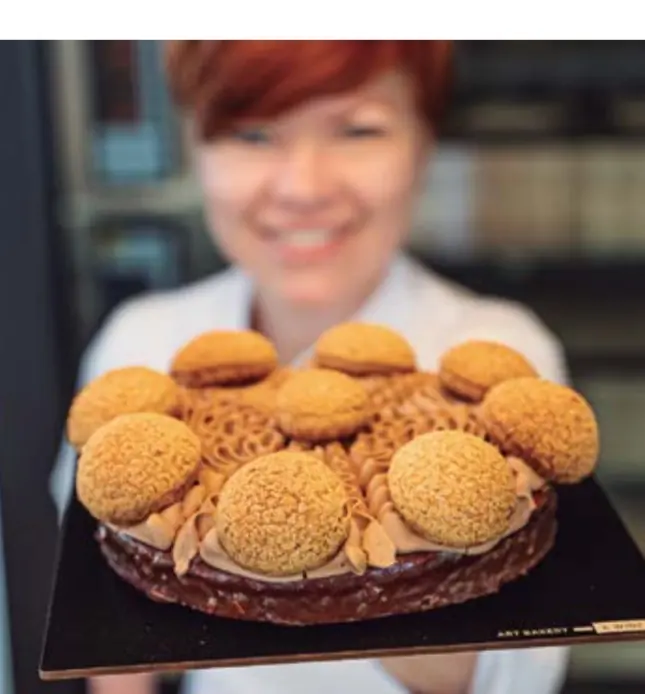
Paris-Brest is one of the choux pastries I like because every part has a clear purpose: the ring must be dry and light, the almonds add toast and texture, and the praline mousseline should be rich without feeling heavy.
This is my working formula. I make the pastry cream first so it can cool completely, bake the choux ring until it has real structure, then whip the cream only when the pastry cream and butter are at compatible temperatures.
My Paris-Brest formula
Yield: one large Paris-Brest, approximately 20–22 cm, or several smaller rings.
- Choux: 75 g water
- 75 g whole milk
- 70 g unsalted butter
- 80 g flour
- 2 g fine salt
- 2 g granulated sugar
- 150 g whole egg, added progressively
- Sliced almonds, as needed
- Pastry cream: 250 g whole milk
- 10 g vanilla paste
- 50 g egg yolks
- 70 g granulated sugar
- 10 g flour
- 10 g cornstarch
- 8 g unsalted butter
- Praline mousseline: 270 g cold pastry cream
- 90 g almond praline 60%
- 180 g unsalted butter, softened but not greasy
- Icing sugar for finishing
1. Make and chill the pastry cream
Bring the 250 g milk and vanilla paste to a boil. In a bowl, combine the sugar, flour and cornstarch, then whisk in the yolks until smooth. Temper with the hot milk, return everything to the saucepan and cook while whisking vigorously until the cream boils and thickens fully.
Mix in the 8 g butter. Transfer immediately to a shallow clean container, cover the surface and cool rapidly to 5°C / 41°F or below. Keep refrigerated until completely cold.
2. Cook the choux panade
Bring the water, milk and butter to a full boil. Add the flour, salt and sugar and mix immediately until no dry flour remains. Return to the heat and cook the panade until it forms a cohesive mass and a light film develops on the base of the pan.
Transfer to a mixer fitted with the paddle and mix briefly so the strongest heat escapes before adding the eggs.
3. Add the eggs progressively
Beat the eggs and add them gradually while mixing. I do not judge choux only by a fixed egg number: the flour and the amount of water driven off during panade cooking change how much egg the dough can accept.
The finished paste should be smooth and glossy and should fall slowly from the paddle in a thick ribbon. My formula uses about 150 g egg, but stop if the correct consistency is reached before the final addition.
4. Pipe the Paris-Brest ring
Mark a circle about 20–22 cm on the underside of the baking paper. With a 12 mm plain nozzle, pipe an even ring, then reinforce it with a second ring directly beside the first and a third line centred over the join if you need more height and structure.
Brush very lightly with egg wash without flooding the tray and cover the surface with sliced almonds. Consistent piping matters: thin sections dry before thick sections have set and can distort the finished ring.
5. Bake until the ring is structurally dry
Bake at 170°C / 338°F for about 40 minutes as my starting point. Do not open the oven during the early expansion phase. The finished ring should be well coloured, firm and light rather than pale and flexible.
A large ring holds much more steam than a small cream puff. If necessary, give it additional drying time after it has set. Cool completely before cutting.
6. Whip the praline mousseline
Smooth the 270 g cold pastry cream, then combine it with the 90 g almond praline. Add the 180 g softened butter and whip until the cream becomes light, smooth and aerated.
Temperature is critical. Very cold pastry cream against much warmer butter can split the emulsion; butter that is too warm makes the mousseline greasy and weak. I want both components cool but pliable enough to emulsify cleanly. If the cream looks curdled, correct the temperature gently before continuing to whip rather than adding more ingredients.
7. Fill and finish
Slice the completely cooled choux ring horizontally with a serrated knife. Pipe the praline mousseline generously and evenly over the lower half, keeping the piping visible around the edge.
Replace the almond-covered top without pressing down on the cream and finish with a restrained dusting of icing sugar. Refrigerate only as long as needed for the cream to remain safe and stable; choux gradually softens in the refrigerator.
Why is Paris-Brest shaped like a wheel?
The circular form is part of the identity of Paris-Brest. The pastry was created in connection with the Paris-Brest-Paris cycle race, and the ring evokes a bicycle wheel.
For baking, that geometry also changes the choux problem: a continuous large ring needs more structural drying than individual profiteroles because steam has farther to escape.
What is the traditional filling?
Paris-Brest is associated with praline cream, most commonly a praline mousseline or a closely related praline pastry cream preparation. I use almond praline at 60% because it gives a clear roasted-nut flavour without requiring excessive praline in the cream.
Mousseline is pastry cream enriched and aerated with butter. It should feel lighter than its ingredient list suggests when the emulsion and temperature are correct.
Why does my Paris-Brest collapse?
The most common cause is underbaking. Choux can look expanded before its internal walls have dried enough to support the ring. Opening the oven too early, piping an excessively thick ring or making the paste too loose can make the problem worse.
I look for deep colour, a firm shell and a ring that feels unexpectedly light for its size. Pale, soft choux is usually not finished.
Why did my praline mousseline split?
Mousseline is an emulsion, so temperature mismatch is usually more important than whipping time. If the butter is hard while the pastry cream is warmer, or one component is very cold and the other soft, the cream can become grainy or curdled.
Bring the mixture gradually toward a workable cool room temperature and continue whipping. If it is obviously too warm and loose, cool it briefly; if it is very cold and broken, warm the outside of the bowl gently while whipping.
Can I make Paris-Brest ahead?
Yes, but I keep the components separate. The pastry cream can be made ahead and chilled promptly. The baked choux ring can be stored airtight once completely cool, or frozen unfilled and re-crisped before assembly.
For the best texture, whip the mousseline and assemble reasonably close to serving. Once filled, moisture from the cream begins moving into the shell.
Can I freeze Paris-Brest?
I prefer freezing the unfilled baked choux rather than a finished Paris-Brest. Re-crisp the shell around 150–160°C / 302–320°F until dry, then cool it completely before filling.
A finished mousseline-filled pastry can suffer texture changes through freezing and thawing, so for a clean professional result I prepare the components separately.
My rule for Paris-Brest
I judge the pastry by contrast. The choux should be properly dry, the almonds should taste toasted, and the praline cream should be smooth and aerated rather than dense.
If those three textures are right, Paris-Brest does not need decoration to explain itself. The wheel shape, roasted nuts and praline mousseline already give the pastry its character.